 Federal Pressure and DHS Leadership
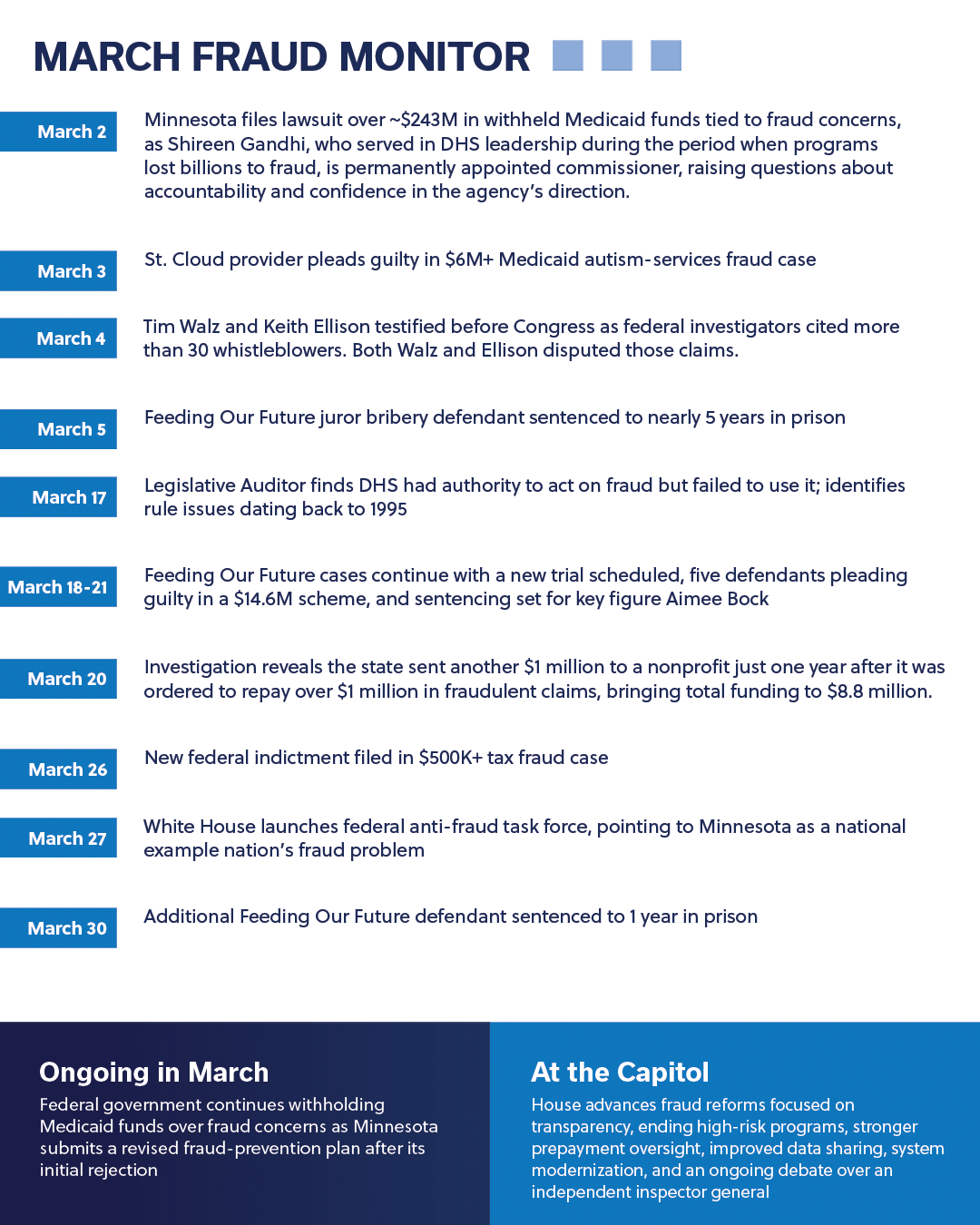
March opened with another dispute between Minnesota and the federal government, this time over Medicaid funding. On March 2, Attorney General Keith Ellison filed suit to challenge the withholding of roughly $243 million in Medicaid payments tied to fraud concerns in certain high-risk programs. Later in the month, the Centers for Medicare & Medicaid Services approved Minnesota’s revised corrective action plan for improving fraud detection, prevention, and recovery in Medicaid. The original plan submitted at the end of 2025 had been rejected. By March 31, however, the funding dispute still had not been resolved. (1)(2)(3)
March 2 also brought a major leadership marker at the Department of Human Services. Gov. Tim Walz made Shireen Gandhi’s appointment as DHS commissioner permanent after she had served in an acting role during one of the agency’s most scrutinized periods in recent memory. Gandhi said the state had documented at least $300 million in fraud, a figure that stood in notable contrast to the much larger estimate former First Assistant U.S. Attorney Joe Thompson had publicly described. (5)(6)
Federal oversight continued on March 4, when Gov. Walz and Attorney General Ellison appeared before the U.S. House Oversight Committee. Members focused on whistleblower concerns, leadership decisions, and the timeline of when state officials became aware of specific fraud issues. Chairman James Comer said the committee had heard from more than thirty whistleblowers. (7)
That federal attention did not end there. On March 27, Vice President JD Vance convened the first meeting of a new federal anti-fraud task force, again pointing to Minnesota as a leading example in the administration’s broader fraud messaging. (4)
Criminal Proceedings
Feeding Our Future remained the most visible fraud case in the state, but it was not the only case advancing in March.
On March 3, Abdinajib Hassan Yussuf, head of Star Autism Center in St. Cloud, pleaded guilty to wire fraud in a scheme involving more than $6 million in fraudulent Medicaid claims in the state’s autism-services program. Two days later, Abdulkarim Farah was sentenced to 57 months in prison for his role in the juror-bribery scheme tied to the first Feeding Our Future trial. On March 26, federal prosecutors also announced that Philip Nelson Green of Crookston had been indicted for filing false tax returns and refund claims exceeding $500,000. (8)(9)(10)
Feeding Our Future itself continued to move in more incremental but still important ways. On March 18, the next trial was set for April after one defendant rejected a plea agreement. On March 20, five additional defendants pleaded guilty in a branch of the case involving roughly $14.6 million in stolen child-nutrition funds. On March 21, Aimee Bock’s sentencing was set for May 21. On March 30, Abdul Abubakar Ali was sentenced to one year and one day in prison. (11)(12)(13)(14)
March also produced a reminder that the problem is not confined to courtrooms. A March 20 KARE 11 investigation reported that the New American Development Center, which had billed about $7.8 million in meal reimbursements and had been ordered to repay roughly $1.1 million, later still received another $1 million from the state. It was a reminder that even after serious concerns surface, weak screening, weak information-sharing, and outdated technology can still allow state money to keep flowing. (15)
The EIDBI Review
One of the month’s most significant non-court developments came on March 17, when the Office of the Legislative Auditor released its special review of alleged kickbacks in the Early Intensive Developmental and Behavioral Intervention autism-services program. The auditor rejected DHS’s position that it lacked authority before 2025 to act on kickback complaints unless those complaints also qualified as fraud, theft, abuse, or error. OLA found that DHS had long possessed that authority, identified a rules error dating to 1995, and noted that current rule language may still hinder payment suspensions during credible investigations. The review examined three specific kickback complaints and added another example of how outdated rules, interpretive ambiguity, and delayed action can weaken oversight even when legal tools already exist. (16)
Rep. Mary Franson responded with legislation to explicitly classify illegal remuneration, or kickbacks, as a credible allegation of fraud, allow payment suspensions during investigations, and codify kickbacks within the definition of fraud. The proposal quickly entered the legislative conversation around how Minnesota defines fraud and when payments can be paused. (17)
At the Capitol
March delivered the most substantial fraud-related legislative activity of the session so far.
Two measures sponsored by House Human Services Co-Chair Joe Schomacker passed the House floor. One would give legislators access to the full initial Optum fraud-vulnerability review while limiting broader dissemination. Another would formally repeal Housing Stabilization Services after DHS had already terminated the benefit due to fraud concerns. (18)
More broadly, the legislative discussion in March centered on a few major themes. One was earlier intervention, including stronger prepayment review and broader authority to sanction problematic providers in medical-assistance programs. Another was greater visibility, especially better access to fraud findings and stronger cross-agency information sharing so bad actors cannot move between programs unnoticed. A third was systems modernization, as lawmakers increasingly grappled with whether fragmented and outdated state systems are capable of supporting real-time oversight. A fourth was institutional design, particularly whether Minnesota should create a statewide inspector general with genuine independence or one more closely tied to the governor’s office. The inspector general debate progressed in March but remained unresolved, and it is still one of the biggest points of disagreement at the Capitol. (19)(20)(21)
There is broad, stated agreement in the House that fraud must be prevented, detected, and prosecuted more effectively. Where the real disagreement begins is in how that shared intent should be translated into law: what authority agencies should have, what information should be shared and with whom, how aggressive enforcement tools should be, how much money should be appropriated for prevention and oversight, and how to strengthen fraud controls without unnecessarily disrupting services for vulnerable Minnesotans.
Legislative Action to Combat Fraud
Alongside ongoing investigations, the Legislature has begun taking steps to address fraud in state programs. Several proposals have already passed the House, with more still under consideration as the session enters its final weeks.
Important Measures Passed
-
HF 4425 – Extends the statute of limitations for theft involving public dollars, giving investigators more time to pursue complex fraud cases.
-
HF 3378 – Gives legislators access to the full unredacted Optum report, improving transparency and oversight of high-risk Medicaid programs.
-
HF 3379 – Repeals Housing Stabilization Services following significant fraud concerns.
Important Proposals Still Moving
With roughly 25 days remaining in session, additional reforms continue to move forward:
-
HF 3578 – Strengthens accountability for executive branch oversight failures.
-
HF 4104 – Site visit for grant recipients over a certain dollar amount required.
-
HF 4950 – Ensures individuals who profit from fraud are held financially accountable.
-
HF 1338 / SF 856 – Establish an independent Office of Inspector General with authority to investigate fraud across all state programs, improve data access across agencies, and strengthen oversight. The Senate has passed its version, but the House has not yet reached agreement.
-
HF 3395 – Requires budget cuts, a corrective action plan, staff dismissal, and a freeze on new enrollment when a state agency withholds payment to a program participant suspected of committing fraud, or a law enforcement agency refers for prosecution a case of suspected fraud committed against a state program.
While there is broad agreement that fraud must be addressed, many of the most impactful reforms have yet to be enacted. With limited time remaining, the focus now is on whether the Legislature will deliver the stronger enforcement and oversight changes needed to protect taxpayer dollars.
Conclusion
March made clear that fraud in Minnesota is not going away anytime soon, and substantial work remains.
Federal-state tensions persisted, DHS leadership was formalized under continued scrutiny, criminal cases continued to move, and the Legislature kept working through the harder structural questions now defining Minnesota’s fraud debate. Who gets what information, and when? When can payments be stopped? How should fraud be defined in law? How can agencies share data more effectively? How do aging systems get modernized? And how independent should a statewide watchdog be?
Fraud and its consequences are felt daily by taxpayers, vulnerable program participants, and the frontline workers trying to deliver services the right way. This is our state, and we all have a role to play in restoring trust in it: insisting on transparency, demanding competent administration, and supporting reforms that protect both public dollars and the people these programs are meant to serve.
Oversight works best when it is grounded in what people are seeing on the ground – service recipients, frontline workers, providers, neighbors, local officials, and taxpayers who notice patterns that do not add up. If you have concerns, questions, or firsthand insight, please reach out and share them.
If you find this update useful, consider forwarding the MN Fraud Monitor to friends, family, and neighbors who care about accountability and effective government. And if there are other topics you’d like to see covered in a similar monthly format, I’d welcome your suggestions.
Report Fraud!
Minnesota has lost an estimated $9 billion to fraud in recent years; funds intended for vulnerable residents and key priorities. Report suspected fraud confidentially at MNFraud.com and help protect taxpayer dollars.
|