Trump is Positioned. Elon Lights the Fuse.
Dear Reader,
Two of the most powerful men alive are about to collide in the crypto market.
The Trump family is already loaded. World Liberty Financial. The $TRUMP token.
A White House rewriting crypto policy in real time. They didn't stumble into this… they built their positions before the broader market caught on.
Elon is about to detonate the largest liquidity event in history. The SpaceX IPO isn't just a listing.
It's a flood. With a valuation targeting $1.75 trillion, hundreds of billions of dollars are about to be unlocked, repositioned, and chased into the next opportunity.
That money doesn't park in SpaceX forever. It spills outward. Into tech. Into risk assets.
And it finds its way into crypto faster than any other asset class on earth.
Trump has been building for this. Elon is about to fire the starter pistol.
There's a single crypto sitting at the exact intersection of these two forces. Plugged into the right infrastructure.
Sitting at a valuation that won't last once the wave hits.
And institutions are already there… loading up while the retail crowd stares at SpaceX.
The window closes the moment the public catches on.
Get my #1 coin for the Trump presidency bull run before this window closes.
Regards,
Bryce Paul
Crypto 101
The $185 Billion AI Pivot Away From GPUs
Authored by Jeffrey Neal Johnson. Published: 4/23/2026.
Key Points
- Marvell Technology is solidifying its leadership in the custom silicon market by creating high-efficiency chips for major technology companies.
- The company's strategic partnerships with cloud computing giants create a significant competitive moat and ensure long-term, predictable revenue streams.
- Strong institutional interest and positive analyst forecasts reflect growing market confidence in Marvell Technology's long-term growth trajectory in the AI sector.
- Special Report: Elon Musk already made me a “wealthy man”
The surging demand for artificial intelligence (AI) has ignited a boom in the semiconductor sector, elevating the graphics processing unit (GPU) as the dominant source of computational power. That first wave has been lucrative for many, but inside the world’s most advanced data centers a quieter revolution is underway: the very hardware that enabled the AI surge is creating significant challenges for hyperscale operators.
The vast energy requirements and operational costs of running AI models on thousands of generalized chips are forcing a strategic pivot. Big Tech is moving beyond one-size-fits-all hardware toward custom-designed silicon tailored to proprietary workloads. This shift from general-purpose to application-specific designs creates a durable, long-term opportunity for the specialized companies building the new infrastructure.
The New Architects of AI: Why Custom Silicon Is King
The REAL Reason Trump is Invading Iran (Ad)
For a moment…
Forget about Trump’s ties to Israel.
Forget about reports of Iran’s nuclear program.
Because my research has led me to believe we’re risking World War 3 with Iran for a completely different reason.
Click here to find out what it is.The move to custom chips is driven by massive capital commitments. Alphabet Inc. (NASDAQ: GOOGL), for example, has indicated capital expenditures that could reach $185 billion in 2026 to expand the infrastructure supporting its services, backed by a roughly $240 billion contract backlog for Google Cloud.
To maximize returns, companies must consider Total Cost of Ownership (TCO): not just the chip price but long-term costs for power, cooling and maintenance. Custom Application-Specific Integrated Circuits (ASICs) can deliver a decisive advantage. Unlike GPUs, which are generalists, ASICs are optimized for a single task—achieving higher performance with lower power consumption.
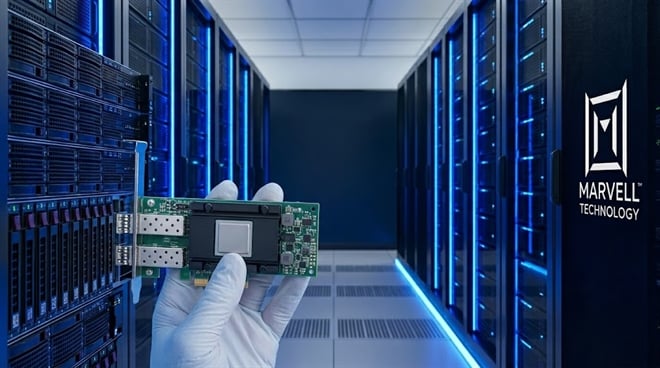
That’s where Marvell Technology, Inc. (NASDAQ: MRVL) has positioned itself as a preferred partner for custom solutions. Reports of a potential collaboration between Marvell and Google to develop two custom AI chips—a microprocessor unit (MPU) and an inference-focused Tensor Processing Unit (TPU)—are notable catalysts.
For investors, such a partnership signals Marvell’s strength in a lucrative niche. It’s a challenge to competitors and a validation of Marvell’s technology and design capabilities.
Marvell’s business model creates a strong competitive moat. Once its custom silicon is integrated into a hyperscaler’s core infrastructure, it becomes mission-critical. The costs and complexity of switching vendors are substantial, producing sticky customer relationships and highly predictable, long-term revenue streams that are insulated from the pricing pressures of more commoditized semiconductor products.
Why Big Money Appears to Be Betting on Custom Silicon
The market seems to be recognizing this strategic edge. Marvell’s stock recently climbed above $151 on trading volume exceeding 31 million shares, well above its average daily volume—an indication that large, institutional investors may be building positions.
That institutional confidence is reflected on Wall Street. Of 37 analysts covering the stock, 29 rate it a Buy. Recent price-target revisions further underscore this optimism:
Aggressive Upgrades: Firms such as Oppenheimer have raised price targets on Marvell to $170, signaling belief in the company’s runway as a key supplier of custom silicon.
Low Bearish Sentiment: The stock’s low short interest suggests few market participants are betting against Marvell, reinforcing the broadly positive outlook.
Marvell is also committed to returning capital to shareholders. The board has authorized a $5 billion share repurchase program, which reduces outstanding shares, can boost earnings per share, and signals management's confidence in the company's valuation.
Some insiders have sold shares recently, but those transactions occurred under pre-arranged Rule 10b5-1 trading plans—typical mechanisms for executives to manage personal finances. These sales should be weighed against Marvell’s larger strategic repurchase program.
Investing in the Bedrock of the AI Economy
The data-center architecture is being redesigned, with custom silicon emerging as the standard for AI performance and efficiency. This represents an enduring evolution in the hardware that will power future digital systems. Marvell Technology’s ability to build deep, collaborative partnerships with leading technology companies places it near the center of this transformation.
By serving as a foundational architect for hyperscalers like Alphabet, Marvell is positioning itself as an essential provider of AI infrastructure. Investors who want exposure to the custom-silicon trend may consider adding Marvell to their watchlist and monitoring upcoming earnings calls for confirmation of additional design wins with hyperscaler partners.
Churchill Downs: The Derby Is Just the Beginning
Submitted by Chris Markoch. First Published: 4/24/2026.

Key Points
- Churchill Downs beat Q1 2026 earnings expectations, driven by strong growth in historical racing machines.
- The company’s $85 million Preakness Stakes IP acquisition adds high-margin licensing revenue and strategic control.
- With analysts seeing ~35% upside, HRM expansion remains the key driver for long-term CHDN stock growth.
- Special Report: Elon Musk already made me a “wealthy man”
In a game of word association, Churchill Downs and the Kentucky Derby are often paired. But investors should familiarize themselves with Churchill Downs Inc. (NASDAQ: CHDN), the parent company that operates the racetrack hosting the Kentucky Derby. It’s more than an event-driven business and has significant growth potential.
That potential showed up in the company’s Q1 2026 earnings report, where Churchill Downs delivered records on both the top and bottom lines.
The REAL Reason Trump is Invading Iran (Ad)
For a moment…
Forget about Trump’s ties to Israel.
Forget about reports of Iran’s nuclear program.
Because my research has led me to believe we’re risking World War 3 with Iran for a completely different reason.
Click here to find out what it is.Revenue of $663 million beat estimates of $659.32 million and rose 3% from $642.6 million in Q1 2025, a quarter in which the company had previously missed estimates. Earnings per share (EPS) of $1.21 beat forecasts by $0.18 and were $0.14 higher year over year.
The Real Reason to Bet on Churchill Downs
Historically, the second quarter has been Churchill Downs’ strongest quarter, and with good reason: that’s when the Kentucky Derby is run. Outside of Derby week, revenue from Churchill Downs Racetrack is relatively small — this quarter it accounted for $3 million, a year-over-year decline of $1 million.
That’s why the Derby itself, as iconic as it is, isn’t the primary reason to invest in CHDN. The real growth engine is the company’s leadership position in Historical Racing Machines (HRMs). These are slot-machine–style terminals that let players wager on outcomes of previously run horse races; the historical data is stripped so the experience feels like live gambling.
There’s a method to the madness: HRMs are legally classified as a form of pari-mutuel horse-race wagering rather than casino gambling, which allows them to operate in states where traditional casinos are restricted or illegal.
In the quarter, segment revenue totaled $301 million, a $24 million increase year over year, driven almost entirely by HRMs. Expansion is a major part of the growth story:
Marshall Yards Racing & Gaming in southwestern Kentucky opened Feb. 25, 2026.
Rockingham Grand Casino in Salem, New Hampshire, announced Jan. 12, is a $180–$200 million investment targeting a mid-2027 opening.
The company is allocating $70–80 million of its 2026 capital expenditure budget to Rockingham alone.
Churchill Downs Expands Its Racing Empire With Preakness Deal
The Kentucky Derby is the first — and arguably the most iconic — leg of horse racing’s Triple Crown, which also includes the Preakness Stakes and the Belmont Stakes.
Investors should note that on April 21, two days before the earnings release, Churchill Downs announced it agreed to purchase the intellectual property for both the Preakness Stakes and the Black-Eyed Susan Stakes for $85 million.
Under the deal, Churchill Downs will own the trademarks and related rights to the Preakness Stakes without needing to operate the event or own Pimlico, the host racetrack. Instead, it collects an annual licensing fee from the state of Maryland and gains leverage over future broadcast rights, calendar negotiations, potential HRM licensing, and the cultural narrative of American thoroughbred racing.
It acquired those rights for less than one quarter of its current free cash flow (FCF) — a factor that hadn’t been priced into CHDN before earnings.
CHDN Stock Outlook: Can HRM Growth Drive the Next Leg Higher?
CHDN jumped more than 10% on the day of its earnings report. Before the release, the stock was trading near its 52-week low, suggesting investors may have already seen the floor — but what’s the ceiling?
Analysts give CHDN a consensus price target of $135.60, implying roughly 35% upside. With that much potential, it’s reasonable to ask whether the Preakness IP rights could push price targets even higher.
Churchill Downs operates across four revenue streams: live racing, Historical Racing Machines, the TwinSpires wagering platform, and casino gaming. Of these, live racing and casino gaming aren’t large enough to drive growth on their own — casino revenue actually declined year over year in Q1, weighed down by the exit from Louisiana. TwinSpires, which handles online and retail horse-race wagering plus sports betting, is a steady contributor but not a high-growth engine.
That puts the growth burden squarely on HRMs — a business that produced $257 million in pari-mutuel revenue in Q1 and is actively expanding into new states. The Preakness IP acquisition adds an intriguing wrinkle: if it helps accelerate HRM legalization in Maryland, as some analysts expect, Churchill Downs’ primary growth driver could gain additional runway.
Looking at the chart, CHDN was in a cautious recovery after a steep selloff from a December 2025 peak around $120, which produced a “death cross” when the 50-day simple moving average (SMA) crossed below the 200-day SMA.
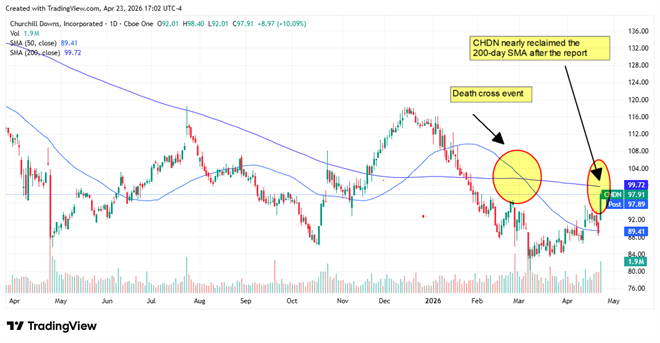
Price action reclaimed the 200-day SMA on the day of the report — a meaningful move in a single session, especially when paired with a fundamental catalyst. The key question is whether CHDN can consolidate around the 200-day SMA near $92–$93. That consolidation could set the stage for a “golden cross” in a matter of weeks. Waiting for that confirmation may be prudent, but risk-tolerant investors might consider initiating a position at these levels.
This email message is a sponsored message provided by Crypto 101 Media, a third-party advertiser of The Early Bird and MarketBeat.
© 2026 Boardwalk Flock LLC. All Rights Reserved.
2382 Camino Vida Roble, Suite I
Carlsbad, CA 92011, United States
The advice and strategies contained herein may not be suitable for your situation. You should consult with a professional where appropriate.
Readers acknowledge that the authors are not engaging in the rendering of legal, financial, medical, or professional advice. The reader agrees that under no circumstances Boardwalk Flock, LLC is responsible for any losses, direct or indirect, which are incurred as a result of the use of the information contained within this, including, but not limited to, errors, omissions, or inaccuracies.
Results may not be typical and may vary from person to person. Making money trading digital currencies takes time and hard work. There are inherent risks involved with investing, including the loss of your investment. Past performance in the market is not indicative of future results. Any investment is at your own risk.
If you need help with your subscription, feel free to contact MarketBeat's U.S. based support team at [email protected].
If you no longer wish to receive email from The Early Bird, you can unsubscribe.
© 2006-2026 MarketBeat Media, LLC. All rights protected.
345 North Reid Place, Sixth Floor, Sioux Falls, S.D. 57103. USA..