Dear Reader,
The SpaceX/xAI IPO could trigger one of the largest capital shifts in market history. But when that kind of money moves… It doesn’t move evenly. It hits pressure points first.
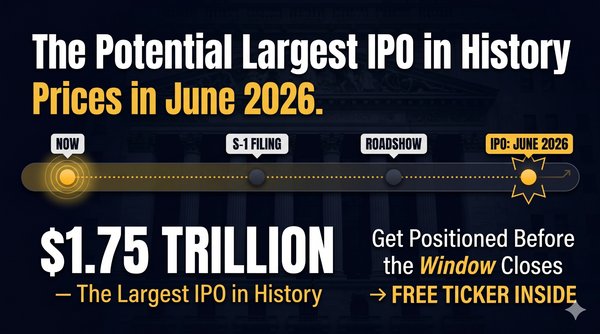
Right now, one specific company is sitting directly in the path of this $1.75 trillion tidal wave.
It’s a critical hardware supplier tied to the infrastructure Musk is scaling in Memphis.
When the IPO prospectus (the S-1) goes public in June, this “hidden” dependency will be hidden no longer.
Dylan Jovine has identified the exact trigger point that could reprice this stock overnight.
Procter & Gamble Gave the Market What It Wanted: A Reason to Buy
Submitted by Thomas Hughes. First Published: 4/24/2026.
Key Points
- Procter & Gamble had a better-than-expected quarter, alleviating fears and providing a reason to buy.
- Cash flow and capital return remain strong, giving investors leverage.
- Analysts and institutions underpin the rebound; how high it gets depends on how long you hold it.
- Special Report: Elon Musk already made me a “wealthy man”
Procter & Gamble (NYSE: PG) is a high-quality consumer staples and home-products company with a long track record of cash generation and capital returns. It is a quintessential buy-and-hold name—ideal for income and dividend compounding—but the stock struggled in 2026 amid concerns about tariffs, foreign-exchange headwinds, margin pressure and cash-flow. Those fears produced volatility and a sharp March correction. The takeaway after the late-April fiscal Q3 report is that the market overreacted: many concerns were overstated, and prices are near long-term lows, creating a buying opportunity.
Procter & Gamble Navigates Hurdles: Reinvigorates Market Interest
Procter & Gamble delivered a solid quarter, extending its growth trend through organic improvement and acquisition-related strength. Net revenue of $21.24 billion rose 7.3% year over year, outpacing consensus by roughly 350 basis points.
The REAL Reason Trump is Invading Iran (Ad)
For a moment…
Forget about Trump’s ties to Israel.
Forget about reports of Iran’s nuclear program.
Because my research has led me to believe we’re risking World War 3 with Iran for a completely different reason.
Click here to find out what it is.Organic sales grew 3%, driven by a 2% increase in volume and a 1% price contribution, with broad-based strength across segments.
Beauty led the company, up 7%, while Grooming lagged at 1% growth; overall consumer resilience was evident.
On the earnings side, tariff-related and other headwinds were partially offset by price increases, efficiency gains and a favorable foreign-exchange tailwind.
The quarter produced roughly $4 billion in net earnings, about $4 billion in operating cash flow, and 82% free-cash-flow productivity. Free cash flow of $3.28 billion comfortably covered capital returns—dividends plus share repurchases—totaling $3.2 billion.
Procter & Gamble’s capital-return program is meaningful for its size, consistency and growth. The company is a Dividend King, having raised its dividend annually for 70 consecutive years, and it has sustained a mid-single-digit compound annual growth rate in its payout. Looking ahead, management expects modest single-digit revenue growth and sufficient earnings to support continued capital returns and maintain its financial health.
The results suggest the cadence of dividend increases will persist alongside ongoing share buybacks. Buybacks matter because they reduce share count and help offset the dilutive effect of dividend growth. In fiscal Q3, diluted shares outstanding fell about 1.35% year over year. The stock yields nearly 3% while trading near the low end of its historical P/E range.
Analysts and Institutions Underpin Procter & Gamble Stock Price Rebound
Analysts contributed to PG’s 2026 decline by cutting price targets, but those reductions now largely align with a late-April consensus that implies a modest double-digit gain from the critical support level.
Following the better-than-expected report and guidance, analyst sentiment may stabilize, which would help firm the stock’s price floor.
The low end of the analyst target range sits near $142—close to Q1 lows and the key support level—while consensus expects the market to clear a cluster of moving averages and re-enter rally mode.
Institutions are potential buyers on weakness. The group owns more than 65% of the stock and has been net buyers on roughly a 2-to-1 basis over the trailing 12 months.
Institutional activity picked up in 2025 as the share price declined and played a role in the nearly 20% rebound when shares touched critical levels in January 2026. The risk is that some institutions began trimming positions in early Q2 and may not participate in a new rally. With the AI-driven trade back in force, large investors could reallocate toward tech and continue reducing PG exposure.
Technical Setup: A Rebound With Resistance Overhead
Technical indicators show unusual volatility for a classic buy-and-hold name but also a durable price floor that has led to multiple rebounds over time. The mid-Q2 setup looks like another bounce with potential upside in the $15–$20 range, but resistance near the 150-day exponential moving average (EMA) could cap gains. The 150-day EMA often reflects long-term investor behavior, and current data suggests some selling by those holders. If the market fails to clear this level, a stronger rebound may be delayed until later in the year.
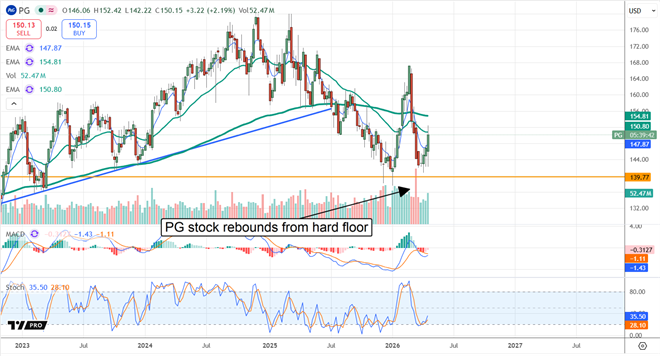
The longer-term outlook is constructive. With shares trading near the low end of the historical P/E range, valuation re-rating alone could support a gain of roughly 50%. Combine that with even modest growth, and PG could offer substantially higher upside over a multi-year horizon—potentially as much as 100% for patient, buy-and-hold investors.
Kinder Morgan’s Cash Flow Drives Upside: Potential Swells in Q1
Submitted by Thomas Hughes. First Published: 4/24/2026.
Key Points
- Kinder Morgan outperformed in Q1 and is on track for a better-than-expected year.
- Cash flow and capital returns are strong; outperformance suggests distribution increases can accelerate.
- An expanding network and demand trends say the long-term forecasts are too low, and an uptrend can be sustained.
- Special Report: Elon Musk already made me a “wealthy man”
Kinder Morgan (NYSE: KMI) is well-positioned as a leading middleman in natural gas markets. Although the business is diversified across energy, its primary focus is natural gas, where demand is rising. Gas is becoming more available and many industries are adopting it as a lower-cost, cleaner alternative to traditional fuels. Supply disruptions around the Strait of Hormuz have also shifted more global demand toward the United States, and Kinder Morgan is doubling down on growth.
Kinder Morgan Is a High-Quality Growth (and Cash Flow) Machine
Among the company’s attractions are its fortress-like balance sheet and its ability to fund acquisitions internally. Highlights from fiscal Q1 include higher cash and asset levels, reduced debt, improved shareholders’ equity, and continued capital returns. The company does repurchase shares, but buybacks are irregular; the emphasis is on sustainable dividends and distribution increases. KMI yields about 3.7% at recent support levels and has raised its dividend for nine consecutive years.
The REAL Reason Trump is Invading Iran (Ad)
For a moment…
Forget about Trump’s ties to Israel.
Forget about reports of Iran’s nuclear program.
Because my research has led me to believe we’re risking World War 3 with Iran for a completely different reason.
Click here to find out what it is.Q1 also featured an expected 2% dividend increase, with signals that next year’s raise could be larger. The key takeaway from guidance is that profitability metrics are running modestly above budget and trends are favorable for investors.
For long-term holders, the upside opportunity includes momentum from accelerating distributions likely to be announced at year-end, on top of the company’s expanding network. Another tuck-in acquisition is in the works, projects were placed into service in Q1, and backlog recovery is running above a $1-to-$1 ratio.
In this environment, KMI’s growth could accelerate and exceed consensus estimates. Analysts currently forecast about 7% revenue growth for 2026, versus nearly 14% reported in Q1, and 2027 is modeled as a contractionary year. The more likely outcome is continued strong performance and upward analyst revisions—already evidenced by several brokers raising revenue, earnings, and price targets after the release.
Analysts and Institutions Underpin KMI Stock Price Rally
MarketBeat tracks 17 analysts with current ratings, which collectively peg KMI at a Hold. Coverage is steady but price targets are being raised. Following the release, the late-April consensus implies roughly 10% upside from the critical support level, with revisions pushing the high end higher. Reaching that range would put the stock at a fresh long-term high and support further gains.
Valuation metrics suggest meaningful upside over the next three to five years. Trading around 23X 2026 earnings, the stock looks fairly valued relative to the S&P 500 today. If growth is only modest, the multiple could compress toward the mid-teens (around 16X) by 2030; however, actual growth is likely to be stronger. Natural gas demand is expected to rise at a modest compound annual rate, increasing roughly 30% by 2031, and longer-term forecasts anticipate continued strength through the decade.
Institutional activity highlights the 2026 opportunity: institutions own more than 60% of the stock and have been net buyers over the trailing 12 months. MarketBeat data show institutional buyers outnumber sellers by about $2-to-$1, a dynamic that can support further appreciation. Short interest has ticked up—rising more than 10% as of early April—but remains low at roughly 2.5%. In this context, short sellers currently pose only a modest headwind and may even fuel upside if short-covering accelerates.
KMI Uptrend Intact: Market Tests Critical Support
The stock’s price action softened after the release, but that pullback is a normal retracement within a broader uptrend, not a structural red flag. The move down has been a retest of critical support that aligns with prior highs and the early-2026 breakout point—coincidentally near the long-term 150-day EMA. Given institutional positioning, that level should act as firm support and could trigger a robust rebound. A brief dip below it wouldn’t be fatal, provided no material negative news emerges and price recovers promptly.
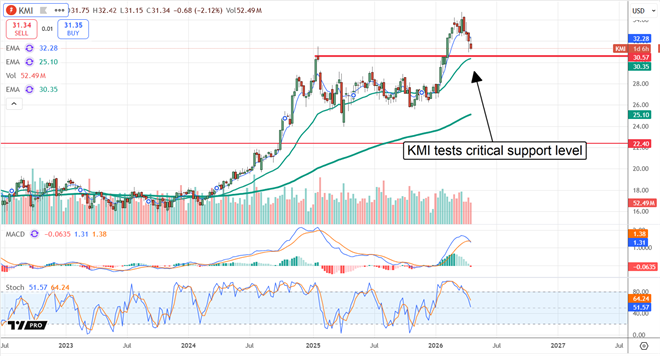
KMI’s principal operational risk is project execution. Pipelines, collection systems, and liquefaction facilities are complex and heavily regulated; investors should expect occasional hurdles and delays. Insider selling has occurred, which warrants monitoring, but insiders still own a meaningful ~12% stake, benefit from share-based compensation, and have realized sizable gains since the stock bottomed five years ago.
This email message is a sponsored email from Behind the Markets, a third-party advertiser of MarketBeat. Why was I sent this email message?.
If you need help with your newsletter, please email MarketBeat's South Dakota based support team at [email protected].
If you would no longer like to receive promotional emails from MarketBeat advertisers, you can unsubscribe or manage your mailing preferences here.
Copyright 2006-2026 MarketBeat Media, LLC. All rights protected.
345 North Reid Place, Suite 620, Sioux Falls, S.D. 57103-7078. United States..