
| From | The American Enterprise <[email protected]> |
| Subject | A Landmark Tech Ruling and What Lies Ahead |
| Date | April 30, 2026 4:50 PM |
Links have been removed from this email. Learn more in the FAQ.
Links have been removed from this email. Learn more in the FAQ.
Welcome to the April 2026 edition of The American Enterprise. This month, we are featuring essays by Clay Calvert on the landmark court ruling on social media addiction, John G. Ferrari and Dillon Prochnicki on how the Iran war reveals the risks posed by America's limited defense industrial capacity, and Dan Buck on impacts of the digitization of American classrooms on students.
TheAmericanEnterprise_test3 (1) ([link removed] )
April 2026
Welcome to the April 2026 edition of The American Enterprise. This month, we are featuring essays by Clay Calvert ([link removed] ) on the landmark court ruling on social media addiction, John G. Ferrari ([link removed] ) and Dillon Prochnicki on how the Iran war reveals the risks posed by America's limited defense industrial capacity, and Daniel Buck ([link removed] ) on how the digitization of American classrooms affects students.
Make sure to subscribe ([link removed] ) and read the online version here ([link removed] ) !
A Landmark Tech Ruling and What Lies Ahead ([link removed] )
Calvert_04.2026 ([link removed] )
By Clay Calvert
When a California jury last month awarded $6 million in a social media addiction trial to a 20-year-old plaintiff—identified by her initials, K. G. M.—one word dominated media outlets’ description of the verdict: “landmark ([link removed] ) .” It was the first time a jury penalized a social media company—here, both Meta and Google—for ostensibly injuring a minor this way. While articles ([link removed] ) from the Los Angeles Times ([link removed] ) to the New York Post ([link removed] ) emphasized how this outcome could be a harbinger for a deluge of future rulings against tech companies, the reality is more complex.
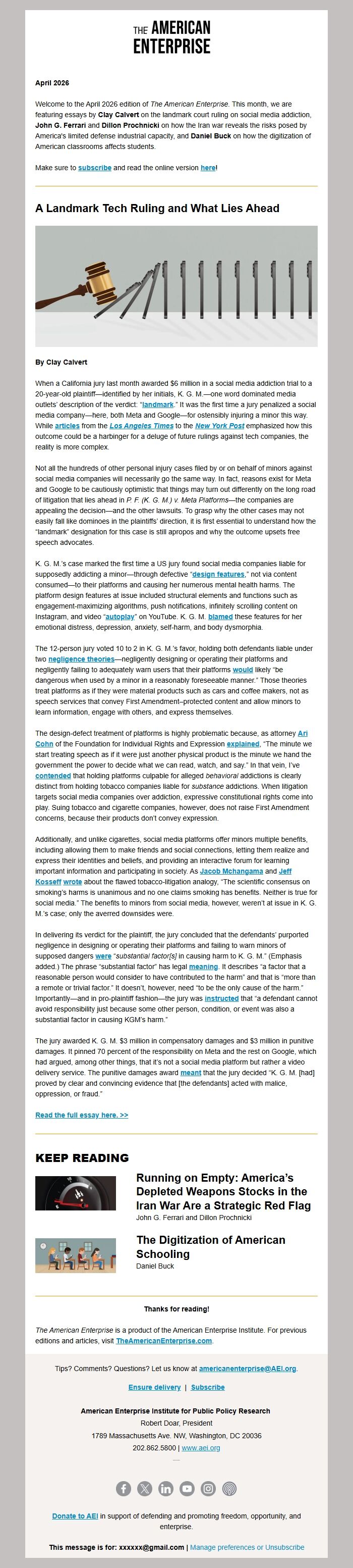
Not all the hundreds of other personal injury cases filed by or on behalf of minors against social media companies will necessarily go the same way. In fact, reasons exist for Meta and Google to be cautiously optimistic that things may turn out differently on the long road of litigation that lies ahead in P. F. (K. G. M.) v. Meta Platforms—the companies are appealing the decision—and the other lawsuits. To grasp why the other cases may not easily fall like dominoes in the plaintiffs’ direction, it is first essential to understand how the “landmark” designation for this case is still apropos and why the outcome upsets free speech advocates.
K. G. M.’s case marked the first time a US jury found social media companies liable for supposedly addicting a minor—through defective “design features ([link removed] ) ,” not via content consumed—to their platforms and causing her numerous mental health harms. The platform design features at issue included structural elements and functions such as engagement-maximizing algorithms, push notifications, infinitely scrolling content on Instagram, and video “autoplay ([link removed] ) ” on YouTube. K. G. M. blamed ([link removed] ) these features for her emotional distress, depression, anxiety, self-harm, and body dysmorphia.
The 12-person jury voted 10 to 2 in K. G. M.’s favor, holding both defendants liable under two negligence theories ([link removed] ) —negligently designing or operating their platforms and negligently failing to adequately warn users that their platforms would ([link removed] ) likely “be dangerous when used by a minor in a reasonably foreseeable manner.” Those theories treat platforms as if they were material products such as cars and coffee makers, not as speech services that convey First Amendment–protected content and allow minors to learn information, engage with others, and express themselves.
The design-defect treatment of platforms is highly problematic because, as attorney Ari Cohn ([link removed] ) of the Foundation for Individual Rights and Expression explained ([link removed] ) , “The minute we start treating speech as if it were just another physical product is the minute we hand the government the power to decide what we can read, watch, and say.” In that vein, I’ve contended ([link removed] ) that holding platforms culpable for alleged behavioral addictions is clearly distinct from holding tobacco companies liable for substance addictions. When litigation targets social media companies over addiction, expressive constitutional rights come into play. Suing tobacco and cigarette companies, however, does not raise First Amendment concerns, because their products don’t convey expression.
Additionally, and unlike cigarettes, social media platforms offer minors multiple benefits, including allowing them to make friends and social connections, letting them realize and express their identities and beliefs, and providing an interactive forum for learning important information and participating in society. As Jacob Mchangama ([link removed] ) and Jeff Kosseff ([link removed] ) wrote ([link removed] ) about the flawed tobacco-litigation analogy, “The scientific consensus on smoking’s harms is unanimous and no one claims smoking has benefits. Neither is true for social media.” The benefits to minors from social media, however, weren’t at issue in K. G. M.’s case; only the averred downsides were.
In delivering its verdict for the plaintiff, the jury concluded that the defendants’ purported negligence in designing or operating their platforms and failing to warn minors of supposed dangers were ([link removed] ) “substantial factor[s] in causing harm to K. G. M.” (Emphasis added.) The phrase “substantial factor” has legal meaning ([link removed] ) . It describes “a factor that a reasonable person would consider to have contributed to the harm” and that is “more than a remote or trivial factor.” It doesn’t, however, need “to be the only cause of the harm.” Importantly—and in pro-plaintiff fashion—the jury was instructed ([link removed] ) that “a defendant cannot avoid responsibility just because some other person, condition, or event was also a substantial factor in causing KGM’s harm.”
The jury awarded K. G. M. $3 million in compensatory damages and $3 million in punitive damages. It pinned 70 percent of the responsibility on Meta and the rest on Google, which had argued, among other things, that it’s not a social media platform but rather a video delivery service. The punitive damages award meant ([link removed] ) that the jury decided “K. G. M. [had] proved by clear and convincing evidence that [the defendants] acted with malice, oppression, or fraud.”
Read the full essay here. >> ([link removed] )
KEEP READING
Ferrari_3.2026 ([link removed] )
Running on Empty: America’s Depleted Weapons Stocks in the Iran War Are a Strategic Red Flag ([link removed] )
John G. Ferrari and Dillon Prochnicki
Buck_10.2025 ([link removed] )
The Digitization of American Schooling ([link removed] )
Daniel Buck
Thanks for reading!
The American Enterprise is a product of the American Enterprise Institute. For previous editions and articles, visit TheAmericanEnterprise.com ([link removed] ) .
Tips? Comments? Questions? Let us know at [email protected] (mailto:[email protected]) .
Ensure delivery ([link removed] ) | Subscribe ([link removed] )
American Enterprise Institute for Public Policy Research
Robert Doar, President
1789 Massachusetts Ave. NW, Washington, DC 20036
202.862.5800 | www.aei.org ([link removed] )
Unsubscribe from the link below. ([link removed] )
Facebook ([link removed] )
X ([link removed] )
LinkedIn ([link removed] )
YouTube ([link removed] )
Instagram ([link removed] )
Podcast Logo New_Gray ([link removed] )
Donate to AEI ([link removed] ) in support of defending and promoting freedom, opportunity, and enterprise.
This message is for: [email protected] | ([link removed] ) Manage preferences or Unsubscribe ([link removed] )
TheAmericanEnterprise_test3 (1) ([link removed] )
April 2026
Welcome to the April 2026 edition of The American Enterprise. This month, we are featuring essays by Clay Calvert ([link removed] ) on the landmark court ruling on social media addiction, John G. Ferrari ([link removed] ) and Dillon Prochnicki on how the Iran war reveals the risks posed by America's limited defense industrial capacity, and Daniel Buck ([link removed] ) on how the digitization of American classrooms affects students.
Make sure to subscribe ([link removed] ) and read the online version here ([link removed] ) !
A Landmark Tech Ruling and What Lies Ahead ([link removed] )
Calvert_04.2026 ([link removed] )
By Clay Calvert
When a California jury last month awarded $6 million in a social media addiction trial to a 20-year-old plaintiff—identified by her initials, K. G. M.—one word dominated media outlets’ description of the verdict: “landmark ([link removed] ) .” It was the first time a jury penalized a social media company—here, both Meta and Google—for ostensibly injuring a minor this way. While articles ([link removed] ) from the Los Angeles Times ([link removed] ) to the New York Post ([link removed] ) emphasized how this outcome could be a harbinger for a deluge of future rulings against tech companies, the reality is more complex.
Not all the hundreds of other personal injury cases filed by or on behalf of minors against social media companies will necessarily go the same way. In fact, reasons exist for Meta and Google to be cautiously optimistic that things may turn out differently on the long road of litigation that lies ahead in P. F. (K. G. M.) v. Meta Platforms—the companies are appealing the decision—and the other lawsuits. To grasp why the other cases may not easily fall like dominoes in the plaintiffs’ direction, it is first essential to understand how the “landmark” designation for this case is still apropos and why the outcome upsets free speech advocates.
K. G. M.’s case marked the first time a US jury found social media companies liable for supposedly addicting a minor—through defective “design features ([link removed] ) ,” not via content consumed—to their platforms and causing her numerous mental health harms. The platform design features at issue included structural elements and functions such as engagement-maximizing algorithms, push notifications, infinitely scrolling content on Instagram, and video “autoplay ([link removed] ) ” on YouTube. K. G. M. blamed ([link removed] ) these features for her emotional distress, depression, anxiety, self-harm, and body dysmorphia.
The 12-person jury voted 10 to 2 in K. G. M.’s favor, holding both defendants liable under two negligence theories ([link removed] ) —negligently designing or operating their platforms and negligently failing to adequately warn users that their platforms would ([link removed] ) likely “be dangerous when used by a minor in a reasonably foreseeable manner.” Those theories treat platforms as if they were material products such as cars and coffee makers, not as speech services that convey First Amendment–protected content and allow minors to learn information, engage with others, and express themselves.
The design-defect treatment of platforms is highly problematic because, as attorney Ari Cohn ([link removed] ) of the Foundation for Individual Rights and Expression explained ([link removed] ) , “The minute we start treating speech as if it were just another physical product is the minute we hand the government the power to decide what we can read, watch, and say.” In that vein, I’ve contended ([link removed] ) that holding platforms culpable for alleged behavioral addictions is clearly distinct from holding tobacco companies liable for substance addictions. When litigation targets social media companies over addiction, expressive constitutional rights come into play. Suing tobacco and cigarette companies, however, does not raise First Amendment concerns, because their products don’t convey expression.
Additionally, and unlike cigarettes, social media platforms offer minors multiple benefits, including allowing them to make friends and social connections, letting them realize and express their identities and beliefs, and providing an interactive forum for learning important information and participating in society. As Jacob Mchangama ([link removed] ) and Jeff Kosseff ([link removed] ) wrote ([link removed] ) about the flawed tobacco-litigation analogy, “The scientific consensus on smoking’s harms is unanimous and no one claims smoking has benefits. Neither is true for social media.” The benefits to minors from social media, however, weren’t at issue in K. G. M.’s case; only the averred downsides were.
In delivering its verdict for the plaintiff, the jury concluded that the defendants’ purported negligence in designing or operating their platforms and failing to warn minors of supposed dangers were ([link removed] ) “substantial factor[s] in causing harm to K. G. M.” (Emphasis added.) The phrase “substantial factor” has legal meaning ([link removed] ) . It describes “a factor that a reasonable person would consider to have contributed to the harm” and that is “more than a remote or trivial factor.” It doesn’t, however, need “to be the only cause of the harm.” Importantly—and in pro-plaintiff fashion—the jury was instructed ([link removed] ) that “a defendant cannot avoid responsibility just because some other person, condition, or event was also a substantial factor in causing KGM’s harm.”
The jury awarded K. G. M. $3 million in compensatory damages and $3 million in punitive damages. It pinned 70 percent of the responsibility on Meta and the rest on Google, which had argued, among other things, that it’s not a social media platform but rather a video delivery service. The punitive damages award meant ([link removed] ) that the jury decided “K. G. M. [had] proved by clear and convincing evidence that [the defendants] acted with malice, oppression, or fraud.”
Read the full essay here. >> ([link removed] )
KEEP READING
Ferrari_3.2026 ([link removed] )
Running on Empty: America’s Depleted Weapons Stocks in the Iran War Are a Strategic Red Flag ([link removed] )
John G. Ferrari and Dillon Prochnicki
Buck_10.2025 ([link removed] )
The Digitization of American Schooling ([link removed] )
Daniel Buck
Thanks for reading!
The American Enterprise is a product of the American Enterprise Institute. For previous editions and articles, visit TheAmericanEnterprise.com ([link removed] ) .
Tips? Comments? Questions? Let us know at [email protected] (mailto:[email protected]) .
Ensure delivery ([link removed] ) | Subscribe ([link removed] )
American Enterprise Institute for Public Policy Research
Robert Doar, President
1789 Massachusetts Ave. NW, Washington, DC 20036
202.862.5800 | www.aei.org ([link removed] )
Unsubscribe from the link below. ([link removed] )
Facebook ([link removed] )
X ([link removed] )
LinkedIn ([link removed] )
YouTube ([link removed] )
Instagram ([link removed] )
Podcast Logo New_Gray ([link removed] )
Donate to AEI ([link removed] ) in support of defending and promoting freedom, opportunity, and enterprise.
This message is for: [email protected] | ([link removed] ) Manage preferences or Unsubscribe ([link removed] )
Message Analysis
- Sender: American Enterprise Institute
- Political Party: n/a
- Country: United States
- State/Locality: n/a
- Office: n/a
-
Email Providers:
- HubSpot