
|
 |



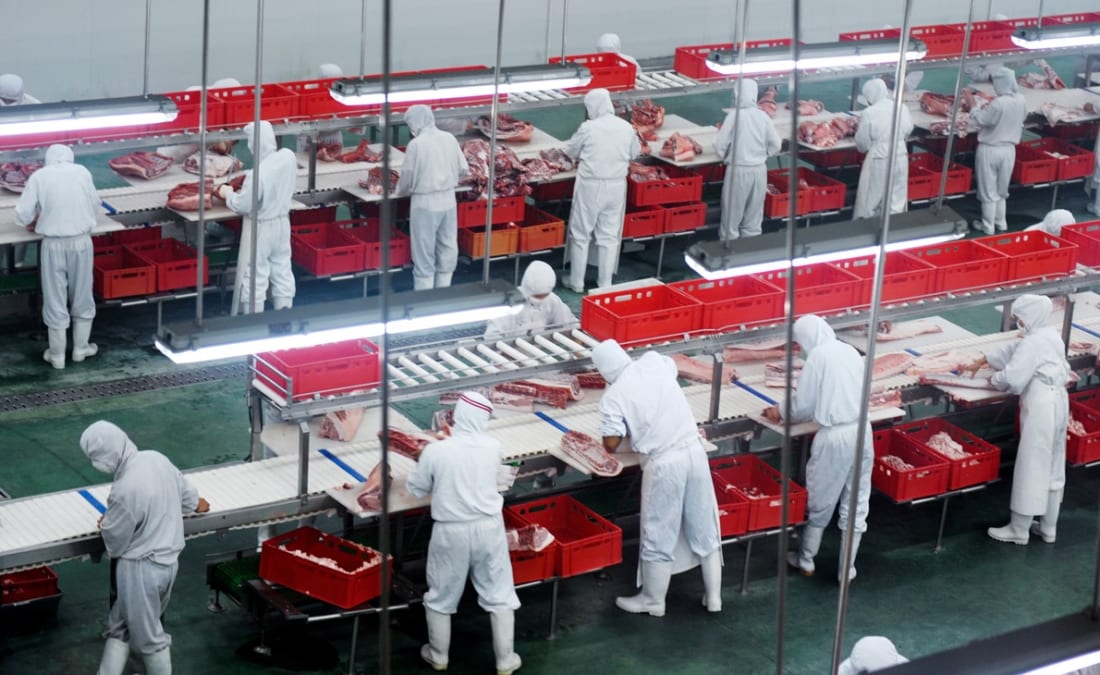 |
Photo by iStock/hxdbzxy
Two chickens a second. 18 hogs per minute. That’s how fast meatpacking plants can currently run in the U.S. Meatpacking workers repeat the same motions thousands of times a day, resulting in reported rates of occupational illness six times higher than the national average across all industries. Short-staffed meat inspectors have little time to identify carcasses contaminated with feces or disease and face immense pressure to keep lines going rather than halt them for inspection. Despite these dangers, President Trump’s Department of Agriculture plans to let packers run the lines even faster. It’s the administration’s latest deregulatory gift to the meat industry, after pausing new protections for livestock farmers, repealing salmonella standards, and rehiring a food safety lead with deep industry ties.
USDA has proposed increasing the line speed limit in poultry plants from 140 birds per minute to 175 and completely removing any limit on pork processing line speeds. This rule is the culmination of a steady, decades-long overhaul of slaughter regulations, which have shifted inspection duties from government officials to plant employees and permitted dozens of plants to run faster lines.
USDA and industry say that lifting line speed limits for all plants will lower meat prices. But workers, former inspectors, and food safety advocates submitted tens of thousands of comments opposing the change, warning that faster line speeds will endanger workers, animals, and consumers.
“This is basically The Jungle all over again,” said Delcianna Winders, director of the animal law and policy institute at Vermont Law School, referring to the eye-opening 1906 novel that led to reforms of the meatpacking industry. “We have laws that require protecting food safety, herd health, and animal welfare, but the USDA is going out of its way to completely delegate to industry.”
The meat industry has pushed the USDA to lift line speed limits for over 20 years. Starting in the mid-1990s, USDA began developing and piloting new pork and poultry slaughter systems that, among other changes, shift some carcass inspection duties from USDA inspectors to plant employees. USDA asserts that these modernized inspection systems can operate at faster line speeds without jeopardizing food safety. USDA first proposed increasing line speed limits for poultry plants in 2012 and pork plants in 2019, but these proposals faced legal challenges. In the meantime, USDA has granted waivers to dozens of the largest processing plants, allowing them to operate at faster line speeds. This latest rule would finally raise line speed limits for all poultry and pork plants using the modernized inspection systems.
After a lawsuit from the United Food and Commercial Workers union (UFCW) blocked USDA’s last effort to lift line speed limits, USDA hired the University of California, San Francisco to study worker safety risks in select pork and poultry plants operating faster line speeds. The studies found that faster line speeds had no impact on repetitive injury risk in five of the six pork plants studied and that self-reported work-related pain was not higher in poultry plants operating at faster speeds. USDA points to these findings as justification to raise line speed limits at all modernized pork and poultry plants.
Mark Lauritsen, director of the UFCW meatpacking division, argues that USDA misrepresents these studies, which also found that 45% of pork plant workers and 80% of poultry plant workers are at an increased risk for repetitive motion injuries. Critically, the studies emphasize that increasing the number of animals any individual worker must process, or the “piece rate,” does raise the risk of a repetitive motion injury. Both studies say that if plants want to operate at higher speeds without more injuries, they need to hire more workers to keep piece rates down.
Unlike plants in the study, Lauritsen says that most U.S. meatpacking plants do not have space to add more workers to the line. “If there is no physical space capacity to put another person in there, each individual worker is doing a higher piece rate,” Lauritsen explained. “This is a disaster when it comes to safety and health, the industry knows it, they just don’t care.” Updating plants to safely accommodate more workers and faster lines “would take a massive re-engineering of these facilities, and I just don’t see that happening,” Lauritsen said.
USDA also points to studies that found faster speeds did not increase the number of food safety noncompliance reports nor significantly increase the presence of salmonella in poultry plants. “[New Swine Inspection System] establishments are capable of ensuring food safety when operating at increased line speeds,” USDA said.
But consumer safety advocates and whistleblowers disagree. “Based on my direct experience, I believe these high-speed models lead to lower-quality meat products and increase the likelihood that unsafe food reaches the public,” Jill Mauer, a former inspector who worked in a high-speed pork plant, wrote in a comment to USDA.
Mauer and other commenters argue that data showing little to no increased contamination at faster speeds reflects biased sampling. “In my experience those tests are meaningless,” Mauer wrote. “The plant chooses samples from pristine carcasses.”
Low noncompliance reports, likewise, reflect a lack of reporting, not necessarily a lack of issues. Inspectors cannot complete noncompliance reports while they are stationed on the processing line; they need a present offline inspector to file the report. Understaffed plants may not have a second inspector available. “There are practical constraints that affect what actually gets documented,” wrote Hallie Varvel, a former supervisory veterinarian in one of the trial high-speed pork plants. “A lot of times we just see things going on and can’t always stop it or write it up.”
Inspector staffing constraints will only get worse since the Trump administration terminated USDA meatpacking inspectors’ union contract. Losing union benefits and protections will make recruiting new inspectors more challenging and make existing inspectors more vulnerable and less likely to blow the whistle on unsafe conduct.
The social and logistical barriers for inspectors to hold packers accountable are already too high. Varvel and Mauer both wrote that inspectors face confrontation and retaliation from plant employees when they try to stop the line. Mauer testified that employees tried to hide defective carcasses from her. USDA’s proposals may make this worse by implicitly consolidating authority to stop the line in the Inspector-in-Charge (IIC).
“The rule contemplates that there’s a supervising inspector who is always there. The reality is that that person is either not always designated or not physically present at the plant,” explains Amanda Hitt, director of strategic initiatives at Vermont Law’s animal law and policy institute. “USDA relying on this IIC is kind of odd, because in theory every inspector has the power to slow and stop the line.”
Faster line speeds will also wear down equipment, which poses additional worker and consumer safety risks. Varvel wrote that in her plant, hydraulic fluid “routinely leaked onto products” when line speeds increased. With recent recalls of pork products contaminated with hard plastic and metal fragments, Varvel worries that equipment strain could lead to more foreign material contamination.
Dominant meatpacking corporations will likely push their equipment to the limit for the same reason they push workers to the limit: they want to process meat as cheaply as possible and boost profits. As packers push more product through existing plants, Lauritsen expects plant closures, particularly of smaller, older plants. Plants that remain open may process more product in less time and cut workers’ hours. “This is a job killer, and even if it doesn’t kill a job, it takes hours away from people, it’s a backdoor pay cut,” Lauritsen said. “That’s bad for the communities and small towns they work in.”
Packers have been closing plants at an unprecedented rate since 2023, cutting hundreds, sometimes thousands, of jobs in towns like Lexington, Nebraska, Perry, Iowa, and Noel, Missouri. These closures hurt rural economies, leave contract farmers stranded with debt, and reduce overall processing capacity and resiliency in the meat supply chain, but Wall Street loves them. Since Tyson closed its large beef packing plant in Lexington, its profit margins are up.
What We’re Reading
Small midwestern dairy farms face increased competition from large dairy businesses like Riverview, which owns 15 dairy operations with an average of 9,000 cows per site. (Land Stewardship Project)
Recently unsealed documents from the California Attorney General’s lawsuit against Amazon reveal how Amazon bullies its suppliers to raise prices at non-Amazon retailers. (The Guardian)
On Monday, the Supreme Court heard Bayer’s appeal to avoid liability for failing to warn consumers about the cancer risks of using its products. (Reuters)
Follow F&P on Twitter | Subscribe to this Newsletter | F&P Website | Contact Us
 |
Food & Power is a free publication of the Open Markets Institute. If you enjoyed this post and want to support our work, you can donate to Open Markets. Thank you!
| ||||||||||


