Worst News for Stocks in 50 Years
Wall Street’s declared what could be the worst news for the U.S. stock market in 50 years.
If Goldman Sachs and Morgan Stanley are right... this won't be like the crashes we're used to. What's about to hit America next could keep your portfolio in the red for 10 years or longer - unless you make a big change now.
To hear about this decade-long crisis now being predicted by multiple Wall Street banks...
And to see what you can do to prepare your wealth before this hits...
Click here to learn how to defend your portfolio.
Regards,
Keith Kaplan
CEO, TradeSmith
P.S. You may have noticed we see "surprise" crashes every year now. Think about it: rate spikes in 2022... the bank crisis in 2023... $8 trillion wiped out in 2024... $11 trillion wiped out during the tariff crash in 2025... and, this year, $12 trillion was wiped out in 30 days during the Iran War. Something is off and Wall Street suggests this could continue (and worsen) well into the 2030s. Click here to learn the truth about this market and see what you must do now to prepare.
Constructing a Profit: Inside the $17B QXO Shake-Up
Reported by Jeffrey Neal Johnson. Published: 4/21/2026.

Key Points
- QXO, Inc. is actively consolidating the building materials industry to achieve market leadership and enhance long-term shareholder value.
- The acquisition has positioned TopBuild Corp. shares as a compelling short-term arbitrage opportunity for investors ahead of the deal's closing.
- The post-announcement dip in QXO's stock may present a strategic entry point for investors who believe in the company’s long-term growth vision.
- Special Report: Elon Musk already made me a “wealthy man”
A landmark $17 billion transaction is set to reshape the U.S. building materials industry. QXO, Inc. (NYSE: QXO) has entered into a definitive agreement to acquire TopBuild Corp. (NYSE: BLD), creating the second-largest publicly traded distributor of building products in North America. Investors should view this as more than a merger; it signals a clear acceleration of consolidation across the sector.
This acquisition is the latest step in QXO's aggressive expansion strategy, which recently closed its purchase of Kodiak Building Partners. The move comes as the construction supply chain grows more complex: fluctuating material costs, logistical challenges, and mounting pressure to improve efficiency have made scale a competitive advantage. Firms that control larger parts of the supply chain should be better positioned to manage costs and serve large-scale builders.
Ticker Revealed: Pre-IPO Access to "Next Elon Musk" Company (Ad)
We’ve found The Next Elon Musk… and what we believe to be the next Tesla.
It’s already racked up $26 billion in government contracts.
Peter Thiel just bet $1 Billion on it.
👉 Unlock the ticker now and get it completely free.The announcement prompted immediate and divergent market reactions. TopBuild shares jumped nearly 20% as investors priced in the acquisition premium, while QXO’s stock fell over 3% on exceptionally high volume. Those contrasting moves reflect two separate investment narratives in this evolving story.
Calculating the Opportunity in TopBuild Stock
The strategic rationale for combining QXO and TopBuild centers on achieving market dominance through scale. For the business, the anticipated benefits are substantial, notably:
Enhanced procurement power. Greater purchasing volume should allow the combined company to negotiate more favorable pricing from raw-material suppliers, reducing cost of goods sold and improving margins.
Operational scale and efficiency. Integrating TopBuild’s extensive installation and distribution network can streamline logistics, lower overhead, and expand the service footprint, creating a more efficient end-to-end operation.
For investors, the deal creates a clear merger-arbitrage scenario. In this strategy, traders seek to capture the spread between the target’s current share price and the agreed acquisition price. QXO has offered TopBuild shareholders $505 in cash per share. After the announcement, TopBuild closed at $489.81, leaving a spread of $15.19 per share.
That gap exists because the transaction is not yet final; the deal is expected to close in the third quarter of 2026. The spread compensates the market for the time value and the small risks that remain — for example, regulatory approvals or closing conditions.
While several shareholder lawsuits challenging deal fairness have been filed, such actions are routine in the M&A landscape. Arbitrageurs point to the unanimous approval of the transaction by both companies' boards as an indicator of strong internal confidence, an important factor when assessing the likelihood of a successful closing.
Dilution vs. Dominance: The Long-Term Case
TopBuild’s rise and QXO’s roughly 3.14% share drop (on more than 55 million shares traded) reflect a typical market response to an acquisition. Two main drivers explain the acquirer’s decline: share dilution and increased leverage.
The deal will be funded 55% with newly issued QXO stock, meaning millions of additional shares will dilute existing owners' stakes. The remaining 45% will be paid in cash and financed with new debt, increasing QXO's liabilities. Investors often react to these near-term mechanical changes, which can pressure the acquirer’s stock price.
QXO’s management appears to be accepting that short-term dip in exchange for a dominant market position. Leadership says the deal is expected to be immediately accretive — that is, to increase QXO’s earnings per share (EPS) right away because TopBuild’s incremental earnings should more than offset dilution from new shares.
Wall Street’s forward-looking view supports this longer-term thesis. Despite the drop to $24.21, the consensus analyst rating for QXO remains a Moderate Buy, with an average 12-month price target of $32.40. Analysts appear to be looking past the near-term financing effects to the potential upside from consolidation.
From Arbitrage to Long-Term Value
The QXO-TopBuild merger is a transformative transaction driven by deliberate consolidation. The market’s reaction has created two distinct opportunities for investors.
For TopBuild, the stock now mainly functions as a short-term arbitrage play, trading primarily on the $505 offer price. Arbitrageurs will monitor the spread and any deal-related developments as the third-quarter 2026 close approaches.
For QXO, the post-announcement pullback may present an entry point for long-term investors who believe consolidation will drive significant enterprise value. More cautious investors may wait for further clarity on financing and integration milestones as the closing date nears, while those with higher risk tolerance may view current volatility as an opportunity. Ultimately, QXO’s stock will serve as a barometer of market confidence in the company’s ambitious strategy for market dominance and sustained growth.
Sky-High Stakes: United and American Merger Rumors
Reported by Jeffrey Neal Johnson. Published: 4/15/2026.
Key Points
- Recent news of potential industry consolidation has driven a significant upward trend in the stock prices of the major domestic passenger carriers.
- A strategic combination between leading airlines would create massive economies of scale and help protect operating margins from future energy price spikes.
- Strong balance sheets and active share buyback programs among the larger carriers indicate a high level of confidence in the long term aviation industry.
- Special Report: Elon Musk already made me a “wealthy man”
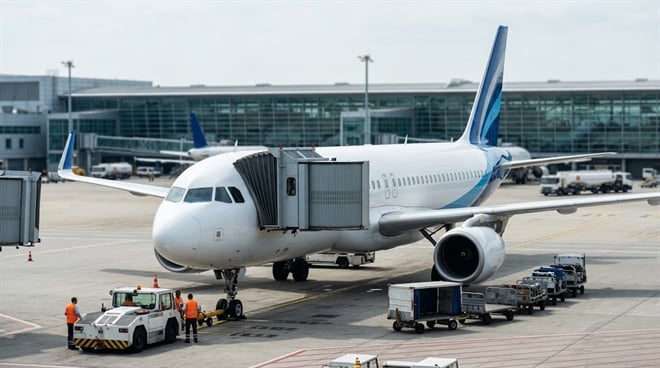
Chief executives at major legacy airlines are pursuing unprecedented consolidation strategies to address global supply-chain disruptions and energy sector instability. Investors looking for the reason behind the recent surge in aviation stocks should pay attention to the latest rumored developments out of Washington.
Reports say a high-level White House meeting included United Airlines (NASDAQ: UAL) CEO Scott Kirby proposing a potential megamerger between two of the country's largest carriers. The idea of a company being "too big to fail" is resurfacing in the transportation industry, as leaders balance the economic benefits of scale against heightened federal antitrust scrutiny. Market participants are trying to reconcile short-term trading gains from these rumors with long-term fundamentals. Understanding the macroeconomic pressures and structural differences among these companies is essential in this uncertain environment.
Geopolitical Pressures Drive Strategic Shifts
Available Now: Investigating Project Prophet (Ad)
Porter Stansberry flew the Porter and Co. team 3,300 miles to Dublin to investigate a 17-year investing experiment called Project Prophet - and documented everything on film.
Rooted in the laws of physics, this quantitative approach challenges conventional wealth-building wisdom. With 17 years of verified data behind it, Porter calls it unlike anything he has seen in nearly 30 years in the business.
Watch the full investigation and decide for yourselfThe primary catalyst for recent margin pressure across the airline industry is the spike in jet fuel costs tied to the conflict in Iran. Fuel is one of the largest variable expenses for any commercial carrier, and geopolitical disruption to supply lines quickly dents airline balance sheets. With recent reports of a ceasefire and peace talks, oil prices have eased to roughly $92 per barrel but continue to hover near the $100 mark. That reprieve helps operating budgets in the short term, but many analysts view it as fragile.
Merging now would act as a structural hedge against future energy shocks by creating larger economies of scale. A combined carrier could better optimize fleet utilization and negotiate bulk fuel contracts. Consolidation would also eliminate redundant operational costs that burden independent carriers during geopolitical crises. By sharing maintenance facilities, streamlining administrative overhead and combining pilot rosters, a unified airline could absorb supply-chain shocks more effectively than standalone operators.
A larger fleet also provides operational flexibility: airlines can ground older, less fuel-efficient aircraft when prices spike and rely on newer models to keep critical routes operating. That adaptability is crucial when navigating volatile global commodity markets.
Comparing Two Divergent Financial Realities
American Airlines Group (NASDAQ: AAL) shares recently rose about 8% to above $12, while United Airlines Holdings (NASDAQ: UAL) shares gained roughly 2% to over $97 on the merger talk. Despite the shared momentum, the two carriers sit in very different financial positions.
American Airlines operates from a position of clear financial vulnerability. The carrier has a market cap near $8 billion and a negative book value of $5.65 per share. Adding to the upward price action for American Airlines is a potential short squeeze.
Short interest entered the month at nearly 26% of AAL's available float. When positive news triggers a sudden price move, traders betting against the stock can be forced to cover, which can accelerate gains.
By contrast, United Airlines is in a stronger financial position. The Chicago-based carrier has a market capitalization around $31.6 billion and trailing 12-month earnings of $10.22 per share. Institutional ownership exceeds 69%, signaling confidence from major funds.
United is supporting its valuation with a $1.5 billion share buyback program. That stronger balance sheet would make it easier for United to absorb a highly leveraged competitor.
The contrast in these metrics helps explain why a merger would appeal differently to each party. For the smaller carrier, consolidation offers a lifeline and a path to restructure debt. For the larger airline, acquiring a major rival would be a rare opportunity to gain dominant market share and eliminate a direct competitor.
Washington Resistance Meets Standalone Success
A combined United-American entity would control roughly one-third of the domestic air travel market, inviting intense scrutiny from the Department of Justice. Regulators have historically blocked major airline consolidations to protect consumer prices and preserve competitive route networks.
Federal agencies have intervened to stop much smaller aviation mergers in the past. To satisfy antitrust concerns, the airlines might have to propose extensive route divestitures, relinquishing overlapping flights to regional competitors. A regulatory defense could lean on national-security arguments, claiming a financially stable mega-carrier ensures reliable domestic transport infrastructure during global crises.
For investors seeking sector exposure without merger-and-acquisition or regulatory risk, Delta Air Lines (NYSE: DAL) offers a strong standalone benchmark. Delta shares recently rose nearly 7% to about $71 despite not being involved in the merger rumors, showing that a standalone model can thrive in the current environment.
Delta demonstrates consistent profitability without consolidation:
Delta reported an earnings beat of $0.64 per share.
Annual revenues are $63.36 billion.
The airline maintains a net margin of 6.87%.
Investors receive a steady dividend yield of about 1%.
Preparing for the Next Phase of Aviation
These merger discussions mark a potential turning point for legacy carriers. Executives are increasingly prioritizing long-term survival and scale over remaining independent. Upcoming financial disclosures will shed more light on how well these companies are managing internal costs versus external energy pressures. United Airlines is scheduled to report next on April 21, followed by American Airlines on April 23.
Investors should weigh the speculative upside of industry consolidation against the stable cash flows of fundamentally strong peers. Regulatory opposition is a major risk to any merger-driven thesis; if Washington blocks consolidation, highly leveraged carriers could see sharp declines. Likewise, renewed geopolitical conflict could quickly erase the recent fuel-cost relief.
As earnings approach and regulatory feedback surfaces, investors may want to add United and American to their watchlists. Those with lower risk tolerance might prefer standalone carriers with established dividend histories and lower debt levels before taking positions in this volatile sector.
This email message is a paid advertisement sent on behalf of TradeSmith, a third-party advertiser of InsiderTrades.com and MarketBeat.
This ad is sent on behalf of TradeSmith at 1125 N. Charles Street, Baltimore, Maryland 21201. If you’re not interested in this opportunity, please click here.
If you have questions about your subscription, please don't hesitate to contact MarketBeat's U.S. based support team at [email protected].
If you no longer wish to receive email from InsiderTrades.com, you can unsubscribe.
© 2006-2026 MarketBeat Media, LLC.
345 N Reid Pl. #620, Sioux Falls, SD 57103-7078. U.S.A..