Elon Musk confirms that SpaceX plans to go public in 2026.
That's why I'm looking into ways to own a stake before it officially trades on the NASDAQ.
Click here to get my urgent report (email required).
Elon Musk now believes Space Exploration Technologies must raise $30 billion to fund his new Space Master Plan.
SpaceX is looking at going public with a $1.5 trillion valuation - making this the biggest IPO ever.
Here's how to claim a stake before the IPO.
Ian Wyatt
*By clicking the link above you'll receive emails from IPO Watch and Ian Wyatt.
STMicronelectronics Sends Industrial Chips Into Overdrive
Written by Thomas Hughes. Posted: 4/24/2026.
Key Points
- STMicronelectronics is well-positioned for a global semiconductor supercycle.
- Q1 results confirm that momentum is building and improving profitability is ahead.
- Analysts and institutions indicate accumulation and underpin a shifting market dynamic.
- Special Report: Elon Musk already made me a “wealthy man”
Industrial chipmakers have been in rebound mode, with names like STMicroelectronics (NYSE: STM) leading the charge. In late April, STMicroelectronics’ Q1 results not only affirmed the rebound—centered on inventory normalization and improving demand—but also pointed to accelerating momentum. The result: its share price and those of its peers rocketed higher and are likely to continue rising over the long term.
This isn't just normalization; it's the acceleration of a multiyear semiconductor supercycle driven by demand across multiple segments.
Ticker Revealed: Pre-IPO Access to "Next Elon Musk" Company (Ad)
We’ve found The Next Elon Musk… and what we believe to be the next Tesla.
It’s already racked up $26 billion in government contracts.
Peter Thiel just bet $1 Billion on it.
👉 Unlock the ticker now and get it completely free.Simply put, AI is driving a systemic shift in technology that is prompting major hardware upgrades—from calculators to spaceships. Data centers need to be built, as do the connections, the industrial infrastructure, and the endpoint devices that AI will power—and those require chips that STMicroelectronics is well-suited to provide.
The chart action speaks for itself. The market underwent a large correction beginning in 2024 and has only now recovered. April's price action set a long-term high, breaking above critical resistance and signaling a shift in market dynamics. In this scenario, the STM stock price could rally by roughly the correction’s dollar value—about $25—in the near-to-mid term, and potentially by the same percentage in the longer term.
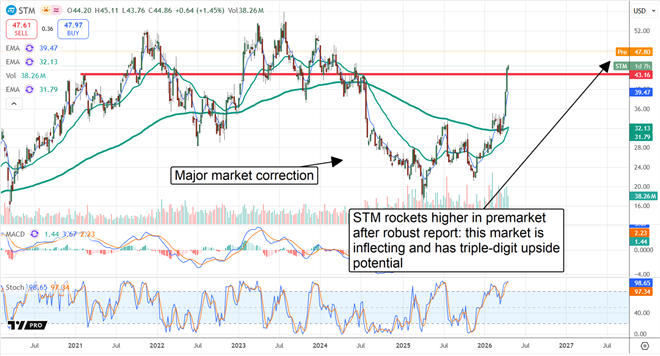
That implies more than 100% upside, potentially achievable within a few quarters given the current setup. STM trades at a premium to this year's forecast—around 40x earnings—but that multiple reflects a robust outlook that may still understate future growth. Longer-term estimates, which could also be conservative, imply the stock would trade at roughly 15x 2030 earnings, setting the stage for a potential >100% rally.
STMicroelectronics: Looking Past Weak Earnings to a Strong Future
STMicroelectronics posted a mixed quarter: fiscal Q1 revenue topped MarketBeat’s consensus while earnings missed, but the growth story is what matters because one-offs affected results. Revenue rose 23% year-over-year (YOY) to $3.1 billion, accelerating sequentially and reversing last year’s contraction. Strength was driven by OEM and distribution demand, with most underlying segments contributing.
The main weakness was in the Power & Discrete business, which contracted 1.8% but is expected to improve in coming quarters. Areas of strength included Analog, Embedded Processing, and RF/Optical—each posting double-digit gains. RF led with a 32% increase, Analog rose 23%, and Embedded Processing gained 31.3%.
Margins were mixed because acquisition-related items affected both GAAP and adjusted results. After adjusting for inventory, working capital changes, and acquisition impacts, margins improved and net cash flow rose by double digits, leaving ample free cash flow to support financial health and capital returns. While adjusted EPS of $0.13 missed estimates by $0.05, the market is focused on guidance, which points to another quarter of acceleration and stronger margins; management's Q2 outlook may remain cautious.
STMicroelectronics Builds Value and Pays You to Own It
STMicroelectronics' balance sheet reflects the effects of the acquisition and capital returns, with cash down sequentially, though the reductions are modest and offset by other improvements. The company is well-capitalized with nearly $2 billion in cash, rising total assets, lower total liabilities YOY, and improved equity. Leverage remains low: long-term debt is under 0.35x liabilities, about 0.12x equity, and just over 1x cash.
Looking ahead, STM can not only sustain the dividend and share buybacks but is likely to increase them as the semiconductor supercycle progresses. The dividend yields roughly 0.6%—modest, but enough to keep dividend-focused investors engaged—while buybacks are reducing the share count. Trailing 12-month buyback activity reduced the share count by about 2% YOY in Q1, and that pace is expected to continue through the year.
Analysts and Institutions Drive STM Price Action
MarketBeat tracks 14 analysts with current ratings on STM, and the trend is improving. Several price-target increases and upgrades were recorded just before and after the report, firming the Moderate Buy view and lifting consensus targets.
The consensus price target is notable: after being flat on a TTM basis, it jumped about 20% following the report. The downside is that consensus still lags the market; the upside is that price trends point toward the high end of the range and are likely to stay strong.
Institutions, which collectively own roughly 60% of the company, have been ramping up buying activity in early 2026.
Procter & Gamble Gave the Market What It Wanted: A Reason to Buy
Written by Thomas Hughes. Posted: 4/24/2026.

Key Points
- Procter & Gamble had a better-than-expected quarter, alleviating fears and providing a reason to buy.
- Cash flow and capital return remain strong, giving investors leverage.
- Analysts and institutions underpin the rebound; how high it gets depends on how long you hold it.
- Special Report: Elon Musk already made me a “wealthy man”
Procter & Gamble (NYSE: PG) is a high-quality, consumer staples and home-products company with a long track record of cash flow and capital returns. It's a quintessential buy-and-hold stock—ideal for income and dividend compounding—but the share price has struggled in 2026. Concerns about tariffs, currency headwinds, margins, and cash flow prompted volatility and a sharp March correction. The takeaway in late April, after fiscal Q3 results, is that many fears were overblown, the market overreacted, and prices are near long-term lows, creating an opportunity for buyers.
Procter & Gamble Navigates Hurdles: Reinvigorates Market Interest
Procter & Gamble delivered a solid quarter, extending its growth trend through organic strength and contributions from acquisitions. Net revenue of $21.24 billion rose 7.3% year over year (YOY), outpacing consensus by roughly 350 basis points.
Ticker Revealed: Pre-IPO Access to "Next Elon Musk" Company (Ad)
We’ve found The Next Elon Musk… and what we believe to be the next Tesla.
It’s already racked up $26 billion in government contracts.
Peter Thiel just bet $1 Billion on it.
👉 Unlock the ticker now and get it completely free.Organic sales grew 3%, driven by a 2% volume gain and a 1% price impact, with strength across all segments.
Beauty led with 7% growth, while Grooming grew 1%. Overall, consumer resilience was evident.
Earnings held up despite tariff-related and other headwinds; management offset pressure with price increases, efficiency gains, and a favorable foreign-exchange tailwind.
The quarter produced $4 billion in net earnings and $4 billion in operating cash flow, with an 82% cash-flow conversion measure. Free cash flow was $3.28 billion, more than enough to cover capital returns—dividends and buybacks totaled $3.2 billion.
Procter & Gamble’s capital-return program matters for its reliability, scale, and growth. The company is a Dividend King, having increased its distribution annually for 70 consecutive years, and it has sustained a mid-single-digit compound annual growth rate (CAGR) in its dividend. Looking ahead, management expects modest single-digit revenue growth and sufficient earnings to maintain capital returns and its financial health.
The results imply the company can continue raising the dividend and buying back shares. Buybacks matter because Procter & Gamble consistently reduces its share count, which offsets dilution from payout increases and supports the dividend CAGR. Diluted share count fell roughly 1.35% YOY in fiscal Q3, and the stock yields nearly 3% with shares trading near the low end of their historical P/E range.
Analysts and Institutions Underpin Procter & Gamble Stock Price Rebound
Analysts played a role in PG’s 2026 price decline, issuing several downward price-target revisions. Those reductions, however, now sit against a late-April consensus that implies a modest double-digit gain from current support levels.
The better-than-expected report and guidance should help firm analyst sentiment and strengthen the price floor.
The low end of analysts' ranges is about $142—very near Q1 lows and a critical support level—while consensus views place the market back above several moving averages and into a potential rally.
Institutions are potential buyers on this dip. The group owns more than 65% of the stock and has accumulated at roughly a $2-to-$1 pace on a trailing 12-month basis.
Institutional activity picked up in 2025 as the share price declined and contributed to the nearly 20% rebound after touching critical levels in January 2026. The risk is that institutions began selling in early Q2 and may not participate in the current rebound. With the AI trade back in force and pulling capital toward technology, institutions could shift focus away from staples and trim PG positions further.
Technical Setup: A Rebound With Resistance Overhead
The technical signals show elevated volatility—unusual for a classic buy-and-hold name—but also a well-established price floor that has produced multiple rebounds over the years. The mid-Q2 setup points to another bounce with potential upside of $15 to $20, but there is a clear risk: resistance at the 150-day exponential moving average (EMA) may cap gains. The 150-day EMA reflects long-term investor activity, including institutions, and current data indicate selling from that group. If the market fails to clear this level, a stronger rebound is unlikely until later in the year.
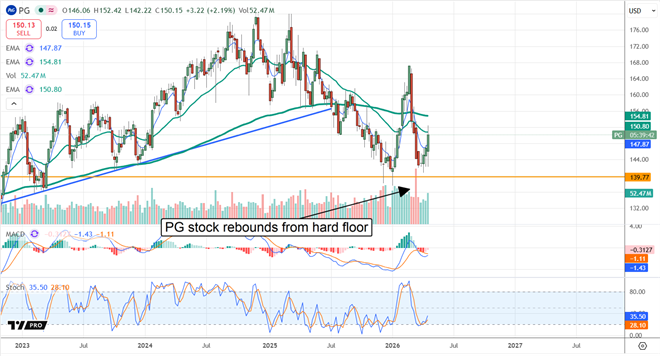
The long-term outlook remains constructive. With shares near the low end of their historical P/E range, valuation re-rating alone could lift the stock by as much as 50%. Combined with modest organic growth, PG could offer materially greater upside—potentially as much as 100% over time for patient buy-and-hold investors.
This email message is a paid advertisement provided by Wyatt Investment Research, a third-party advertiser of DividendStocks.com and MarketBeat.
If you have questions about your subscription, please feel free to contact MarketBeat's South Dakota based support team at [email protected].
If you no longer wish to receive email from DividendStocks.com, you can unsubscribe.
© 2006-2026 MarketBeat Media, LLC. All rights reserved.
345 North Reid Place, Suite 620, Sioux Falls, South Dakota 57103. United States of America..