| Written by Jeffrey Neal Johnson 
A definitive agreement for The Real Brokerage Inc. (NASDAQ: REAX) to acquire RE/MAX Holdings, Inc. (NYSE: RMAX) for an $880 million enterprise value is a high-stakes strategic survival maneuver masked as a property technology (prop-tech) expansion. Facing severe margin compression in the post-National Association of Realtors settlement era, Real is sacrificing its balance sheet for immediate global distribution.
The core investment thesis now rests on whether aggressive technological integration can outpace the structural headwinds currently suffocating traditional real estate sector models. This deal is more than an opportunistic buy; it's a calculated strategic response to a fundamental reshaping of the residential real estate industry, where scale and efficiency have become the only viable paths to survival.
Merger Mathematics: Anatomy of a Consolidation PlayThe transaction creates a formidable industry player, combining two of the largest U.S. brokerages by sales volume into a single entity, the Real REMAX Group. The pro forma company will command a global network of over 180,000 agents, generating an estimated $2.3 billion in revenue and $157 million in adjusted EBITDA based on 2025 projections.
Under the terms, RE/MAX shareholders can elect to receive $13.80 in cash or 5.152 shares of the combined company for each RE/MAX share held, a 72% premium over the pre-announcement closing price. This premium signals the perceived value of RE/MAX's established agent network when bolted onto a modern tech framework.
The aggregate cash component is capped between $60 million and $80 million. Upon closing, existing Real shareholders will own approximately 59% of the new entity, with former RE/MAX shareholders holding the remaining 41%. Management has targeted $30 million in annual run-rate cost savings by the end of 2027, a key driver intended to expand the combined company’s adjusted EBITDA margin from a pro forma 3% to a target of 7%.
A Merger Forged by Regulatory ChangeThis acquisition cannot be analyzed in isolation, as it is a direct and aggressive response to the existential threat posed by recent antitrust commission settlements involving the National Association of Realtors (NAR). This landmark legal shift has dismantled the traditional cooperative compensation model, which guaranteed commissions for buyers' agents, ushering in an era of intense fee competition and permanent margin compression. Both companies are directly impacted, with Real Brokerage agreeing to a $9.25 million settlement and RE/MAX to a more substantial $55 million settlement.
In this new era, where agents must explicitly justify and negotiate their fees with buyers, the value proposition shifts from brand affiliation to tangible technological support. Immense scale and efficiency are no longer offensive growth strategies but critical defensive necessities.
Real’s cloud-based, low-overhead platform, offering integrated CRM, transaction management, and marketing tools, could provide a potential lifeline to the capital-light but agent-heavy RE/MAX franchise model. The deal represents a structural trade: Real acquires a century of brand equity and global distribution, while RE/MAX gains access to a modern technology stack designed to empower its agents to compete and thrive in a lower-margin world.
Trading a Pristine Balance Sheet for Instant ScaleThe market’s immediate and punitive reaction, an over 25% single-day decline in Real Brokerage’s stock price, is a direct reflection of the deal's financing structure. Management at Real Brokerage consistently highlighted its debt-free, highly liquid balance sheet as a core competitive advantage during its Q4 2025 earnings call.
The abrupt pivot to a leveraged model, underpinned by a $550 million financing commitment led by Morgan Stanley and Apollo Global Funding, represents a fundamental shift in the company's risk profile. Investors punish such moves because increased debt introduces interest expense that weighs on earnings, reduces financial flexibility for future moves, and heightens bankruptcy risk in an economic downturn.
This new debt will primarily refinance RE/MAX's existing obligations and fund the cash portion of the acquisition. Institutional investors have rapidly repriced RE/MAX's equity to account for this heightened financial risk. Management has set a public target to lower its net debt-to-adjusted EBITDA ratio to below 2.0x within 2 years of the deal's closing, a critical deleveraging metric that will now become a primary focus for shareholders.
Organic Vs. Acquired: A High-Stakes Growth PivotThe transaction effectively sidelines Real’s previously successful and low-cost growth engine. The company demonstrated exceptional organic growth, increasing its agent count by 31% to over 33,000 by the end of 2025. The strategic debate for investors is whether the significant capital outlay and equity dilution required to absorb RE/MAX’s vast, legacy network is superior to continuing this proven organic growth strategy. Significant pre-deal insider selling at RE/MAX, including 142,693 shares sold by a major shareholder in early April, may signal a lack of confidence in the legacy firm's ability to compete on a standalone basis.
The primary operational challenge will be seamlessly migrating tens of thousands of independent RE/MAX franchisees onto Real’s proprietary technology platform without significant agent attrition. The operational chasm is vast: Real is an asset-light, cloud-native firm, whereas RE/MAX is a deeply entrenched global franchisor.
Integrating these two disparate corporate cultures and business models carries substantial execution risk, particularly during a period of such profound industry disruption. Shareholder rights firms, including Halper Sadeh LLC and Ademi LLP, have already launched investigations into the fairness of the acquisition price for RE/MAX shareholders, adding a layer of legal and regulatory uncertainty. The long-term success of this merger hinges entirely on management's ability to execute a flawless technological and cultural integration that validates its high-cost, high-risk bet on acquired scale.
 Read This Story Online Read This Story Online |  |
| Written by Leo Miller 
Several stocks with market capitalizations above $100 billion just made notable dividend announcements. These names are among the largest in their respective industries, and despite widely differing performance, continue to make good on their commitments to return more capital to shareholders.
Costco Announces 13% Dividend Boost Amid Strong Start to 2026First up is the world’s second most valuable consumer staples stock, Costco Wholesale (NASDAQ: COST). With Costco having a market capitalization of nearly $450 billion, Walmart (NASDAQ: WMT) is the only larger consumer staples name.
In 2025, Costco slumped, delivering a total loss of nearly 5%. This marked only the sixth year in which COST generated a negative annual return since 1994. That is an impressive track record, with Costco’s return being positive in over 80% of the last 32 years.
After a down 2025, Costco shares have come roaring back in 2026. Overall, the stock has delivered a total return exceeding 15%. Costco has provided multiple strong monthly sales reports, leading to considerable gains in the stock. Sales rose by 9.3% year over year (YOY) in January and 11.3% YOY in the five weeks ended April 5.
Additionally, Costco has benefited from a market-wide rotation into consumer staples stocks.
Amid a strong start to the year, Costco has just announced a significant 13% dividend increase. The company’s quarterly dividend will move up to $1.47, payable on May 15 to shareholders of record as of the May 1 close. This gives Costco an indicated dividend yield near 0.6%. Although the yield is not large, Costco has consistently issued substantial dividend increases, with an annualized five-year dividend growth rate of 12.75%.
High-Yield Sanofi Boosts Dividend After Mixed 2025Next up is Sanofi (NASDAQ: SNY), one of the world’s largest pharmaceutical companies. The stock is one of just 15 within the pharma and biotechnology industries with a market capitalization above $100 billion. SNY shares have been range-bound for a significant time, with a total loss of over 10% over the past five years. Despite the company’s blockbuster drug Dupixent posting impressive growth of 25% in 2025, a series of disappointing pipeline readouts pressured shares.
However, the firm is shaking things up, recently announcing a new CEO in Belén Garijo. Garijo’s goal will be to reinvigorate Sanofi’s innovation pipeline and develop a new blockbuster drug aside from Dupixent. Dupixent alone accounted for almost 40% of sales last quarter, demonstrating the company’s need for greater product diversification.
In the meantime, Sanofi continues to return more capital to shareholders. The company recently increased its dividend to $2.42 per depository receipt. This was a 19% hike in U.S. dollar terms, with the size of the increase reflecting the impact of a stronger euro.
Because France withholds tax on dividends paid abroad, and depositary fees trim a bit more, the effective yield to U.S. holders ranges from roughly 4.7% gross down to about 3.5% net.
The firm will make its annual payment on June 3 to shareholders of record as of the May 4 close. Notably, the firm has a long history of issuing dividend increases, having boosted its payout for 31 years in a row through 2025.
AI Pushes Down SAP, Dividend Moves Up Amid Strong EarningsLast up is global software giant SAP (NYSE: SAP). With a market capitalization near $400 billion, SAP is the world’s fourth most valuable software stock. However, like most names in this industry, SAP has come under serious pressure recently.
The stock is down more than 25% in 2026 and down over 40% from its 52-week high. The artificial intelligence software sell-off in late January and early February hit SAP particularly hard. The stock has now fallen to a forward price-to-earnings ratio of approximately 20X, near its lowest level over the past three years.
Still, SAP saw a strong 7.4% bounce after its latest earnings report, with the company beating adjusted earnings per share estimates while falling slightly short on sales. The firm’s cloud revenue growth of 27% was a strong point, while current cloud backlog rose 25%, signaling solid demand ahead.
Notably, the firm’s operating margin increased by around 275 basis points to 30%.
SAP also raised its dividend per depository receipt to approximately $2.93, an increase of approximately 15% in U.S. dollar terms. After German withholding tax and depositary fees, the net yield to U.S. holders runs from roughly 1.4% down to 1.2%. The company will pay its annual dividend on May 15 to shareholders of record as of the May 5 close.
Multiple Analysts Eye $1,100 for Steady-Eddy CostcoCostco has garnered several price target upgrades in April, with many analysts calling for the stock to eclipse the $1,100 mark. Price targets updated in April average around $1,074, moderately higher than the MarketBeat consensus price target near $1,046. This updated average target implies upside in shares of just over 5%.
However, it is worth noting that targets typically don’t stray too far from Costco’s actual price, with it being one of the least volatile names in the market. This hasn’t stopped the stock from delivering a total return above 100% over the past three years.
Read This Story Online |  Porter Stansberry flew the Porter and Co. team 3,300 miles to Dublin to investigate a 17-year investing experiment called Project Prophet - and documented everything on film.
Rooted in the laws of physics, this quantitative approach challenges conventional wealth-building wisdom. With 17 years of verified data behind it, Porter calls it unlike anything he has seen in nearly 30 years in the business. Watch the full investigation and decide for yourself |
| Written by Thomas Hughes 
Coca-Cola (NYSE: KO) is not without headwinds, but it is navigating them well, delivering market-beating results and driving ample cash flow.
Its Q1 earnings results highlighted its strengths, with organic sales picking up and margins improving. Among those strengths is its reliable cash flow, which underpins a healthy capital return.
KO stock tends to trend higher over the long term, and, despite a post-earnings surge, still presents a buying opportunity in early Q2 2026. Dividends and buybacks help with leverage. The Q1 release included outperformance and margin strength, a trend likely to continue through year’s end due to consumer resilience and labor market health.
Coca-Cola Stock Trades at Value Levels in 2026Trading below its long-term P/E average, this stock could rise by two to seven price multiples over the coming quarters and then sustain the higher valuation going forward. In addition to its position as a healthy dividend stock, it is a great diversifier in a world dominated by AI. The stock has a low beta below 0.2X, which means it can help reduce portfolio volatility while providing steady income.
Evidence of KO’s buy-and-hold quality can be seen in its institutional activity, which shows that institutional investors bought KO stock throughout the Q4 2025 and Q1 2026 tech market consolidation. MarketBeat data show that institutional investors own more than 70% of KO stock, providing solid support for its price. They have accumulated at a $2-to-$1 pace on a trailing 12-month basis, ramping activity into Q1 2026.
Q1 2026 institutional activity accelerated to about $3-to-$1, providing a strong price tailwind reflected in the chart. KO’s price action rocketed higher at the year’s start, breaking to new highs and setting a peak in March. The likely outcome for Q2 is that institutions extend the trend, as the April price pullback aligned the market with the 150-day exponential moving average, a benchmark for institutional buying.
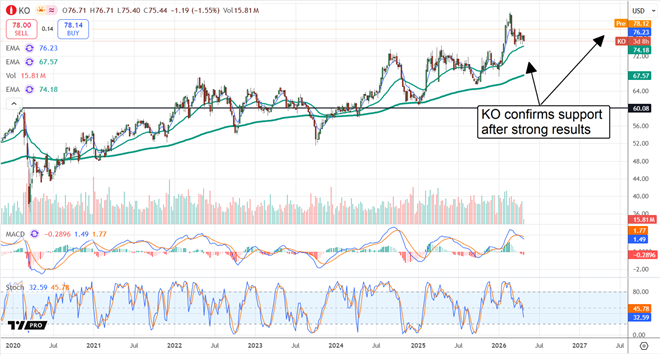
Analysts are also aligned with KO’s uptrend in stock price. MarketBeat data shows 15 analysts rating the stock as a Buy, with a 100% Buy-side bias. The consensus price target, which has increased over the past month, quarter, and year, forecasts a double-digit upside from the critical support levels, and the trend leads to the high-end range. The high target of $90, set prior to the release, puts this market at a fresh all-time high and is likely to be surpassed by year’s end. Assuming Coca-Cola can sustain its current trends, as guidance indicates, analysts’ sentiment will remain positive.
Distribution Growth Makes KO a Great Stock for CompoundingThe Coca-Cola Company’s capital return is central to its buy-and-hold quality. Buybacks are part of the equation, but not the driving force, as they barely offset dilution and serve more as a stabilizer than a boost for shareholder leverage. Dividends, on the other hand, are more robust. The company pays out approximately 65% of its earnings, average for a Dividend King with over 60 years of annual increases in its history, and yields about 2.7% with shares near $80. Looking ahead, the payment is reliable and likely to continue increasing at a modest single-digit pace, offsetting inflation's impact.
Coca-Cola Moves Higher as Organic Strength ShinesCoca-Cola had a good quarter, much better than it may appear, because the growth is organic. Acquisitions are fine; they boost top- and bottom-line figures and build leverage for future growth spurts and/or business recoveries, but organic growth is best. It reflects strength in core markets and increased by 10% in Q1. Organic growth was driven by an 8% increase in concentrate sales and 2% increase in price and mix. Concentrate sales were impacted by days and timing, but that’s always a factor; this time around, the impact was favorable, and core strengths are also present.
Margin news was also good. The company widened GAAP and adjusted margin, with foreign exchange tailwinds adding hundreds of basis points to the operating income. GAAP operating income increased by 19%, adjusted operating income by 12%, with the GAAP and adjusted EPS both rising by 18%. Cash flow is another critical detail, coming in at $2 billion, with $1.8 billion in free cash flow, sufficient for management to sustain its full-year outlook. While not a robust catalyst, a sustainable cash-flow and capital-return outlook is all this market needs.
Catalysts for KO include gains in market share. The company reported gains in share across total non-alcoholic beverages and is positioned to continue gaining share over time. Key growth drivers include emerging markets in Latin America and Asia, where rapidly industrializing nations and their expanding middle classes drive consumption.
Read This Story Online |  A physicist in Dublin claims his AI algorithm has beaten the market for 17 consecutive years - with nearly 2,000% total returns and only one losing year across two decades of crises.
Porter Stansberry flew to Ireland to investigate the claim firsthand. The result is a new investigative documentary called 'Investigating Project Prophet,' available to stream now at no cost. Stream 'Investigating Project Prophet' free and see what they found |
|