
Email
Policy Brief | The Popular Mobilization Forces: Power, Influence, and the Future of Iraq
| From | Center for the National Interest <[email protected]> |
| Subject | Policy Brief | The Popular Mobilization Forces: Power, Influence, and the Future of Iraq |
| Date | April 27, 2026 2:46 PM |
Links have been removed from this email. Learn more in the FAQ.
Links have been removed from this email. Learn more in the FAQ.
[link removed]
** CFTNI Policy Brief
------------------------------------------------------------
** The Popular Mobilization Forces: Power, Influence, and the Future of Iraq
------------------------------------------------------------
In our latest Policy Brief, we welcome a guest contributor from Iraq, Alfadhel Ahmad, who writes in collaboration with CFTNI Senior Fellow Joshua Yaphe. The title is The Popular Mobilization Forces: Power, Influence, and the Future of Iraq, and the two authors explore the sad reality that the current Iran War is masking. Washington has little influence over the PMF, which are so deeply embedded in the economy and society that they cannot simply be wished away. And the PMF are facing serious challenges related to political participation, troop motivation, and financial sustainability, all of which could lead to a competition among the armed groups for survival.
Alfadhel and Joshua propose that a major political or economic crisis could upset the balance at any time. That might mean a fight among the militias, with the state lacking the capacity and the political will to intervene. In the meantime, however, the authors believe that there are opportunities to engage with those PMF members who genuinely want to transition away from militancy to politics. They contend that the structural conditions that allow the PMF to operate and flourish will not last forever, and some of these armed groups are probably already facing extinction.
Read the brief ([link removed]) .
For more CFTNI publications, please see our website ([link removed]) .
Paul J. Saunders
President
[link removed]
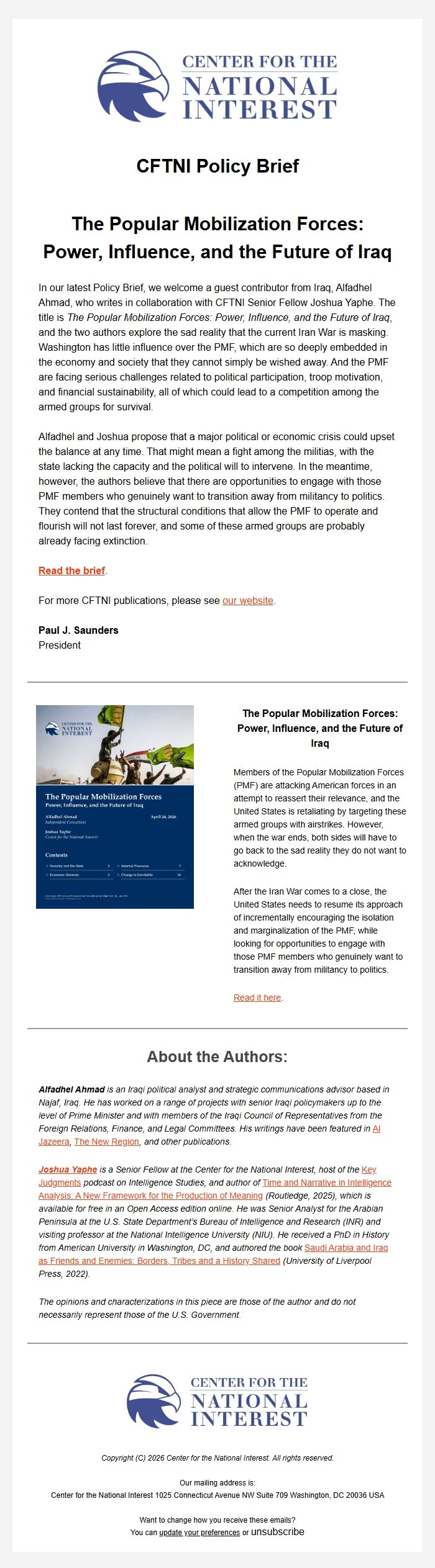
The Popular Mobilization Forces: Power, Influence, and the Future of Iraq
Members of the Popular Mobilization Forces (PMF) are attacking American forces in an attempt to reassert their relevance, and the United States is retaliating by targeting these armed groups with airstrikes. However, when the war ends, both sides will have to go back to the sad reality they do not want to acknowledge.
After the Iran War comes to a close, the United States needs to resume its approach of incrementally encouraging the isolation and marginalization of the PMF, while looking for opportunities to engage with those PMF members who genuinely want to transition away from militancy to politics.
Read it here ([link removed]) .
About the Authors:
Alfadhel Ahmad is an Iraqi political analyst and strategic communications advisor based in Najaf, Iraq. He has worked on a range of projects with senior Iraqi policymakers up to the level of Prime Minister and with members of the Iraqi Council of Representatives from the Foreign Relations, Finance, and Legal Committees. His writings have been featured in Al Jazeera ([link removed]) , The New Region ([link removed]) , and other publications.
Joshua Yaphe ([link removed]) is a Senior Fellow at the Center for the National Interest, host of the Key Judgments ([link removed]) podcast on Intelligence Studies, and author of Time and Narrative in Intelligence Analysis: A New Framework for the Production of Meaning ([link removed]) (Routledge, 2025), which is available for free in an Open Access edition online. He was Senior Analyst for the Arabian Peninsula at the U.S. State Department’s Bureau of Intelligence and Research (INR) and visiting professor at the National Intelligence University (NIU). He received a PhD in History from American University in Washington, DC, and authored the book Saudi Arabia and Iraq as Friends and Enemies: Borders, Tribes and a History Shared ([link removed]) (University of Liverpool Press,
2022).
The opinions and characterizations in this piece are those of the author and do not necessarily represent those of the U.S. Government.
Copyright (C) 2026 Center for the National Interest. All rights reserved.
Our mailing address is:
Center for the National Interest
1025 Connecticut Avenue NW
Suite 709
Washington, DC 20036
USA
Want to change how you receive these emails?
You can update your preferences ([link removed]) or unsubscribe ([link removed])
** CFTNI Policy Brief
------------------------------------------------------------
** The Popular Mobilization Forces: Power, Influence, and the Future of Iraq
------------------------------------------------------------
In our latest Policy Brief, we welcome a guest contributor from Iraq, Alfadhel Ahmad, who writes in collaboration with CFTNI Senior Fellow Joshua Yaphe. The title is The Popular Mobilization Forces: Power, Influence, and the Future of Iraq, and the two authors explore the sad reality that the current Iran War is masking. Washington has little influence over the PMF, which are so deeply embedded in the economy and society that they cannot simply be wished away. And the PMF are facing serious challenges related to political participation, troop motivation, and financial sustainability, all of which could lead to a competition among the armed groups for survival.
Alfadhel and Joshua propose that a major political or economic crisis could upset the balance at any time. That might mean a fight among the militias, with the state lacking the capacity and the political will to intervene. In the meantime, however, the authors believe that there are opportunities to engage with those PMF members who genuinely want to transition away from militancy to politics. They contend that the structural conditions that allow the PMF to operate and flourish will not last forever, and some of these armed groups are probably already facing extinction.
Read the brief ([link removed]) .
For more CFTNI publications, please see our website ([link removed]) .
Paul J. Saunders
President
[link removed]
The Popular Mobilization Forces: Power, Influence, and the Future of Iraq
Members of the Popular Mobilization Forces (PMF) are attacking American forces in an attempt to reassert their relevance, and the United States is retaliating by targeting these armed groups with airstrikes. However, when the war ends, both sides will have to go back to the sad reality they do not want to acknowledge.
After the Iran War comes to a close, the United States needs to resume its approach of incrementally encouraging the isolation and marginalization of the PMF, while looking for opportunities to engage with those PMF members who genuinely want to transition away from militancy to politics.
Read it here ([link removed]) .
About the Authors:
Alfadhel Ahmad is an Iraqi political analyst and strategic communications advisor based in Najaf, Iraq. He has worked on a range of projects with senior Iraqi policymakers up to the level of Prime Minister and with members of the Iraqi Council of Representatives from the Foreign Relations, Finance, and Legal Committees. His writings have been featured in Al Jazeera ([link removed]) , The New Region ([link removed]) , and other publications.
Joshua Yaphe ([link removed]) is a Senior Fellow at the Center for the National Interest, host of the Key Judgments ([link removed]) podcast on Intelligence Studies, and author of Time and Narrative in Intelligence Analysis: A New Framework for the Production of Meaning ([link removed]) (Routledge, 2025), which is available for free in an Open Access edition online. He was Senior Analyst for the Arabian Peninsula at the U.S. State Department’s Bureau of Intelligence and Research (INR) and visiting professor at the National Intelligence University (NIU). He received a PhD in History from American University in Washington, DC, and authored the book Saudi Arabia and Iraq as Friends and Enemies: Borders, Tribes and a History Shared ([link removed]) (University of Liverpool Press,
2022).
The opinions and characterizations in this piece are those of the author and do not necessarily represent those of the U.S. Government.
Copyright (C) 2026 Center for the National Interest. All rights reserved.
Our mailing address is:
Center for the National Interest
1025 Connecticut Avenue NW
Suite 709
Washington, DC 20036
USA
Want to change how you receive these emails?
You can update your preferences ([link removed]) or unsubscribe ([link removed])
Message Analysis
- Sender: Center for the National Interest
- Political Party: n/a
- Country: United States
- State/Locality: n/a
- Office: n/a
-
Email Providers:
- MailChimp