
|
 |
A Watchman Briefing from Christian Action Network



 |
For decades, we’ve held our computers in our hands or tucked them into our pockets. But a new frontier is opening where the “device” disappears entirely. Companies like Science Corporation are no longer just building tools; they are building a bridge into the human mind.
This is the era of the NeuroMate, a world where the line between your own thoughts and artificial intelligence begins to blur.
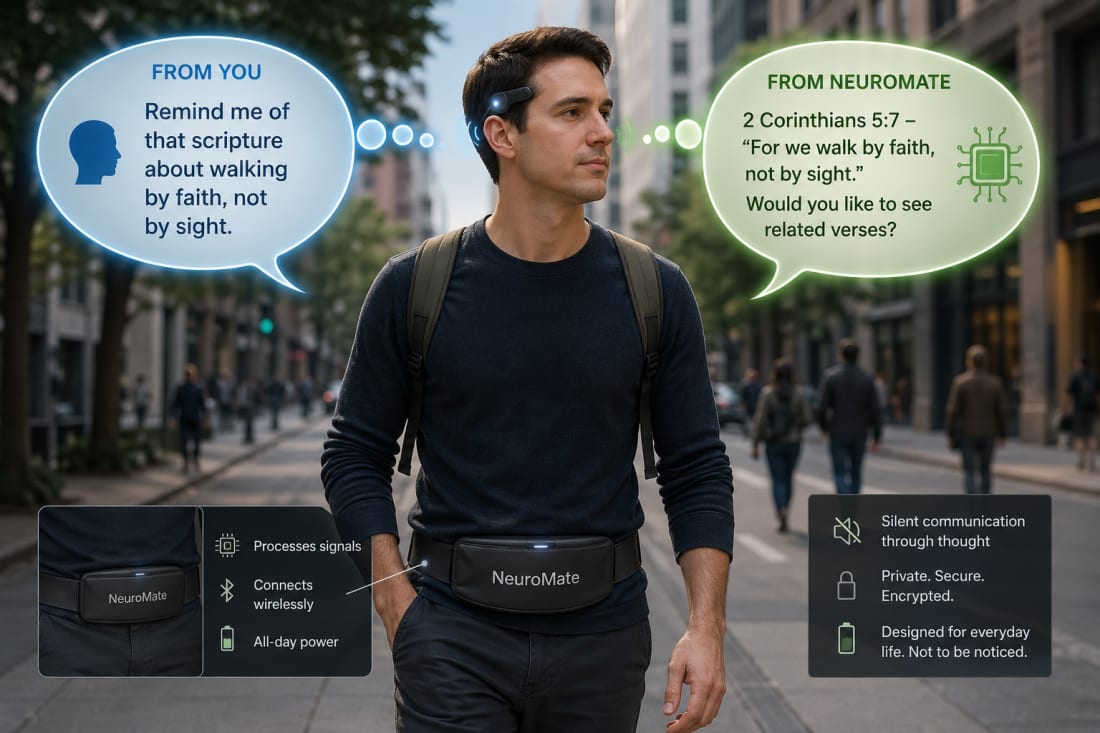
And it all starts with an implant in your brain connected to an AI device. It doesn’t have a name yet. But it will. I call it a NeuroMate.
At first, this won’t be invisible. The system will likely rely on a dedicated external device, such as a small wearable pack, headset, or medical unit, that handles the heavy computing.
The brain implant acts as the bridge, while the processing power remains just outside the body. Over time, that external piece will shrink, integrate, and become less noticeable, but it will still be there, quietly powering the connection.
The Two-Way Conversation
Most of us are used to “commanding” technology. We click a mouse or speak to a voice assistant. But the “merge” science is working on is different. It is bidirectional, meaning it’s a continuous loop:
Mind to Machine:
You don’t need to speak or type. The NeuroMate “listens” to the electrical firing of your neurons and translates your intent into action.
Machine to Mind:
This is the game-changer. The computer sends signals back. It’s not a voice in your ear. It’s a pulse of data your brain may perceive as a vision, a memory, or a sudden “knowing.”
This is not a one-way command. It is a feedback loop, brain to AI to brain again, unfolding in real time.
Why “Merge” Is the Only Word That Fits
We often say we “connect” to the internet, but you can always disconnect. A merge implies something deeper.
Science Corp is experimenting with “biohybrid” technology, interfaces that use living cells to knit the computer into your brain’s gray matter. When your biological neurons and the AI’s digital processors begin working together, the NeuroMate is no longer just a tool you use.
It becomes part of how you think, see, and interact with the world.
Life with a NeuroMate
Imagine a blind person “seeing” because a camera is feeding images directly into their visual cortex. Imagine someone who has lost the ability to speak, “thinking” a sentence and having it appear instantly on a screen.
Now bring it closer to home.
Imagine recalling any passage of Scripture at a moment’s notice. Not by flipping pages or searching an app, but because the words are immediately present in your mind. A verse you struggle to remember comes to mind instantly. Related passages connect themselves. Themes across the Bible unfold in real time as you speak or reflect.
The words are not stored in your brain like a file, but they are never out of reach.
Eventually, for the rest of us, it could mean solving complex problems with an AI partner that works alongside our thoughts in real time, or accessing knowledge as naturally as remembering a name.
We are standing at the dawn of something new, not a replacement of humanity, but a transformation in how humans think and interact with the world.
A person who is never truly alone in thought, because their NeuroMate is always there, always listening, always responding.
How Should Christians Respond to This Technology?
The rise of the NeuroMate doesn’t demand a simple answer. It calls for careful discernment.
There is little question that technology like this could be used for good. Restoring sight to the blind, helping the paralyzed communicate, or assisting those suffering from neurological disease reflects a long tradition of using human knowledge to relieve suffering.
But this technology does not stop at healing.
For the first time, we are looking at systems that may not only read the human mind, but also send signals back into it. That raises deeper questions, not just about what we can do, but about what we should allow.
Scripture emphasizes the importance of the mind and heart. The call is not only to think, but to guard what shapes our thinking. When a machine becomes part of the feedback loop of thought itself, Christians must ask:
Who is influencing the mind?
Who controls the system?
What happens to discernment when knowledge becomes instant?
Even something that sounds beneficial, like recalling Scripture at a moment’s notice, comes with a tension. There is a difference between having access to the Word and having it written on the heart.
Technology can assist. It can amplify. But it cannot replace spiritual formation, conviction, or wisdom.
So the question is not whether this technology will arrive. It is already on its way.
The question is whether we will approach it with clarity, caution, and conviction, or simply accept it because it is new and powerful.
Christians have faced moments like this before, where new tools promised convenience but carried deeper consequences.
This may be one of those moments again.
Martin Mawyer is the founder of the Digital Intelligence Project and the President of Christian Action Network. He is the host of the “Shout Out Patriots” podcast, and author of When Evil Stops Hiding. For more action alerts, cultural commentary, and real-world campaigns defending faith, family, and freedom, subscribe to Patriot Majority Report.
| ||||||||||


