In 1934, the government executed a legal maneuver that transferred billions in wealth overnight.
Most Americans had no idea it was coming.
A small group who saw it early walked away wealthy.
Everyone else paid for it.
Trump has the same legal authority today. Advisors close to the administration believe he's considering using it. If he does, the transfer happens fast — and the window to be on the right side of it is already closing.
We put together a free report on exactly what this move is, why the timing points to now, and the one step ordinary Americans can take to position themselves before it happens.
It costs nothing. Takes 30 seconds to request.
The people who moved early in 1934 didn't have a warning.
You do.
 |
A Healthy Rebound Could Lie Ahead for UNH Shareholders
Submitted by Thomas Hughes. Originally Published: 4/21/2026.
Key Points
- UnitedHealth Group is on track for a business recovery and a stock price rebound that could add 50% or more to its stock price over time.
- Resumed buybacks signal management confidence in the growth, cash flow, and capital return outlook.
- Analysts signaled the bottom in this stock ahead of the Q1 release; the release confirmed it.
- Special Report: Elon Musk’s $1 Quadrillion AI IPO
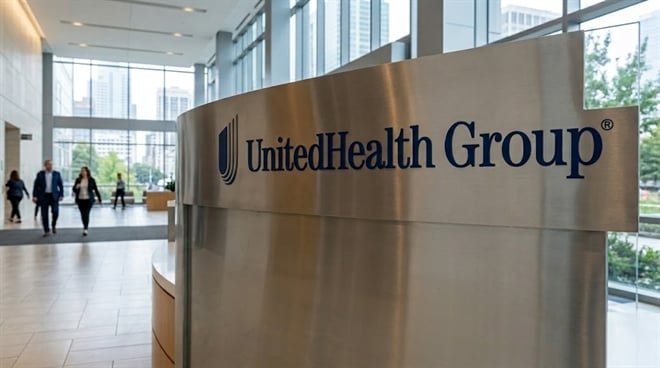
UnitedHealth (NYSE: UNH) faces hurdles, but the bottom appears to be in and a reversal is underway. Headwinds are easing, allowing the company to focus on what it does best: generating healthy cash flow from its insurance and industry-related services and returning capital to shareholders. The catalyst in late April was the company's Q1 2026 earnings release, which showed outperformance versus consensus forecasts. Management also provided stronger guidance and reinstated share buybacks.
UnitedHealth paused buybacks last year to shore up balance-sheet health amid uncertain conditions. The April update announced at least $2 billion in buybacks will be completed this quarter — roughly 0.65% of the company's market capitalization — with shares trading near long-term lows.
The SpaceX "Headfake" (Look here instead) (Ad)
When the SpaceX IPO launches, most investors will already be too late. The real opportunity isn't the IPO itself - it's the infrastructure behind it.
One small-cap company supplies a mission-critical component to Musk's xAI Colossus site that can't be built around. While retail waits for a ticker that doesn't exist yet, early money is moving into this supplier at a fraction of its potential value.
See the small-cap stock powering the SpaceX buildout todayThe pause in buybacks did not materially weaken shareholder leverage: FY2025 activity reduced the share count by an average of 0.9% in Q1 2026. The broader takeaway is that management's confidence in the business has improved and the outlook points to continued progress.
Balance-sheet metrics also show improvement, aided by divestitures. The sale of Optum UK trimmed obligations and helped reduce debt. Highlights include increases in cash, receivables, current and total assets, a decline in long-term debt, leverage sitting near the low end of the historical range, and equity rising nearly 400 basis points (bps).
These trends should support a robust capital-return profile going forward. UnitedHealth pays a substantial dividend in addition to repurchasing shares. The company distributes roughly 50% of its earnings outlook and has grown distributions at a double-digit compound annual rate over the past five years.
UnitedHealth Shares Advance Following Its Beat-and-Raise Quarter
UnitedHealth delivered a solid quarter, with strength in the UnitedHealth segment offsetting weakness in Optum. Net revenue of $111.72 billion rose 2% year-over-year and outpaced consensus by roughly 75 bps, driven by a 2.1% gain at UnitedHealth and a 3% decline at Optum. Importantly, the company logged margin improvement: a declining medical care cost ratio was only partially offset by higher operating costs tied to investments in growth, services, and efficiency — notably AI.
Key catalysts for the stock move included earnings that exceeded MarketBeat’s consensus by nearly 1000 basis points and firmer guidance. Management raised its adjusted earnings target to $18.25, above the $17.87 consensus; that target may even be conservative. The insurance industry is well suited to benefit from AI-driven efficiency, given its data-dependent operations and opportunities for automation across underwriting, claims and policy administration.
Analysts Put Bottom in UNH Stock Price Decline: Institutions Bought the Dip
MarketBeat data show that analysts began signaling a bottom for UNH ahead of the earnings release. Four April revisions were tracked prior to the report — two upgrades and two price-target increases — reinforcing the consensus ratings. The consensus of 28 analysts is a Moderate Buy, sentiment is strengthening, and the downtrend in revisions appears to have ended. That momentum is likely to continue into Q2 and the rest of the year as performance, cash flow, and capital returns keep sell-side interest alive.
Institutional investors, meanwhile, have been accumulating UNH at an aggressive pace, buying at nearly a $2-to-$1 ratio over the trailing five quarters compared with prior periods. Institutions now own nearly 90% of the stock, providing a solid support base and a likely tailwind heading into Q2.
The biggest near-term risk is technical: while the bottom appears to be in and the reversal is underway, UNH faces a meaningful resistance level. The baseline of a Double-Bottom pattern sits near $365 and may cap gains in the short term. If the market can clear that level — roughly in line with the consensus price target — a move into the low-$400s becomes more likely.
Future catalysts include margin recovery and further value realization. Management is focused on improving Optum margins, and the announced 2027 Medicare Advantage rate increase should be favorable to the bottom line. If UnitedHealth's operational improvements, cash flow generation, and capital returns continue, investors are likely to return, boosting valuation over time. After a recent pullback to about 18x this year’s outlook, the stock could appreciate meaningfully — potentially 50% in the near-to-mid term and several-fold over the long term.
3 Surprising S&P 500 Outperformers of 2026
Submitted by Ryan Hasson. Originally Published: 4/12/2026.

Key Points
- LyondellBasell, APA Corporation, and Valero Energy rank 11th, 14th, and 25th among the S&P 500's top-performers on the year, while the index sits close to flat.
- All three have been driven by the same catalyst: the U.S. and Israel's conflict with Iran, which sent oil prices surging.
- After their stellar runs, all three have pulled back sharply this week following ceasefire news, potentially offering investors a fresh entry point within each stock's broader uptrend.
- Special Report: Elon Musk’s $1 Quadrillion AI IPO
In recent years, when investors have considered market outperformance, many of the usual suspects have likely come to mind, such as AI stocks, semiconductor names, and mega-cap technology. For much of the past few years that's been the story. But 2026 has delivered something different so far. Many of the S&P 500's strongest performers year to date aren't tech companies — three in particular stand out. A refiner, a petrochemical giant, and an oil producer — Valero Energy (NYSE: VLO), LyondellBasell (NYSE: LYB), and APA Corporation (NASDAQ: APA) — rank 25th, 11th and 14th among S&P 500 performers year to date.
The common thread is the geopolitical shock triggered by the U.S. and Israel's conflict with Iran in late February, which sent oil prices surging and disrupted global supply chains. After a stellar run, all three leaders have recently pulled back significantly, potentially creating fresh momentum entry points for investors.
Valero Energy: The Refiner Built for This Moment
The SpaceX "Headfake" (Look here instead) (Ad)
When the SpaceX IPO launches, most investors will already be too late. The real opportunity isn't the IPO itself - it's the infrastructure behind it.
One small-cap company supplies a mission-critical component to Musk's xAI Colossus site that can't be built around. While retail waits for a ticker that doesn't exist yet, early money is moving into this supplier at a fraction of its potential value.
See the small-cap stock powering the SpaceX buildout todayValero Energy is one of the largest independent petroleum refiners and fuel producers in the world. The company operates across refining, renewable fuels, ethanol production and an extensive logistics network.
Historically the business has been overlooked in favor of producers and explorers higher up the energy supply chain. But in 2026, refiners have been among the market's most powerful trades, and Valero has led the way with about a 44% year-to-date gain, ranking as the 25th best-performing stock in the S&P 500.
The Iran conflict has been the primary catalyst. Disruptions to oil flows through the Strait of Hormuz tightened global refining capacity, pushing crack spreads higher and improving the economics of U.S.-based refiners like Valero that source feedstock domestically. The company had already demonstrated earnings power before the geopolitical tailwind arrived. In Q4 2025, Valero posted earnings per share of $3.82, beating the consensus estimate of $3.27 by 55 cents. Earnings are expected to grow nearly 32% in the coming year, to $10.45 per share. Institutional ownership stands at nearly 79%, with significant inflows over the prior 12 months, and the stock carries a 2% dividend yield. For investors seeking exposure to the refining giant, the recent roughly 9% pullback from its 52-week high could present a compelling opportunity if the uptrend holds.
LyondellBasell: The Petrochemical Winner Nobody Saw Coming
LyondellBasell is a global chemical company specializing in polyolefins and advanced polymers. After a significant decline in 2025 amid a prolonged industry downturn and negative earnings, the stock wasn't on most investors' radars. Yet it has surged nearly 66% year to date, ranking as the 11th-best-performing stock in the S&P 500.
With the conflict disrupting oil flows through the Strait of Hormuz, input costs have risen sharply for international petrochemical producers that rely on oil-based naphtha cracking. LYB, which uses low-cost North American natural gas liquids as feedstock, suddenly found itself with a meaningful competitive advantage.
Earnings are expected to grow about 26.15% in the coming year, from $6.31 to $7.96 per share, as the company targets more than $1 billion in cost savings by year-end. The recent cease-fire announcement prompted profit-taking, sending the stock down nearly 6%. If the stock can confirm a higher low within this uptrend, the pullback could turn into an attractive momentum entry point for one of the S&P 500's top performers this year.
APA Corporation: The Oil Producer Quietly Delivering
APA Corporation is an independent oil and gas exploration and production company with operations in the Permian Basin, Egypt and the North Sea. Like LYB, it wasn't generating much buzz at the start of the year, but its nearly 60% gain has made it the 14th-best-performing S&P 500 stock. The move has been driven by surging oil prices and operational improvements that largely flew under the radar.
APA generated over $1 billion in free cash flow in 2025 despite declining oil prices, cut annual costs by $300 million, and kept production roughly flat.
In its most recent earnings report, the company posted earnings per share of $0.91, beating the consensus estimate by $0.29. Like the other two names, APA pulled back after oil prices eased following the cease-fire announcement.
That pullback could offer an opportunity for investors who believe supply-chain disruptions won't be resolved overnight. The April 8 low of almost $35 would need to hold for the stock to confirm a higher low within its uptrend and keep its year-to-date momentum intact.
This email content is a sponsored email provided by American Alternative, a third-party advertiser of InsiderTrades.com and MarketBeat.
If you have questions about your newsletter, please contact our U.S. based support team at [email protected].
If you no longer wish to receive email from InsiderTrades.com, you can unsubscribe.
© 2006-2026 MarketBeat Media, LLC.
345 N Reid Place, Sixth Floor, Sioux Falls, S.D. 57103. USA..