Trump Admin to Pump $1 Billion into this "Off-the-Radar" AI Stock

The U.S. government pumped more than $1 billion into Intel. The stock popped 128%. It pumped $400 million into MP Materials. The stock popped 200%. It bought 10% of Trilogy Metals. The stock popped 500%. And now, Trump has chosen this AI stock for a $1 billion payday.
Click here for the full story and stock pick (free).
Alcoa Dips After Q1 Miss, But Higher Aluminum Prices Loom
Submitted by Thomas Hughes. Originally Published: 4/18/2026.
Key Points
- Alcoa's weak Q1 is explainable; the outlook is far more robust.
- Analysts and institutional trends reveal aggressive accumulation and limited downside risk.
- Market disruptions support supply/demand imbalances and favorable pricing for Alcoa products.
- Special Report: Elon Musk’s $1 Quadrillion AI IPO
Alcoa’s (NYSE: AA) fiscal Q1 2026 earnings fell short of the consensus on both the top and bottom lines. Still, the market appears to be looking past the quarter’s weakness toward stronger times ahead.
Seasonal Q1 factors, favorable demand trends and pricing point to accelerating growth, improving profitability and greater capacity for capital returns. While headwinds remain, demand trends suggest sustained growth: the aluminum market is expected to expand roughly 40% by 2030 and then maintain a modest single-digit compound annual growth rate through 2050.
The SpaceX "Headfake" (Look here instead) (Ad)
When the SpaceX IPO launches, most investors will already be too late. The real opportunity isn't the IPO itself - it's the infrastructure behind it.
One small-cap company supplies a mission-critical component to Musk's xAI Colossus site that can't be built around. While retail waits for a ticker that doesn't exist yet, early money is moving into this supplier at a fraction of its potential value.
See the small-cap stock powering the SpaceX buildout todayNear-term aluminum prices have been elevated owing to the conflict in Iran. Even if the fighting ends soon, the disruption and its aftereffects will persist. Global shipping has been disrupted and key smelters in Persian Gulf nations remain offline, with repairs likely to take time. In one UAE facility a forced shutdown left liquid aluminum in piping, which solidified and required extensive reconstruction. The best-case scenario is that the facility returns to production within a year, but longer delays are possible. The takeaway for investors: aluminum spot prices were at four‑year highs as of mid‑April and are not expected to drop sharply in the near term.
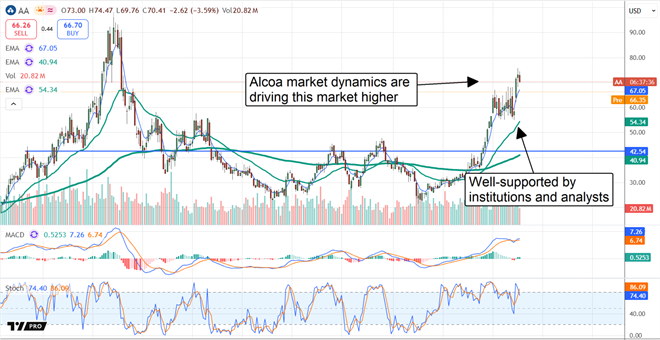
The spot price for aluminum is up more than 60% from 2025’s low and is on track to challenge record levels by year‑end. Analysts who had forecast an oversupply at the start of 2026 are reversing course and raising price targets amid tightening supply-demand dynamics. Deficits are now being cited, driven by sectors such as transportation, construction, packaging and electrical. Data centers are a notable contributor — they are expected to add more than 1 million tonnes of combined aluminum and copper demand by 2030, which alone could add over 130 basis points of incremental growth.
Analysts Respond Favorably to Alcoa’s Q1 Report—Buy the Dip
Analysts responded favorably to Alcoa’s report. The first notable update came from BMO Capital Markets, which reaffirmed its rating, maintained a Market Perform view and kept a $75 price target, characterizing the Q1 miss as explainable and forecasting stronger Q2 results. The core of BMO’s argument is that aluminum pricing is working in Alcoa’s favor.
Subsequent analyst notes track with broader trends: a consensus Hold based on 12 ratings but with a bullish tilt — about 41% of ratings are Buy — and an upward move in price targets. The consensus target, while lagging as of mid‑April, offers a floor in the low‑$60s and had risen more than 20% in the month before the report. High‑end targets are consistent with trading near record highs.
Institutional investors are likely buyers when Alcoa’s price dips. MarketBeat data show institutions own about 85% of the shares and have been net buyers over the trailing 12 months (TTM). Net buying has run at approximately $4 purchased for every $1 sold, providing a meaningful tailwind for the stock, with accumulation accelerating to multi‑year highs in Q4 2025 and Q1 2026. Given that backdrop, downside appears limited, with a technical floor in the $60–$65 area that aligns with analyst consensus.
Alcoa Market Pulls Back to Touch Base With Reality: Higher Prices Ahead
Alcoa’s share price fell after the Q1 release, suggesting a near‑term top. That peak is likely a short‑term hurdle that could be cleared by mid‑year or soon after. Until then, a deeper pullback is possible, but support is likely in the $60–$65 range. A drop below $60 would be bearish, though not necessarily a deal‑breaker given the early‑2026 trading range and the stock’s 150‑day exponential moving average; those indicators put a critical support level as low as $54.50 and show support strengthening.
If the price moves into that support range, it should provoke a strong market response — the main uncertainty is how far the market will drive the share price before committing to a trade.
Key catalysts include restarts and cost reductions. Alcoa’s Q1 results were affected by routine seasonal shutdowns and the restart of its San Ciprián facility. San Ciprián is not expected to be cash‑flow neutral until 2027, but its restart should help lower aluminum production costs across the network and improve results in 2026. The main risk for investors is Alcoa’s elevated volatility: the company’s beta is about 1.7, indicating higher than average market sensitivity.
ServiceNow's 18% Drop: AI Fears Continue, But May Be Overblown
Submitted by Leo Miller. Originally Published: 4/24/2026.

Key Points
- ServiceNow has seen several large swings in its share price during 2026 as investors weigh how AI will ultimately affect the company.
- ServiceNow's results were solid, with markets likely overreacting to mixed guidance.
- Analysts continue to eye a large recovery despite lowering targets.
- Special Report: Elon Musk’s $1 Quadrillion AI IPO
Over the past several months, software giant ServiceNow (NYSE: NOW) has been one of the most hotly debated tech stocks in the market.
This is evident from the significant swings in NOW’s share price. After ending 2025 near $150, shares fell to $100 by early February, recovered to nearly $125 a month later, dropped below $85 by early April, and then climbed back above $100 in the following two weeks.
The SpaceX "Headfake" (Look here instead) (Ad)
When the SpaceX IPO launches, most investors will already be too late. The real opportunity isn't the IPO itself - it's the infrastructure behind it.
One small-cap company supplies a mission-critical component to Musk's xAI Colossus site that can't be built around. While retail waits for a ticker that doesn't exist yet, early money is moving into this supplier at a fraction of its potential value.
See the small-cap stock powering the SpaceX buildout todayServiceNow fell sharply after its latest earnings report, plunging roughly 18% in a single day to around $85.
The stock’s up-and-down trading in 2026 largely stems from one debate: how artificial intelligence (AI) tools will affect the growth outlook for incumbent software companies. Given what’s known about this company, here’s where ServiceNow stands.
Understanding ServiceNow’s Volatility: The AI Debate
The rising capabilities and popularity of AI tools have driven much of ServiceNow’s volatility. Many investors worry that a lower barrier to entry for coding will harm incumbent software vendors, as customers could build internally what they previously outsourced to platforms like ServiceNow. AI agents could also automate tasks that today rely on ServiceNow’s products.
Some investors are selling the stock based on this fear; others buy the dips, believing the concern is overblown. Those opposing views explain a large share of the volatility. The ongoing conflict in the Middle East — which has increased marketwide uncertainty — is another meaningful factor affecting NOW.
With AI evolving rapidly, it’s hard to know which view will prevail. But looking at ServiceNow’s fundamentals helps assess whether the market may be pricing in too much pessimism.
Puts and Takes: ServiceNow Beats, But Organic Growth Outlook Faces Scrutiny
In its latest quarter, ServiceNow delivered another set of solid results. Revenue was $3.77 billion, up about 22% year over year — consistent with the company’s growth over the past two years — and slightly above estimates of $3.75 billion. Adjusted earnings per share were $0.97, a 20% year-over-year increase and in line with expectations.
The company reported an operating margin of 32%, 50 basis points higher than guidance, driven in part by AI-related expense efficiencies.
ServiceNow nudged up its guidance, but its organic growth outlook was essentially unchanged. The firm raised the midpoint of full-year subscription guidance by $205 million to $15.775 billion; nearly all of that increment reflects the recently closed acquisition of Armis, which will contribute roughly 125 basis points of growth during the year.
Management also baked some caution into the outlook because of uncertainty related to the Middle East. That appears reasonable: delays in Middle Eastern deals were a 75-basis-point headwind to Q1 growth.
The company trimmed margin guidance to reflect Armis integration. It now expects full-year operating margin of 31.5% and a free cash flow margin of 35% — 50 and 100 basis points lower than prior guidance, respectively. That adjustment is unsurprising, since earlier guidance did not include Armis and acquisitions typically carry integration costs.
Analysts Eye Big-Time Upside After ServiceNow’s Fall
ServiceNow also continues to see momentum in its AI offerings. The number of customers spending $1 million or more in annual contract value (ACV) on its Now Assist platform rose 130% year over year. Management said the company’s target to exceed $1 billion in Now Assist ACV for 2026 may have been conservative: “We might have understated that a little bit. We're already talking about $1.5 billion now.”
ServiceNow believes corporate spending on AI labs is largely incremental rather than cannibalistic. As management put it, “customers are spending a lot on AI, but that is incremental. It is not replacing what they're spending on us.” Given the company’s strong growth to date, that appears to be true for now.
The company also emphasized how its recent AI-related acquisitions will bolster its offerings. ServiceNow said, “We just got them, and we're building out the story with them, and they're going to set the world on fire with reaccelerating revenue growth.”
After the selloff, ServiceNow shares trade at levels that require relatively modest long-term growth to justify the price. The market appears to be pricing a scenario in which AI has a significantly negative net impact on the company. With AI fears elevated, the stock’s post-earnings move felt more panic-driven than justified; near $85, NOW’s risk/reward profile looks skewed to the upside over the long term.
Despite many analysts lowering targets post-earnings, sentiment remains broadly bullish. The average of price targets updated after the results is about $145, implying more than 65% upside — only slightly below the MarketBeat consensus price target near $150. Still, AI-related concerns are likely to keep near-term volatility elevated.
This email content is a sponsored email from InvestorPlace, a third-party advertiser of MarketBeat. Why did I receive this email message?.
This ad is sent on behalf of InvestorPlace Media at 1125 N. Charles Street, Baltimore, Maryland 21201. If you're not interested in this opportunity, please click here.
If you have questions or concerns about your newsletter, feel free to contact our South Dakota based support team at [email protected].
If you would no longer like to receive promotional emails from MarketBeat advertisers, you can unsubscribe or manage your mailing preferences here.
Copyright 2006-2026 MarketBeat Media, LLC. All rights protected.
345 North Reid Place, Sixth Floor, Sioux Falls, South Dakota 57103-7078. United States..