
Email
MDAA Alert: "Operation True Promise IV": Iran’s Missile and Drone Attack Campaign
| From | Riki Ellison, Missile Defense Advocacy Alliance <[email protected]> |
| Subject | MDAA Alert: "Operation True Promise IV": Iran’s Missile and Drone Attack Campaign |
| Date | April 24, 2026 8:43 PM |
Links have been removed from this email. Learn more in the FAQ.
Links have been removed from this email. Learn more in the FAQ.
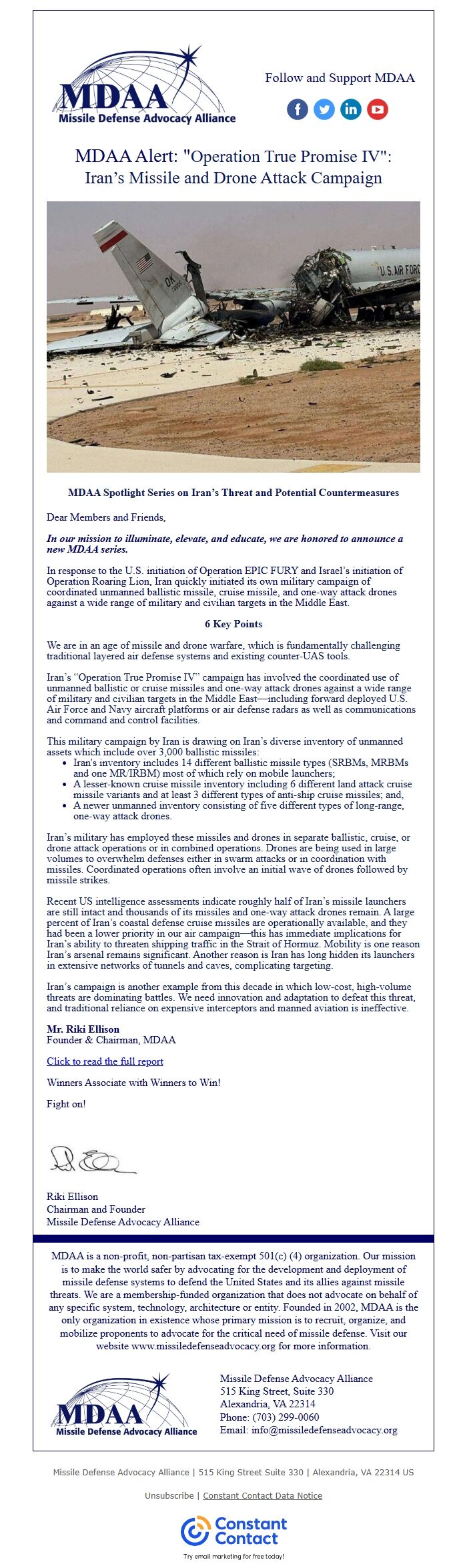
Email from April 24th, 2026 Follow and Support MDAA MDAA Alert: "Operation True Promise IV": Iran’s Missile and Drone Attack Campaign MDAA Spotlight Series on Iran’s Threat and Potential Countermeasures Dear Members and Friends, In our mission to illuminate, elevate, and educate, we are honored to announce a new MDAA series. In response to the U.S. initiation of Operation EPIC FURY and Israel’s initiation of Operation Roaring Lion, Iran quickly initiated its own military campaign of coordinated unmanned ballistic missile, cruise missile, and one-way attack drones against a wide range of military and civilian targets in the Middle East. 6 Key Points We are in an age of missile and drone warfare, which is fundamentally challenging traditional layered air defense systems and existing counter-UAS tools. Iran’s “Operation True Promise IV” campaign has involved the coordinated use of unmanned ballistic or cruise missiles and one-way attack drones against a wide range of military and civilian targets in the Middle East—including forward deployed U.S. Air Force and Navy aircraft platforms or air defense radars as well as communications and command and control facilities. This military campaign by Iran is drawing on Iran’s diverse inventory of unmanned assets which include over 3,000 ballistic missiles: Iran's inventory includes 14 different ballistic missile types (SRBMs, MRBMs and one MR/IRBM) most of which rely on mobile launchers; A lesser-known cruise missile inventory including 6 different land attack cruise missile variants and at least 3 different types of anti-ship cruise missiles; and, A newer unmanned inventory consisting of five different types of long-range, one-way attack drones. Iran’s military has employed these missiles and drones in separate ballistic, cruise, or drone attack operations or in combined operations. Drones are being used in large volumes to overwhelm defenses either in swarm attacks or in coordination with missiles. Coordinated operations often involve an initial wave of drones followed by missile strikes. Recent US intelligence assessments indicate roughly half of Iran’s missile launchers are still intact and thousands of its missiles and one-way attack drones remain. A large percent of Iran’s coastal defense cruise missiles are operationally available, and they had been a lower priority in our air campaign—this has immediate implications for Iran’s ability to threaten shipping traffic in the Strait of Hormuz. Mobility is one reason Iran’s arsenal remains significant. Another reason is Iran has long hidden its launchers in extensive networks of tunnels and caves, complicating targeting. Iran’s campaign is another example from this decade in which low-cost, high-volume threats are dominating battles. We need innovation and adaptation to defeat this threat, and traditional reliance on expensive interceptors and manned aviation is ineffective. Mr. Riki Ellison Founder & Chairman, MDAA Click to read the full report Winners Associate with Winners to Win! Fight on! Riki Ellison Chairman and Founder Missile Defense Advocacy Alliance MDAA is a non-profit, non-partisan tax-exempt 501(c) (4) organization. Our mission is to make the world safer by advocating for the development and deployment of missile defense systems to defend the United States and its allies against missile threats. We are a membership-funded organization that does not advocate on behalf of any specific system, technology, architecture or entity. Founded in 2002, MDAA is the only organization in existence whose primary mission is to recruit, organize, and mobilize proponents to advocate for the critical need of missile defense. Visit our website www.missiledefenseadvocacy.org for more information. Missile Defense Advocacy Alliance 515 King Street, Suite 330 Alexandria, VA 22314 Phone: (703) 299-0060 Email: [email protected] Missile Defense Advocacy Alliance | 515 King Street Suite 330 | Alexandria, VA 22314 US Unsubscribe | Constant Contact Data Notice
Message Analysis
- Sender: Missile Defense Advocacy Alliance
- Political Party: n/a
- Country: United States
- State/Locality: n/a
- Office: n/a