Nobody Understands Why Trump Is Invading Iran (here’s the answer) 
Sell-Side Support Lifts RTX in 2026: 20% Upside Indicated
Written by Thomas Hughes on April 22, 2026
Key Points
- RTX pulled back following the Q1 release, with tepid guidance that forecast growth and margin strength.
- Analysts and institutions are accumulating this stock.
- New contracts and a growing backlog suggest outperformance is likely in upcoming quarters.
- Special Report: Elon Unveils AI Passive Income Stream for Millions of Americans

RTX (NYSE: RTX) stock price has headwinds and hurdles in 2026, but analysts and institutional support, nor demand for its product, are not among them. The primary headwind, more of a missing tailwind, was the pause in buyback activity following a January 2026 executive order from President Trump that restricts share repurchases and dividends at defense contractors identified as underperforming on military contracts. RTX was specifically named in connection with the order.
That has led to an increasing share count, but the increases are minimal given the business growth, balance sheet health, and capacity to make dividend payments.
Dividends are still on the table and yielding about 1.4% with shares near April 2026 highs. The payout is tepid relative to the broad market, just above average, but financial metrics say it is reliable and expected to increase over time. The payout ratio runs just above 50% of the earnings, earnings are growing, and there is ample evidence to suggest the trend will continue. The primary factor is the history, which includes five consecutive annual increases and a high single-digit compound annual growth rate. The risk is that RTX will either fall behind or outrun the budget on defense contracts, triggering Trump’s ire.
For a moment…
Forget about Trump’s ties to Israel.
Forget about reports of Iran’s nuclear program.
Because my research has led me to believe we’re risking World War 3 with Iran for a completely different reason. Click here to find out what it is. Bullish Analysts Trends Support RTX Stock Price Advance
RTX’s analyst trends are not robustly bullish but reflect a solid support base that is accumulating shares. The 22 analysts tracked by MarketBeat peg the stock at Moderate Buy. Analyst coverage is rising, and price targets are rising as well.
The consensus in late April calls for about 8% upside, while the more recent updates point to the high-end range. Those recent updates would put this stock near $240, about 20% upside relative to critical support targets, and the trends are expected to continue. While the guidance update fell short of the consensus, it reflects a strong trajectory, ample free cash flow, and is likely to be cautious.
Institutional activity is equally bullish. This group owns about 87% of the stock and has aggressively accumulated in 2026. Institutions bought at a $2-to-$1 pace in Q1 2026, extending the trend and accelerating the pace in early Q2. The likely outcome is that they continue accumulating as Q2 progresses, limiting downside risk until the market regains traction. As it stands, the critical support level is near the 2026 lows around $190. Short interest is not a significant factor for this market, as it has fallen from the 2024 peak to about 1%.
RTX Stock Price Sets Up for Its Next Big Move
RTX stock price action reflects a market top, so there is substantial risk the sell-off will deepen. However, with support evident at the $190 level, the risk is mitigated, making consolidation within the now-established trading range more likely. In this scenario, price action may move sideways within the range until another catalyst drives action and a technical trigger is in place.
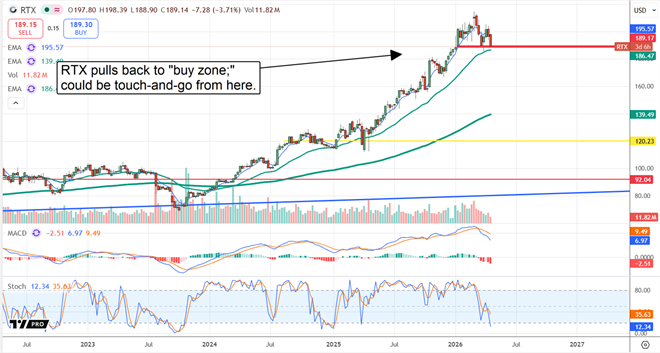
The short-term 30-day exponential moving average (EMA) is rising sharply and connecting with price action, underpinning support at the $190 level. This EMA reflects short-term trading activity, which appears very bullish. Assuming the market advances with the EMA to support it, a move to the range top can occur very quickly. Other signs that the bottom is near include stochastic and MACD, which signal the market is nearing oversold conditions, and bearish momentum aligns with the trend.
The mainstream explanation for the Iran airstrikes may not be the full story. Addison Wiggin, Founder of Grey Swan Investment Fraternity, says there's a deeper motive behind the bombing campaign that most coverage is ignoring.
If you're making investment decisions based on what you're hearing in the news, Wiggin argues you could be working with an incomplete picture. Read Addison Wiggin's full breakdown of the real Iran story RTX Buzzes Into Buyzone Following Strong Q1 Release
RTX had a solid Q1, with strength in all segments driven by commercial and defense-related demand. The $22.1 billion in net revenue increased by nearly 9%, outpacing consensus by nearly 300 bps, with Pratt & Whitney leading the charge. Pratt & Whitney grew by 11%, Raytheon by 10%, and Collins Aerospace by 5%, all of which contributed to margin strength. Margin is the real news, as numerous improvements were logged, resulting in a 22% adjusted net income growth, 21% adjusted earnings per share growth, and 65% free cash flow growth.
Guidance is the headwind that triggered the post-release price pullback. The company guided well, increasing the outlook for revenue and earnings, but fell short of the consensus. The critical detail is that backlog is swelling, up to $271 million or more than 10 quarters' revenue at the Q1 pace. This suggests that execution is the only factor between guidance and outperformance, and that execution is the focus. Among the company’s primary focuses is the backlog, improving throughput, investment and R&D.
The biggest risk for investors is the valuation. Trading above 28X earnings as of early Q2 2026, the stock is at the high end of its range and pricing in a solid growth outlook. In this environment, execution is critical; delays, misteps, or fumbles will be reflected in the stock price.
Read this article online ›
Read More

Did you find this article useful?
 
|