Trump officials planned to let artificial intelligence software developed by one of Elon Musk’s deregulatory foot soldiers undertake “regulation extermination” and even write new federal statutes, according to newly released government documents reviewed exclusively by the Lever.
The documents reveal for the first time how the AI program was pitched to government employees and trained to target certain regulations to boost President Donald Trump’s pro-business deregulation agenda.
According to the records, “SweetREX,” an AI tool developed by a Musk acolyte, was programmed to identify and eliminate rules that imposed costs on private enterprises, limited business innovation, or used race-based classifications, among other criteria. Using such parameters for guidance, the program could also process more than a hundred thousand public comments in less than half an hour.
“The documents reveal, for the first time, the shortcuts this AI tool takes when deciding whether a regulation is legally required and whether its burdens outweigh benefits to the public,” said Daniel McGrath, senior oversight counsel at the legal advocacy group Democracy Forward, which obtained the records through a Freedom of Information Act request.
The new documents detail how SweetREX was pitched to government officials. It is not clear whether staffers went on to use SweetREX during its government-purge operations over the past year or, if they did, whether they tested or evaluated the program to ensure it wasn’t making mistakes.
The Department of Government Efficiency (DOGE), which was devised and then run by tech billionaire and Trump supporter Musk from January to May 2025, claims to have cut $215 billion in government costs through administrative downsizing, contract cancellations, and the elimination of hundreds of thousands of jobs. Along with consuming gargantuan amounts of electricity and water, AI has a history of making poor regulatory decisions with disastrous effects on people’s lives.
The documents show how SweetREX, an AI program developed by University of Chicago undergrad-turned-DOGE staffer Christopher Sweet, was pitched to Department of Housing and Urban Development employees last year as an “AI solution for regulation extermination.”
“The deregulation goal is to eliminate any regulatory provisions that may represent potential overreach or impose unnecessary burdens beyond what Congress has legislated,” the documents state.
According to a slideshow deck in the documents, SweetREX could quickly identify which statutes “you want eliminated,” draft notices of proposed rulemaking (NPRMs) related to the resulting government cuts, read and organize potentially “hundreds of thousands” of public comments submitted in response to those cuts, and draft final rules.
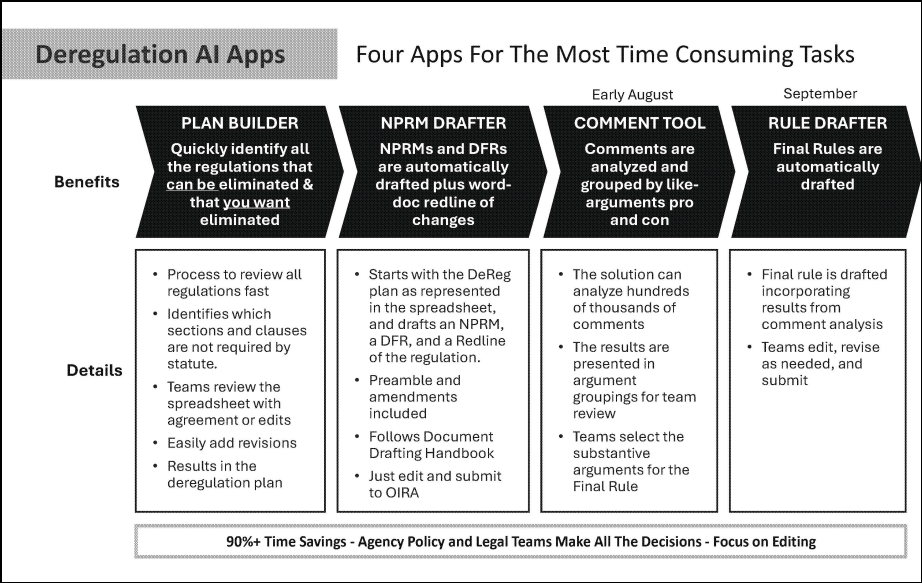
Doing so, promised SweetREX’s promoters, would cut “average hours required per regulatory section” from thirty-six hours to less than three.
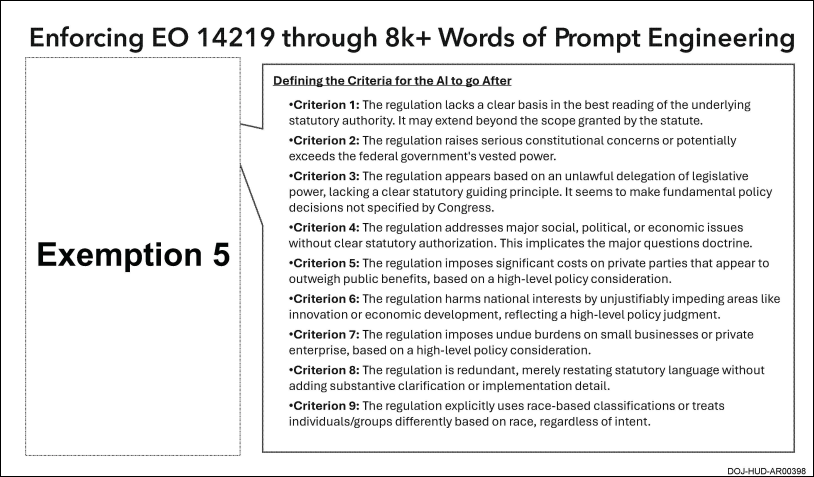
According to the pitch deck, SweetREX would identify regulations to eliminate based on nine different criteria, such as whether the rule raises constitutional concerns, was based on unlawful delegation of legislative power, poses high costs on private interests, limits economic development, places undue burdens on business, or “treats individuals/groups differently based on race.”
SweetREX’s promoters claimed that it could help agencies comply with Trump’s multiple executive orders mandating deregulation across departments, such as gutting environmental regulations for fossil fuel companies. The AI documents also claimed that SweetREX software could provide “evidence-backed flags [to] protect you in court.”
News that SweetREX was being developed to help slash government regulations first emerged last August. In October 2025, Democracy Forward sued multiple federal agencies to compel them to release documents detailing how they used AI to achieve Trump’s deregulatory goals.
The documents reported here are a result of that lawsuit.
This article was first published by the Lever, an award-winning independent investigative newsroom.
Freddy Brewster is a reporter with the Lever. He has been published in the Los Angeles Times, NBC News, CalMatters, the Lost Coast Outpost, and more.
Luke Goldstein is a reporter with the Lever. He is an investigative journalist based in Washington, DC, who was most recently a writing fellow at the American Prospect and was with the Open Markets Institute before that.


