A NASDAQ-listed stock is beginning to show subtle signs of a possible breakout within the next 21 days.
The movement is still under the radar. According to a research associate at Wealth Creation Investing, most traders have not picked up on it yet.
Details are limited for now, but the early indicators are enough to warrant a closer look.
You can review the full research by requesting access here.
Best,
The Wealth Creation Investing Team
By following the link above you're choosing to opt in to receive insightful updates from Wealth Creation Investing + 2 free bonus subscriptions! Your privacy is important to us. You can unsubscribe anytime. See our privacy policy for details.
Up 775% in 5 Months, How Much Higher Can Syntec Optics Go?
Authored by Thomas Hughes. Publication Date: 4/21/2026.
Key Points
- Syntec Optics is in the midst of a transition to commercial production, and it's reflected in the stock price action.
- Risks include insider ownership and tepid sell-side interest, with the CEO owning more than 80% of the shares.
- A move to new highs would confirm a pivot ad likely eading to another $9 price increase.
- Special Report: Have $500? Invest in Elon’s AI Masterplan
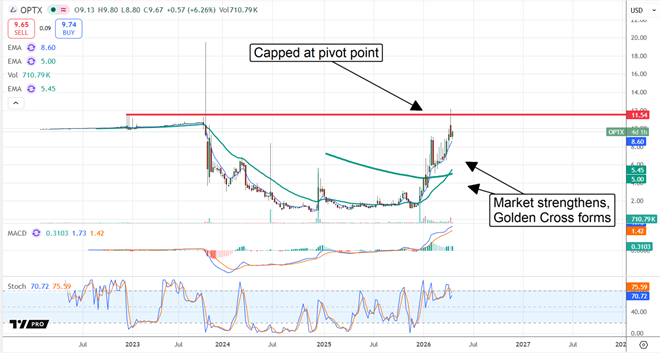
Syntec Optics (NASDAQ: OPTX) has become a favorite of equity speculators, with its share price rising about 775% since late 2025. Given the current technical setup and potential growth drivers, the stock could continue climbing and may post another large, triple‑digit gain over time. The key question is whether the market has enough momentum to clear a critical threshold.
Altucher: This is My Favorite FREE Starlink Pre-IPO Ticker (Ad)
In the next 3 minutes…
James Altucher – legendary investor and venture capitalist…
And someone who’s known for playing his cards “close to the vest”…
Is going to give you the name and ticker symbol of a company he believes will skyrocket thanks to the coming Starlink IPO…
Click here to watch this short 3-minute video now.That threshold is $11.54, a resistance level that has been in place since the IPO/SPAC merger. Given the prolonged overhang at that price and recent price action, it is likely to be a significant hurdle — but not an insurmountable one. For a breakout above $11.54 to be sustained will require a meaningful shift in market dynamics, which could arrive as upcoming catalysts materialize. Until then, the risk of a sharp pullback remains elevated.
If the stock does set a fresh high, the typical upside projection is the height of the trading range. In this case that magnitude is roughly $9, which the piece characterizes as a likely upside move — an increase that would put the stock well above prior levels and establish a new all‑time high. Factors supporting that scenario include newly established support near $9, heavier trading volume, and a bullish exponential moving average (EMA) crossover — a classic Golden Cross that signals a change in trend.
Syntec Optics Is Turning a Corner
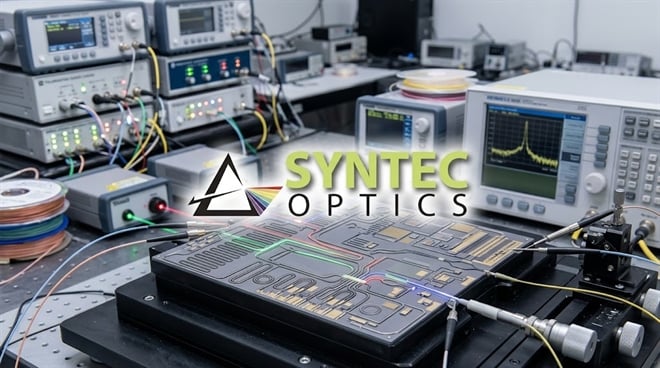
Syntec Optics is an emerging technology company focused on integrated optics and photonics components for multiple end markets. The primary catalyst this year is the company’s planned shift to commercialized production, supported by government contracts and accelerating demand.
Its technical edge centers on polymer‑based optics and related manufacturing capabilities. Polymer optics enable lighter, higher‑performance products that are attractive for defense, industrial, and healthcare applications.
Syntec is also NDAA‑compliant and manufactures in New York, with capacity expansions underway to meet growing demand. The company is already generating revenue and is forecasting growth for the first time in years, driven by next‑generation opportunities in data centers, AI, defense, and space. Tailwinds include onshoring of U.S. and defense supply chains and new product initiatives targeting datacenter and AI customers.
Demand for low‑Earth‑orbit satellites is ramping and is expected to remain strong. The much‑anticipated SpaceX IPO is likely to further energize the sector, increasing launch cadence and institutional interest, which should boost capitalization across adjacent industries — including optical and photonic equipment.
Syntec Holdings Comes With Considerable Insider Risk
One of the main risks with OPTX is insider concentration: CEO Al Kapoor controls more than 80% of the shares. That creates a low‑float situation and the potential for a large sale if insiders elect to liquidate positions, particularly as the stock approaches long‑term highs. To date, insiders have not registered significant sales, but the prospect of future selling could attract short sellers; currently, short interest is not a dominant force.
Two market forces that could offset insider overhang — analyst coverage and institutional ownership — have only begun to engage. MarketBeat tracks a single analyst on OPTX (Weiss Ratings, which rates the stock a Sell), and institutional holdings remain under 2% of shares outstanding. Institutional interest has been rising, with asset managers such as Vanguard and BlackRock appearing among holders, but total institutional ownership is still low, leaving the stock vulnerable to volatile moves on news.
Cash flow is another risk: the company is currently cash‑flow negative. That said, Syntec reported a relatively healthy balance sheet for a small cap, with enough runway to continue operations. Fiscal year 2025 highlights include reduced cash balances offset by higher receivables and inventory, lower long‑term debt and total liabilities, and modest leverage (long‑term debt near 0.35× equity). Dilution has been limited so far — FY2025 dilution impacted shareholder value by roughly 70 basis points.
The next clear catalyst is the Q1 2026 earnings report, expected in late June or early July. Management has guided for a seasonal slowdown in Q1 followed by a pickup in Q2, but the company could outpace guidance or announce new customers, contracts, or orders that would materially change the outlook.
3 ETFs to Benefit From Oil Price Surge Without Direct Investment
Written by Nathan Reiff. Originally Published: 4/18/2026.

Key Points
- The price of oil is back down compared to earlier in the Iran war, but volatility still remains a dominating factor.
- Investors keen to reap the benefits of this turbulence but not interested in investing directly in oil futures might turn to oil infrastructure and services ETFs.
- Funds like PXJ, IEZ, and XES track shares of companies involved in the oil industry without being directly linked to oil itself or to producers.
- Special Report: Have $500? Invest in Elon’s AI Masterplan
Though near-term pressures from the Iran war appear to be easing, 2026 has shown how quickly and dramatically oil prices can fluctuate. Crude oil futures that started the year around $60 quickly spiked to more than $112 in early April before pulling back to around $90 as of mid-month. The volatility means some skittish investors will run for safer plays, but it also presents an opportunity for those willing to take on a bit more risk.
Investing in oil can be complicated, particularly for those without prior experience. One way to control exposure and avoid a direct investment in the commodity is through exchange-traded funds (ETFs), which can be structured to benefit from rising oil prices while taking many of the details out of the hands of individual investors. Another step removed from oil itself is to choose funds that target oil-adjacent stocks, including equipment and infrastructure providers and servicers.
A 20-Year-Old Fund With Outsized Returns and Dividends
Altucher: This is My Favorite FREE Starlink Pre-IPO Ticker (Ad)
In the next 3 minutes…
James Altucher – legendary investor and venture capitalist…
And someone who’s known for playing his cards “close to the vest”…
Is going to give you the name and ticker symbol of a company he believes will skyrocket thanks to the coming Starlink IPO…
Click here to watch this short 3-minute video now.The Invesco Dynamic Oil & Gas Services ETF (NYSEARCA: PXJ) focuses on domestic oil services companies and holds a portfolio of about 30 names in this niche industry. One of the biggest holdings at close to 5.4% of the portfolio—Halliburton Co. (NYSE: HAL)—is likely one of the few companies in the basket familiar to investors without an energy-sector background. The firms in the fund enable domestic oil production and are essential to the transport and storage of oil products across the country.
PXJ is a fairly early entrant to the ETF space, with more than 20 years of trading history. Its targeted focus means it has a relatively small asset base of $121 million and a one-month average trading volume of about 93,000 shares.
Its year-to-date (YTD) return of 40% and one-year return of more than 80% demonstrate how closely tied the share prices of these energy-industry companies are to the price of oil. A dividend yield of 2.2% also provides a nice boost to passive income. With a net expense ratio of 0.63%, however, this fund may be a bit pricey for many investors.
A Lower-Fee Alternative, But Be Mindful of Weighting
A cheaper alternative to PXJ is the iShares U.S. Oil Equipment & Services ETF (NYSEARCA: IEZ), which has a similar purview but a fee of just 0.38%. Like PXJ, it targets domestic oil equipment and services businesses, and its portfolio also contains roughly 30 stocks.
One key distinction between IEZ and PXJ is the weighting of the top holdings. PXJ distributes its assets more broadly, while the largest two positions in IEZ's basket—SLB Ltd. (NYSE: SLB) and Baker Hughes Co. (NASDAQ: BKR)—together make up about 45% of its investments. Concentrating so much in two companies can be risky, but it has contributed to strong performance: IEZ has returned more than 35% YTD and about 70% in the last 12 months. The fund also pays a dividend yield of 1.2%, which trails PXJ but remains attractive.
Lower Price Still, With Strong Returns, But a Lagging Dividend Yield
The SPDR S&P Oil & Gas Equipment & Services ETF (NYSEARCA: XES) is slightly cheaper than IEZ, with an annual fee of 0.35%. It uses an equal-weight approach across its nearly three dozen holdings, which means no single position accounts for more than about 4.5% of the invested assets. That makes it more similar to PXJ's broader distribution than to IEZ's concentration.
Besides the cost advantage over PXJ, XES also offers greater liquidity. The fund has nearly half a billion dollars in managed assets and a substantially higher one-month trading volume than PXJ. On top of that, it delivers strong returns—almost 40% YTD and roughly 90% over the last year.
Another distinction between XES and PXJ is dividend yield: XES yields about 1.2%. While this is a useful bonus on top of strong returns, it is lower than PXJ's yield. Investors seeking more passive income from an oil-infrastructure ETF might favor PXJ, while those prioritizing lower fees and greater liquidity may prefer XES. In any case, all three of these funds have solidly outperformed the broader market on both a year-to-date and one-year basis.
This email communication is a paid advertisement provided by Darwin, a third-party advertiser of DividendStocks.com and MarketBeat.
If you have questions about your newsletter, please don't hesitate to email our South Dakota based support team at [email protected].
If you no longer wish to receive email from DividendStocks.com, you can unsubscribe.
© 2006-2026 MarketBeat Media, LLC.
345 North Reid Place, Suite 620, Sioux Falls, South Dakota 57103. United States of America..