Jack Henry stock offers growth, recurring revenue, and expanding margins, but faces risks from merging banks and larger competitors in a... ͏ ͏ ͏ ͏ ͏ ͏ ͏ ͏ ͏ ͏ ͏ ͏ ͏ ͏ ͏ ͏ ͏ ͏ ͏ ͏ ͏ ͏ ͏ ͏ ͏ ͏ ͏ ͏ ͏ ͏ ͏ ͏ ͏ ͏ ͏ ͏ ͏ ͏ ͏ ͏ ͏ ͏ ͏ ͏ ͏ ͏ ͏ ͏ ͏ ͏ ͏ ͏ ͏ ͏ ͏ ͏ ͏ ͏ ͏ ͏ ͏ ͏ ͏ ͏ ͏ ͏ ͏ ͏ ͏ ͏ ͏ ͏ ͏ ͏ ͏ ͏ ͏ ͏ ͏ ͏ ͏ ͏ ͏ ͏ ͏ ͏ ͏ ͏ ͏ ͏ ͏ ͏ ͏ ͏ ͏ ͏ ͏ ͏ ͏ ͏ |
| | Written by Peter Frank 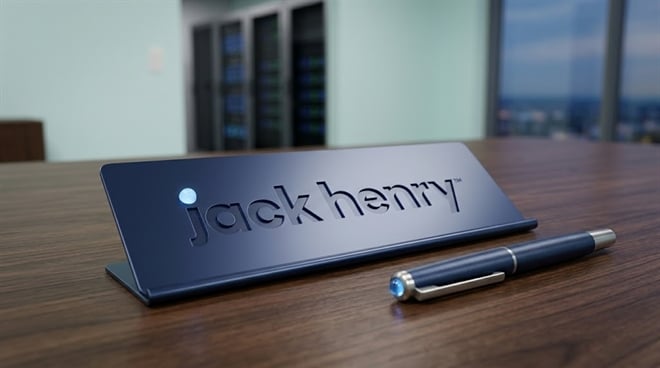
In the world of fintech, Jack Henry & Associates (NASDAQ: JKHY) is one of the oldest and most successful—and among the least talked about. While investors chase flashier names, the company quietly keeps about 7,400 community banks and credit unions running every day.
That’s the good news and the bad news. Switching providers is costly and disruptive for its clients, so Jack Henry has a revenue predictability that most fintechs can only imagine. But its clients are smaller banks and credit unions, each of which faces financial pressures and is more likely to merge or be acquired than other institutions.
For investors, the question is clear: Is the company’s story about its growth in revenue and earnings, recently above analyst expectations, or is it about the pressure on its clients, pulling down its stock price over the past several years? Or is it simply being left behind in favor of higher-risk, high-reward tech stocks?
Strength Lies in Deep Client IntegrationWhat’s not in question is that the company’s edge isn't from a blockbuster product launch or a brilliant new app. The depth of its integration into a bank’s daily operations is what keeps it going strong. When a community bank runs its core banking, payments, and digital channels on Jack Henry's platform, the software is woven into each transaction, customer record, and compliance report.
This grip on its client base shows up in the company's revenue mix. Recurring revenue from long-term contracts accounted for 92% of total sales in fiscal 2025, ended last June. On top of that is a growing cloud business, as cloud revenue accounted for about 32% of total revenue in fiscal 2025 and continues to grow.
Recurring Growth for a Recurring ProviderIts most recent report showed much of the impact. For its second fiscal quarter ended Dec. 31, Jack Henry reported revenue of $619.3 million, up 7.9% from a year earlier. Net income jumped 27.4% to $124.7 million, and earnings per share rose 29% to $1.72, beating analyst expectations by 29 cents.
That gap between growth in revenue and earnings came with an impressive jump in margins. Jack Henry's operating margin widened to 25.7%, up from 21.4% a year earlier. And free cash flow was even stronger, nearly doubling to $172 million in the first half of fiscal 2026, compared to $88 million in the year-ago period.
Although the company said at the time it expected year-over-year revenue growth to “slow slightly,” management raised its full-year fiscal 2026 guidance, targeting revenue of $2.508 to $2.525 billion. And despite the softer growth, the company is calling for earnings per share of $6.61 to $6.72, as others expect earnings to grow more than 7% for the year.
Wall Street Sees Upside Despite Recent DeclinesWall Street's view on Jack Henry is overall positive. The company's shares have been on an up-and-down run in recent years and are down nearly 20% in just the past three months.
In all, 14 analysts covering the company rate the stock an overall Moderate Buy, with 10 tagging it a Buy and four rating it a Hold. With a consensus price target of around $200.15, that’s a meaningful upside from recent levels in the mid-$150s. And though it’s lost much of its growth premium from the past, the company’s P/E ratio is now about 22X, down from the 30s, but stronger than many in the sector.
This is not a high-yield income stock, but it does offer a dividend that grows with the business. The company, which has consistently raised its dividend over the years, currently pays $2.44 per share annually, yielding roughly 1.6% at recent share prices. With free cash flow nearly doubling and a payout ratio that leaves substantial room for increases, investors might expect to see more of the same going forward.
Competition and Consolidation Create RisksDespite its history of a strong recurring business, though, Jack Henry does compete in a market that is in dominated by two larger rivals. Fiserv (NASDAQ) FISV) and Fidelity National Information Services (NYSE: FIS), both several times larger than Jack Henry, have each expanded their cloud platforms and are pursuing smaller banks.
Bank consolidation is an issue to watch. As one bank disappears, so does its business with Jack Henry. That is offset somewhat by a one-time "deconversion" fee, which management has said it expects to increase. Although the revenue bump is helpful, it signals a potential slow drain-off of important recurring business.
A Dependable Compounder for Patient InvestorsDespite the potential negatives, Jack Henry has been a textbook compounder. It is a dominant player in a niche that is not easily disrupted. Its recurring revenue dominates. Its margins are expanding. And its free cash flow is growing.
If its revenue and earnings stay the course, and if its P/E has not fully priced in any near-term advances, the consensus $200 target becomes quite attractive. Or for patient investors, a dependable compounder might fit well in your plans.
 Read This Story Online Read This Story Online |  Jeff Brown predicted Bitcoin before it climbed as high as 52,400%, Tesla before 2,150%, and Nvidia before 32,000%. Now he says SpaceX is shaping up to be the biggest IPO of the decade - and three key milestones just confirmed it.
In the past 21 days: SpaceX crossed 10,000 active satellites, Elon filed confidential IPO paperwork with the SEC, and another rocket launched 25 more satellites. Two-thirds of every satellite in orbit now belongs to one company. The public filing could drop any day. See how to claim your stake in SpaceX before the public can |
| Written by Jeffrey Neal Johnson 
A landmark $17 billion transaction is set to reshape the foundation of the U.S. building materials industry. QXO, Inc. (NYSE: QXO) has entered into a definitive agreement to acquire TopBuild Corp. (NYSE: BLD), a move that will forge the second-largest publicly traded distributor of building products in North America. Investors should view this as more than a merger; it is a clear signal of a powerful trend toward sector consolidation.
This acquisition is the capstone of QXO's aggressive expansion strategy, which recently closed its purchase of Kodiak Building Partners. This pattern of growth comes at a time when the construction supply chain is becoming increasingly complex. Fluctuating material costs, logistical challenges, and persistent pressure to improve efficiency have made scale a critical advantage. Companies that can control larger portions of the supply chain theoretically should be better positioned to manage costs and serve large-scale builders.
The announcement of the TopBuild deal triggered immediate and opposing reactions in the market. Shares of TopBuild rose nearly 20% as investors priced in the acquisition premium. In contrast, QXO’s stock price declined by over 3% on exceptionally high trading volume. These divergent paths highlight two very different narratives for investors to consider in this evolving landscape.
Calculating the Opportunity in TopBuild StockThe strategic logic for combining QXO and TopBuild centers on achieving market dominance through scale. For the business itself, the anticipated advantages are significant. Key areas include:
Enhanced Procurement Power. With greater purchasing volume, the combined entity can negotiate more favorable pricing from raw material manufacturers. This can lead to lower costs of goods sold and directly improve profit margins.
Operational Scale and Efficiency. Integrating TopBuild’s vast installation and distribution network allows for streamlined logistics, reduced overhead, and an expanded service footprint, creating a more efficient end-to-end operation.
For investors, the deal has created a specific, data-driven scenario known as merger arbitrage. This strategy focuses on capturing the value in the spread, the difference between a target company's current stock price and the price the acquirer has agreed to pay. The numbers here are clear: QXO has offered TopBuild shareholders the option to receive $505 in cash for each share. Following the announcement, TopBuild’s stock closed at $489.81, leaving a spread of $15.19 per share.
This gap exists because the transaction is not yet final, with an expected closing in the third quarter of 2026. The spread is the market's price for the time and the minimal risks associated with finalizing any merger, such as regulatory approvals.
While it is common for shareholder lawsuits to be filed questioning a deal's fairness, and several have been announced, such actions are routine in the M&A landscape. Arbitrageurs note that the transaction’s unanimous approval by both companies' boards of directors signals strong internal confidence, a key factor when assessing the probability of a deal successfully closing.
Dilution Vs. Dominance: The Long-Term CaseWhile TopBuild’s stock rose, QXO’s share price fell 3.14% on massive trading volume of over 55 million shares. This reaction, while seemingly negative, is a textbook market response for an acquiring company and is driven by two primary factors: share dilution and increased leverage.
Because the acquisition is to be funded 55% with new QXO stock, millions of new shares will be issued, temporarily diluting the ownership stakes of existing shareholders. The remaining 45% cash portion will be financed by taking on new debt, thereby increasing QXO's liabilities on its balance sheet. Investors often react to these short-term mechanical changes, which can place pressure on the acquirer's stock.
However, QXO's leadership appears to be making a calculated trade-off: accepting this predictable stock dip in exchange for a dominant market position. Management has underscored this strategy by stating the deal is expected to be immediately accretive. This means the acquisition is projected to immediately increase QXO’s earnings per share (EPS), as the additional income from TopBuild is expected to more than offset the increase in shares outstanding.
This long-term value proposition is also reflected in Wall Street’s forward-looking analysis. Despite the dip to $24.21, the consensus analyst rating for QXO remains a Moderate Buy, with an average 12-month price target of $32.40. This suggests that industry experts, looking beyond the initial reaction, see healthy upside as the benefits of the consolidation strategy are realized.
From Arbitrage to Long-Term ValueThe QXO-TopBuild merger is a transformative event driven by a clear strategy of industry consolidation. The market’s reaction has created two distinct situations for investors to evaluate.
For TopBuild, its stock now largely functions as a short-term arbitrage vehicle, with its value closely tied to the $505 acquisition price. Investors focused on this strategy may monitor the spread and news related to the deal's progress toward its third-quarter closing date.
For QXO, the post-announcement dip presents a different narrative. The current share price may offer a compelling entry point for long-term investors who view the strategic consolidation of the building materials sector as a path toward significant enterprise value. While conservative market participants may choose to wait for greater clarity regarding financing structures and integration milestones as the 2026 closing date nears, those with a higher risk tolerance might see this volatility as an opportunity. Ultimately, the stock now serves as a gauge for confidence in QXO’s ambitious vision for market dominance and sustained growth.
Read This Story Online |  When SpaceX goes public, fund managers will sell existing portfolio holdings to fund the move. Trillions in assets get repositioned - and your retirement savings are inside that machinery.
Americans who recognized this dynamic have already moved a portion of their savings into physical gold held outside the banking system. A free 2026 Gold Guide explains how to make the shift without triggering taxes or penalties. Request your free 2026 Gold Guide in 30 seconds today |
| Written by Leo Miller 
After falling more than 25% to below $300 per share, semiconductor giant Broadcom (NASDAQ: AVGO) has staged a sizable recovery. Now trading near $400, the stock is up more than 10% in 2026 and has rebounded more than 30% from its 2026 lows.
In early April, Broadcom expanded its artificial intelligence (AI) chip partnerships with Google parent company Alphabet (NASDAQ: GOOGL) and Anthropic, jolting the stock. Around a week later, Broadcom announced the expansion of its partnership with another massive customer: Meta Platforms (NASDAQ: META).
Importantly, amid these developments and Broadcom’s return to $400, the stock’s forward price-to-earnings (P/E) ratio has fallen considerably amid heightened expectations for forward earnings. This lowers the risk of the stock repeating its late-2025 to early-2026 drawdown.
Meta and Broadcom Work on 2nm AI Chips, Extend Partnership Through 2029With their latest announcement, Broadcom and Meta have confirmed that their strong business relationship will continue for years to come. The firms will collaborate on the future generations of Meta’s custom AI chips over the next three years, extending their partnership through 2029. While the long-standing nature of their relationship wasn’t much in question, this announcement provides increased visibility for Broadcom going forward.
Broadcom and Meta say they will roll out the world’s first two-nanometer (2nm) AI accelerator, a notable technological milestone. Low-nanometer chips are often considered shorthand for “more advanced," signaling that Meta and Broadcom are working on the cutting edge of AI technology. However, nanometers are just one factor that determines how powerful a chip and its surrounding system are.
In light of the deal, Broadcom CEO Hock Tan will not run for re-election to Meta’s Board of Directors.
Price Targets Hold Steady Amid Meta AnnouncementThe companies say their initial commitment exceeds one gigawatt (GW) and is the first phase of a multi-GW rollout. This lines up with Broadcom’s past statements regarding Meta in its last earnings call. Analysts use GWs to describe the size of data center deployments. A multi-GW partnership with Meta has significant financial implications for Broadcom. Bernstein analyst Stacy Rasgon estimates that the company brings in around $20 billion in revenue per GW.
Notably, Broadcom and Meta’s partnership extends beyond just custom AI processors but also into networking components. Networking components include Ethernet switches, which direct the flow of data and allow processing chips to communicate. While Broadcom’s XPUs get most of the attention, networking is a very significant part of Broadcom’s AI business. Next quarter, Broadcom expects its total AI revenue to rise by 76% year over year (YOY) to $14.8 billion. It expects 40% to come from networking, implying sales of $5.92 billion.
On the day of this announcement, Broadcom shares climbed by approximately 4.2%. Still, MarketBeat has not tracked any Wall Street analysts who have updated their price targets since. This comes as much of the information in this release was already accepted.
Nonetheless, the confirmation that Meta and Broadcom’s relationship extends through 2029 is a positive sign.
Despite not receiving upgrades and strong share price appreciation, Wall Street analysts continue to take a bullish outlook on Broadcom stock. The MarketBeat consensus price target on shares sits near $435, a figure that implies a bit less than 10% upside in shares. However, targets updated after Broadcom’s most recent earnings report are considerably more optimistic. They average approximately $489, suggesting the stock could rise by more than 20%. These updated targets range as high as $545, and only as low as $450.
Financials and Outlook Catch Up: Broadcom’s Forward P/E Tanks Despite Return to $400Investors following Broadcom closely will remember the last time shares traded near $400. This came in early December 2025, with Broadcom hitting an all-time high closing price of $411. From that point, Broadcom went on to drop by 29% through late March. Given this history, and with the stock now trading back near this level, it is fair for investors to feel some concern.
However, there is one fundamental difference between Broadcom’s $400 price today and its $400 price in December 2025. In December, the stock’s forward P/E ratio hovered near 47x to 49x. Now, AVGO’s forward P/E is drastically lower, at around 30x.
This comes as Broadcom’s financials and outlook have improved significantly over this time. Due to this, the stock trades at a similar price, but with much higher earnings expectations, allowing its forward P/E to fall over 30%. In short, Broadcom’s current price is now more supported by its near-term outlook, making it less likely that the dramatic fall seen post-December will repeat. Overall, the stock’s 30x P/E ratio is just slightly above its three-year average of 29x.
Read This Story Online |  Your Download Link (Expiring)
If you still haven't downloaded the free Simple Options Trading For Beginners guide...please take a few seconds and download it right now before your download link expires.
That way, no matter what it costs in the future, you'll have a free copy on your computer. Simple Options Trading For Beginners (Download Link Expires)... |
| More Stories |
| |
|
|