
| From | Martina, Womankind Worldwide <[email protected]> |
| Subject | International aid: the funding is shrinking. The need isn't |
| Date | April 21, 2026 1:03 PM |
Links have been removed from this email. Learn more in the FAQ.
Links have been removed from this email. Learn more in the FAQ.
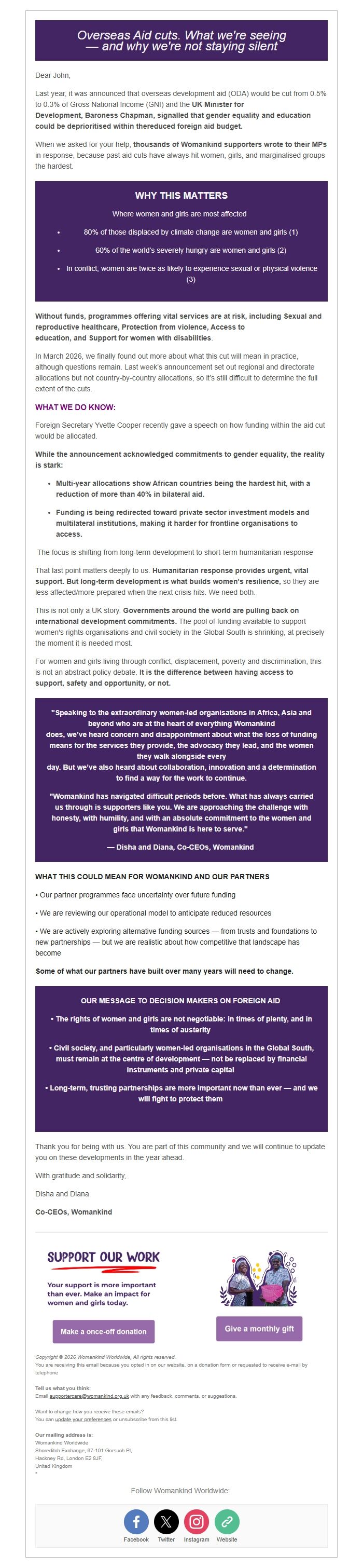
Overseas Aid cuts. What we're seeing
— and why we're not staying silent
Dear John,
Last year, it was announced that overseas development aid (ODA) would be cut from 0.5% to 0.3% of Gross National Income (GNI) and the UK Minister for Development, Baroness Chapman, signalled that gender equality and education could be deprioritised within thereduced foreign aid budget.
When we asked for your help, thousands of Womankind supporters wrote to their MPs in response, because past aid cuts have always hit women, girls, and marginalised groups the hardest.
WHY THIS MATTERS
Where women and girls are most affected
* 80% of those displaced by climate change are women and girls (1)
* 60% of the world’s severely hungry are women and girls (2)
* In conflict, women are twice as likely to experience sexual or physical violence (3)
Without funds, programmes offering vital services are at risk, including Sexual and reproductive healthcare, Protection from violence, Access to education, and Support for women with disabilities.
In March 2026, we finally found out more about what this cut will mean in practice, although questions remain. Last week’s announcement set out regional and directorate allocations but not country-by-country allocations, so it’s still difficult to determine the full extent of the cuts.
WHAT WE DO KNOW:
Foreign Secretary Yvette Cooper recently gave a speech on how funding within the aid cut would be allocated.
While the announcement acknowledged commitments to gender equality, the reality is stark:
* Multi-year allocations show African countries being the hardest hit, with a reduction of more than 40% in bilateral aid.
* Funding is being redirected toward private sector investment models and multilateral institutions, making it harder for frontline organisations to access.
The focus is shifting from long-term development to short-term humanitarian response
That last point matters deeply to us. Humanitarian response provides urgent, vital support. But long-term development is what builds women's resilience, so they are less affected/more prepared when the next crisis hits. We need both.
This is not only a UK story. Governments around the world are pulling back on international development commitments. The pool of funding available to support women's rights organisations and civil society in the Global South is shrinking, at precisely the moment it is needed most.
For women and girls living through conflict, displacement, poverty and discrimination, this is not an abstract policy debate. It is the difference between having access to support, safety and opportunity, or not.
"Speaking to the extraordinary women-led organisations in Africa, Asia and beyond who are at the heart of everything Womankind does, we’ve heard concern and disappointment about what the loss of funding means for the services they provide, the advocacy they lead, and the women they walk alongside every day. But we’ve also heard about collaboration, innovation and a determination to find a way for the work to continue.
"Womankind has navigated difficult periods before. What has always carried us through is supporters like you. We are approaching the challenge with honesty, with humility, and with an absolute commitment to the women and girls that Womankind is here to serve."
— Disha and Diana, Co-CEOs, Womankind
WHAT THIS COULD MEAN FOR WOMANKIND AND OUR PARTNERS
• Our partner programmes face uncertainty over future funding
• We are reviewing our operational model to anticipate reduced resources
• We are actively exploring alternative funding sources — from trusts and foundations to new partnerships — but we are realistic about how competitive that landscape has become
Some of what our partners have built over many years will need to change.
OUR MESSAGE TO DECISION MAKERS ON FOREIGN AID
• The rights of women and girls are not negotiable: in times of plenty, and in times of austerity
• Civil society, and particularly women-led organisations in the Global South, must remain at the centre of development — not be replaced by financial instruments and private capital
• Long-term, trusting partnerships are more important now than ever — and we will fight to protect them
Thank you for being with us. You are part of this community and we will continue to update you on these developments in the year ahead.
With gratitude and solidarity,
Disha and Diana
Co-CEOs, Womankind
[link removed]
[link removed]
[link removed]
[link removed]
============================================================
Copyright © 2026 Womankind Worldwide, All rights reserved.
You are receiving this email because you opted in on our website, on a donation form or requested to receive e-mail by telephone
Tell us what you think:
Email ** [email protected] (mailto:[email protected]?subject=E-newsletter%20feedback)
with any feedback, comments, or suggestions.
Want to change how you receive these emails?
You can ** update your preferences ([link removed])
or ** unsubscribe from this list. ([link removed])
Our mailing address is:
Womankind Worldwide
Shoreditch Exchange, 97-101 Gorsuch Pl,
Hackney Rd, London E2 8JF,
United Kingdom
*
Follow Womankind Worldwide:
** Facebook ([link removed])
** Facebook ([link removed])
** Twitter ([link removed])
** Twitter ([link removed])
** Instagram ([link removed])
** Instagram ([link removed])
** Website ([link removed])
** Website ([link removed])
— and why we're not staying silent
Dear John,
Last year, it was announced that overseas development aid (ODA) would be cut from 0.5% to 0.3% of Gross National Income (GNI) and the UK Minister for Development, Baroness Chapman, signalled that gender equality and education could be deprioritised within thereduced foreign aid budget.
When we asked for your help, thousands of Womankind supporters wrote to their MPs in response, because past aid cuts have always hit women, girls, and marginalised groups the hardest.
WHY THIS MATTERS
Where women and girls are most affected
* 80% of those displaced by climate change are women and girls (1)
* 60% of the world’s severely hungry are women and girls (2)
* In conflict, women are twice as likely to experience sexual or physical violence (3)
Without funds, programmes offering vital services are at risk, including Sexual and reproductive healthcare, Protection from violence, Access to education, and Support for women with disabilities.
In March 2026, we finally found out more about what this cut will mean in practice, although questions remain. Last week’s announcement set out regional and directorate allocations but not country-by-country allocations, so it’s still difficult to determine the full extent of the cuts.
WHAT WE DO KNOW:
Foreign Secretary Yvette Cooper recently gave a speech on how funding within the aid cut would be allocated.
While the announcement acknowledged commitments to gender equality, the reality is stark:
* Multi-year allocations show African countries being the hardest hit, with a reduction of more than 40% in bilateral aid.
* Funding is being redirected toward private sector investment models and multilateral institutions, making it harder for frontline organisations to access.
The focus is shifting from long-term development to short-term humanitarian response
That last point matters deeply to us. Humanitarian response provides urgent, vital support. But long-term development is what builds women's resilience, so they are less affected/more prepared when the next crisis hits. We need both.
This is not only a UK story. Governments around the world are pulling back on international development commitments. The pool of funding available to support women's rights organisations and civil society in the Global South is shrinking, at precisely the moment it is needed most.
For women and girls living through conflict, displacement, poverty and discrimination, this is not an abstract policy debate. It is the difference between having access to support, safety and opportunity, or not.
"Speaking to the extraordinary women-led organisations in Africa, Asia and beyond who are at the heart of everything Womankind does, we’ve heard concern and disappointment about what the loss of funding means for the services they provide, the advocacy they lead, and the women they walk alongside every day. But we’ve also heard about collaboration, innovation and a determination to find a way for the work to continue.
"Womankind has navigated difficult periods before. What has always carried us through is supporters like you. We are approaching the challenge with honesty, with humility, and with an absolute commitment to the women and girls that Womankind is here to serve."
— Disha and Diana, Co-CEOs, Womankind
WHAT THIS COULD MEAN FOR WOMANKIND AND OUR PARTNERS
• Our partner programmes face uncertainty over future funding
• We are reviewing our operational model to anticipate reduced resources
• We are actively exploring alternative funding sources — from trusts and foundations to new partnerships — but we are realistic about how competitive that landscape has become
Some of what our partners have built over many years will need to change.
OUR MESSAGE TO DECISION MAKERS ON FOREIGN AID
• The rights of women and girls are not negotiable: in times of plenty, and in times of austerity
• Civil society, and particularly women-led organisations in the Global South, must remain at the centre of development — not be replaced by financial instruments and private capital
• Long-term, trusting partnerships are more important now than ever — and we will fight to protect them
Thank you for being with us. You are part of this community and we will continue to update you on these developments in the year ahead.
With gratitude and solidarity,
Disha and Diana
Co-CEOs, Womankind
[link removed]
[link removed]
[link removed]
[link removed]
============================================================
Copyright © 2026 Womankind Worldwide, All rights reserved.
You are receiving this email because you opted in on our website, on a donation form or requested to receive e-mail by telephone
Tell us what you think:
Email ** [email protected] (mailto:[email protected]?subject=E-newsletter%20feedback)
with any feedback, comments, or suggestions.
Want to change how you receive these emails?
You can ** update your preferences ([link removed])
or ** unsubscribe from this list. ([link removed])
Our mailing address is:
Womankind Worldwide
Shoreditch Exchange, 97-101 Gorsuch Pl,
Hackney Rd, London E2 8JF,
United Kingdom
*
Follow Womankind Worldwide:
** Facebook ([link removed])
** Facebook ([link removed])
** Twitter ([link removed])
** Twitter ([link removed])
** Instagram ([link removed])
** Instagram ([link removed])
** Website ([link removed])
** Website ([link removed])
Message Analysis
- Sender: Womankind Worldwide
- Political Party: n/a
- Country: United Kingdom
- State/Locality: n/a
- Office: n/a
-
Email Providers:
- MailChimp