 Citigroup, Verizon, and Delta Air Lines have outperformed their struggling sectors during the Iran conflict and could lead when markets... ͏ ͏ ͏ ͏ ͏ ͏ ͏ ͏ ͏ ͏ ͏ ͏ ͏ ͏ ͏ ͏ ͏ ͏ ͏ ͏ ͏ ͏ ͏ ͏ ͏ ͏ ͏ ͏ ͏ ͏ ͏ ͏ ͏ ͏ ͏ ͏ ͏ ͏ ͏ ͏ ͏ ͏ ͏ ͏ ͏ ͏ ͏ ͏ ͏ ͏ ͏ ͏ ͏ ͏ ͏ ͏ ͏ ͏ ͏ ͏ ͏ ͏ ͏ ͏ ͏ ͏ ͏ ͏ ͏ ͏ ͏ ͏ ͏ ͏ ͏ ͏ ͏ ͏ ͏ ͏ ͏ ͏ ͏ ͏ ͏ ͏ ͏ ͏ ͏ ͏ ͏ ͏ ͏ ͏ ͏ ͏ ͏ ͏ ͏ ͏ |
| Written by Bridget Bennett The Dow is in correction territory. Oil has surged past $110 a barrel. Financials, communications, and airlines are among the worst-performing sectors since the Iran conflict began in late February. For most investors, the instinct is to look away.
But Oxford Club Chief Income Strategist Marc Lichtenfeld is looking closer—specifically at the stocks inside those beaten-down sectors that haven't broken down with everything else. Relative strength during a selloff isn't random. When the cycle turns, the names that held up tend to be the first ones institutional money flows back into. Lichtenfeld sees that setup forming right now across three familiar names.
Citigroup: Global Reach Is Its MoatThe financial sector has taken a beating since the Iran conflict began. Rising oil prices threaten to slow the economy, which means less borrowing, fewer IPOs, and weaker investment banking revenue across the board.
But Citigroup (NYSE: C) has held up better than most of its mega-bank peers—and Lichtenfeld says the reason is its treasury and trade solutions business.
While JPMorgan Chase (NYSE: JPM) and Bank of America (NYSE: BAC) dominate domestic headlines, Citigroup operates in more than 160 countries and processes roughly $3 trillion in daily transactions through its cash management platform.
That global footprint matters. A company based in Mongolia or Saudi Arabia is far more likely to turn to Citi for cash management than to any other Wall Street bank. And once that relationship is in place, it's extremely sticky. Switching cash management providers is operationally complex, which gives Citigroup a durable revenue stream that competitors can't easily replicate.
Lichtenfeld expects to see improving margins in Citigroup's next earnings report, scheduled for April 14. The stock trades at roughly 11 times forward earnings, well below its five-year average. In addition, Citigroup's ongoing strategic repositioning—spinning off its Mexico consumer business and reinvesting in commercial banking and wealth—could give the valuation room to expand once the macro pressure lifts.
If financial stocks rebound quickly when the conflict ends, Lichtenfeld sees that as a signal the global economy is healing. If they don't, it may be a warning worth paying attention to.
Verizon: A 5.7% Yield With a Defensive EdgeConsumer uncertainty tends to push people toward cheaper alternatives, and Verizon Communications (NYSE: VZ) sits at the premium end of the wireless market.
That positioning is a headwind in the short term but a tailwind when sentiment improves. People don't downgrade from Verizon because they dislike the service—they do it because the budget gets tight. When confidence returns, so does the willingness to pay for premium.
In the meantime, Verizon's dividend does the heavy lifting. The company has raised its payout for 22 consecutive years. In January, the company declared a quarterly dividend of about 71 cents per share, which puts the forward yield at roughly 5.9%. Free cash flow more than covers the dividend, with guidance calling for at least $21.5 billion in 2026—a 7%-plus increase year over year.
New CEO Dan Schulman has moved aggressively since taking over in October 2025, slashing $9 billion in combined operating and capital expenses and authorizing a $25 billion share buyback program over the next three years.
Verizon also completed its acquisition of Frontier Communications, expanding its fiber access to over 30 million homes and businesses. Lichtenfeld points out that if post-conflict government spending shifts back toward infrastructure, Frontier's rural broadband footprint could become a significant growth driver.
Delta: Refinery Changes the Math on AirlinesAirlines are the most obvious casualty of any conflict that sends oil prices surging. But Delta Air Lines (NYSE: DAL) has a structural advantage no other U.S. carrier can match: it owns the Trainer Refinery in Pennsylvania through its subsidiary Monroe Energy.
That 185,000-barrel-per-day facility produces about 52,000 barrels of jet fuel daily, offsetting 40% to 50% of Delta's domestic fuel costs. When crude prices spiked after Russia invaded Ukraine in 2022, the refinery saved Delta roughly $800 million.
With Brent crude now above $110 a barrel due to the Strait of Hormuz disruptions, the refinery is proving its worth again. While competitors have posted double-digit declines, Delta's stock has remained essentially flat since February.
There's an additional wrinkle: the refinery also produces diesel, which Delta can trade for jet fuel. With diesel prices at elevated levels, that trade is generating meaningful value on its own.
Delta has maintained its full-year 2026 earnings guidance of $6.50 to $7.50 per share, while most peers have pulled or widened their outlooks. The stock trades at roughly nine times trailing earnings with a forward P/E near 9.3, making it one of the cheapest names in the S&P 500 relative to its earnings growth trajectory.
Relative Strength Now, Potential Outperformance LaterThe common thread across all three names is relative strength during sector weakness. That pattern tends to matter when cycles turn. If the Iran conflict ends and oil begins to normalize, the sectors getting punished hardest—financials, communications, airlines—could see some of the sharpest snapbacks. And within those groups, the stocks that held up best during the downturn have historically been the ones that lead the recovery.
None of this requires predicting when the war ends. It requires watching which names the market is quietly telling you it believes in most.
 Read This Story Online Read This Story Online |  John Browne, former Morgan Stanley investment banker and adviser to leaders including Donald Trump and Margaret Thatcher, is warning that millions of Americans could see their purchasing power collapse in the coming months.
Browne, a Senior Editor at Financial Intelligence Report and regular Newsmax contributor, says the threat targets America's financial system directly - and that preparation in the next 48 hours could make a meaningful difference. Discover the exact steps John Browne recommends to protect your wealth |
| Written by Leo Miller 
As of late, not much has been going well for Magnificent Seven member, Meta Platforms (NASDAQ: META).
In 2026, the stock has fallen more than 10% and is closing in on a 15% decline for the year. Overall, Meta has experienced more than 25% drawdown from its 52-week high in August of last year.
Concerns about excessive artificial intelligence (AI) spending continue to linger, even as Meta is projecting Q1 2026 sales growth at its fastest pace in years.
More recently, legal issues with potentially significant consequences have battered the stock. Additionally, like much of the market, the conflict in Iran is dragging Meta down.
However, amid this negativity, Meta secured a clear win over one of the top companies in the AI race: OpenAI. As OpenAI shuts down its Sora app, a challenger to Meta’s social media dominance falls by the wayside, illustrating why Meta’s approach to AI-generated content is more sustainable.
OpenAI Takes Aim at Meta’s Reels With Sora
Sora was OpenAI’s answer to Instagram Reels and TikTok; a short-form video alternative to these highly established platforms.
The content on Sora was fundamentally different from that of Meta’s Reels in that all of the content was AI-generated. While Reels also contains a significant amount of AI videos, human-generated or AI-assisted content continues to play a large role.
When OpenAI first released Sora at the end of September 2025, interest was palpable. Downloads soared to 1 million in just five days, and Sora became the number one app on Apple’s (NASDAQ: AAPL) App Store. Notably, in the first week of October, Meta shares declined by around 3%, while the S&P 500 Index was slightly positive. Downloads reportedly spiked to 2.5 million in October and 3.2 million in November.
For Meta, new competition in short-form videos from a well-funded firm was a non-dismissible threat to its advertising business. This is particularly true, as Reels has become a very significant revenue driver for the company.
In Q3 2025, Meta noted that Reels had achieved an annual revenue run rate of over $50 billion, equating to revenue that quarter of nearly $12.5 billion. Thus, Reels accounted for approximately 25% of the $51.2 billion in total revenue Meta generated in Q3 2025.
As it turned out, Sora’s threat would be gone after less than a year, with the app being a somewhat comical failure.
Sora’s Downfall: Economics Deemed “Completely Unsustainable"
After peaking in November, Sora’s downloads fell off a cliff, dropping to 2.2 million by December and 1.1 million by February 2026.
Many argue that the novelty of a fully AI-generated video platform quickly wore off on users. By late March 2025, OpenAI said it would shut down Sora, as reports emerged that the company had lost an astronomical amount of money while operating it.
With Sora built around AI-generated video, OpenAI had to run substantial inference workloads to produce clips on demand. That translated into heavy energy usage and consumed computing resources that could have supported other tools. In fact, estimates suggest that OpenAI was spending $15 million a day on inference to operate Sora. On an annualized basis, this would equate to roughly $5.4 billion in costs.
Meanwhile, over Sora’s entire life, the app reportedly generated a staggeringly low $2.1 million in revenue. It's not hard to see why Sora’s head of development, Bill Pebbles, called the app’s economics “completely unsustainable."
To add insult to injury, after shutting down Sora, OpenAI lost the $1 billion content partnership it had signed with Walt Disney (NYSE: DIS).
With Sora Gone, Meta Keeps Its Social Media Stronghold
Sora’s closure removes one more would-be competitor from the short-form video landscape, but the deeper takeaway is what it suggests about distribution and costs.
A fully AI-generated feed forces the platform itself to shoulder the inference bill for a large share of what users watch and create. When usage rises, costs can scale brutally. When novelty fades, the economics can break.
This doesn’t mean that AI-generated videos can’t be successful, but rather that doing so through a completely new platform is highly difficult.
In this context, it will be interesting to see if Meta continues to operate its “Vibes” app, which looked like a quick defensive move after Sora’s debut to ensure Meta had a standalone option if AI-only video feeds turned out to be viable.
With Sora’s economics now exposed, Meta may opt to wind Vibes down. Or Meta learns from Sora’s mistakes and finds a sustainable way to keep Vibes alive by targeting a niche audience.
However, the safer bet for AI-generated content may be integration rather than isolation: mixing AI clips alongside human and AI-assisted videos in an established feed. That approach keeps inference costs down and reduces the likelihood of user fatigue, while still letting creators experiment with AI tools. This is the exact strategy that Meta is executing through Reels, and it is a key component of its massive AI-enabled advertising engine. Read This Story Online |  Bill Spetrino, editor of The Dividend Machine, started with just an $8,000 IRA and invested it in a single dividend stock he calls the World's Greatest Dividend Stock - and he's sharing a free report that names it.
Spetrino has identified what he calls The Great American Turnaround, an economic shift driven by three catalysts he believes will reward dividend-focused investors who position early. His free bulletin outlines why waiting for markets to settle could mean paying more for the same yields. Read the free bulletin now and discover the dividend stocks to watch |
Written by Thomas Hughes
Micron Technology’s (NASDAQ: MU) stock price has been volatile, and the wild swings are unlikely to be over.
However, a mix of technical signals, institutional positioning, and analyst expectations suggests the bottom is in, and a rebound is at hand. The question is what could trigger the rebound, and the answer is earnings results.
Micron’s fiscal Q3 2026 earnings report isn’t due until late June, so the rebound may take time to gain traction.
But, as a leading provider of high-bandwidth memory (HBM), the company is central to the AI boom, and outperformance is likely. Analyst estimates are rising thanks to Micron's stunning Q2 performance and mind-blowing guidance. The consensus is calling for nearly 900% earnings growth and for a high triple-digit pace to be sustained over the next three quarters, and the estimates are likely to be low.
Demand trends remain strong. The shortages originally expected through 2026 are now forecast to extend well into 2027 and possibly even further. Micron itself is in the process of negotiating its 2027 production and is expected to lock in record pricing.
The data center ramp is still underway, the inference and refurbishment cycles are yet to be fully priced in, and there is a significant lag in facility construction. Micron is among the most advanced among its peers in terms of expansion plans, but even it won’t see significant production output until next year.
HBM pricing, which was expected to decline in the back half of 2026, is now expected to remain strong or accelerate into year-end. If this is confirmed in Micron’s upcoming report, the rebound and rally are likely to be very robust indeed.
Micron Hammers Out a Bottom in Early Q2Micron’s rapid rise and subsequent correction resulted in a 34% decline in stock price, from peak to bottom.
The bad news is that near-term volatility is likely as this market rebuilds its support base; the good news is that the rapid decline resulted in a Doji signal pointing to a hard bottom. A Doji candle is a price formation in which the open and close are very close together, while intraday price action moved to an extreme, often to both extremes.
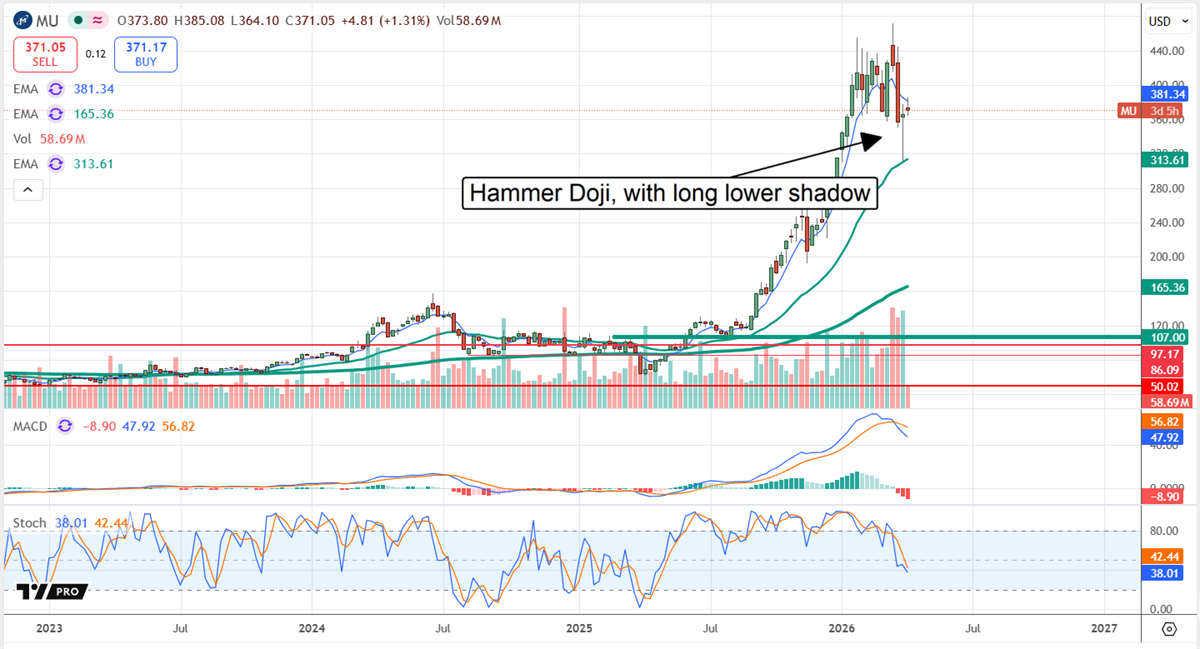 In this case, the Doji formed during a decline is among the five or ten largest price moves over the past few years and has a long lower shadow. The long lower shadow reflects intraday price weakness followed by a sharp rebound, while the candle’s magnitude reflects a high level of market engagement. The sharp rebound confirms support at the critical 150-day exponential moving average, and the long lower shadow points to it.
Trading volume is another critical element, as it rose in tandem with MU’s stock price decline and spiked as the market bottomed. This, too, reflects a high level of market engagement, and institutions are the likely buyers.
MarketBeat’s data show institutional investors owning more than 80% of the stock, buying on balance over the trailing-twelve-month period, and ramping activity in the first quarter. The Q1 activity included a spike in selling, which contributes to volatility but is completely offset by buyers. The critical detail is that buying outpaced selling by $6 billion, a quarterly record reflecting aggressive accumulation.
Q1 Analyst Ratings Stay Positive: MU Stock Is a Buy
Headwinds, risks, and fears notwithstanding, analyst sentiment trends strengthened in Q1.
Micron’s stock is pegged at Buy, with a 90% Buy-side bias, and coverage up by 45% year-over-year (YOY).
Although caution has entered the outlook, the price target revision trend remains bullish, with the consensus up nearly 200% YOY and forecasting a nearly 25% upside in early April.
More importantly, the $463 consensus aligns with the all-time high, with trends pointing to the high-end range and a fresh high. A move to fresh highs can trigger increased market inflows and drive momentum.
Looking at Micron from the value perspective, it is a ridiculously cheap stock. The stock trades at approximately 6x its 2026 consensus and 3x its 2027 consensus, suggesting a triple-digit upside potential. In this scenario, Micron’s results will drive a robust revision cycle, including for revenue and earnings, that extends many years into the future.
Read This Story Online |  Your 401k Won't Survive 2030 (Unless You See This)
The IMF projects that by 2030, US debt will climb to 140% of GDP. That's higher than Greece's debt was when their entire economy collapsed.
When Greece broke, the EU swooped in with $300 billion in emergency bailouts. Greece was OK. But when America crosses that line? There's no one bigger to save us. We ARE the emergency bailout for the rest of the world. Watch how this group of 4,000 investors is preparing → |
| More Stories |
| |
|
|


![The IMF Doesn't Issue Warnings Like This Often [LISTEN]](https://www.marketbeat.com/images/webpush/files/thumb_20260407131546_pushuntitled-design-25.jpg)