
Email
Running on Empty: America’s Weapons Stocks in the Iran War Are a Strategic Red Flag
| From | The American Enterprise <[email protected]> |
| Subject | Running on Empty: America’s Weapons Stocks in the Iran War Are a Strategic Red Flag |
| Date | March 31, 2026 3:52 PM |
Links have been removed from this email. Learn more in the FAQ.
Links have been removed from this email. Learn more in the FAQ.
Welcome to the March 2026 edition of The American Enterprise. This month, we are featuring essays by John G. Ferrari and Dillon Prochnicki on the risks of America’s depleted weapons stock in the face of the Iran war, Charles Lane on the politics of the immigration debate, and Mark Schneider on policy initiatives that can modernize America’s standardized tests in schools.
TheAmericanEnterprise_test3 (1) ([link removed] )
March 2026
Welcome to the March 2026 edition of The American Enterprise. This month, we are featuring essays by John G. Ferrari ([link removed] ) and Dillon Prochnicki on how the Iran war reveals the risks posed by America's limited defense industrial capacity, Charles Lane ([link removed] ) on the politics of the immigration debate, and Mark Schneider ([link removed] ) on policy initiatives that can modernize America’s standardized tests.
Make sure to subscribe ([link removed] ) and read the online version here ([link removed] ) !
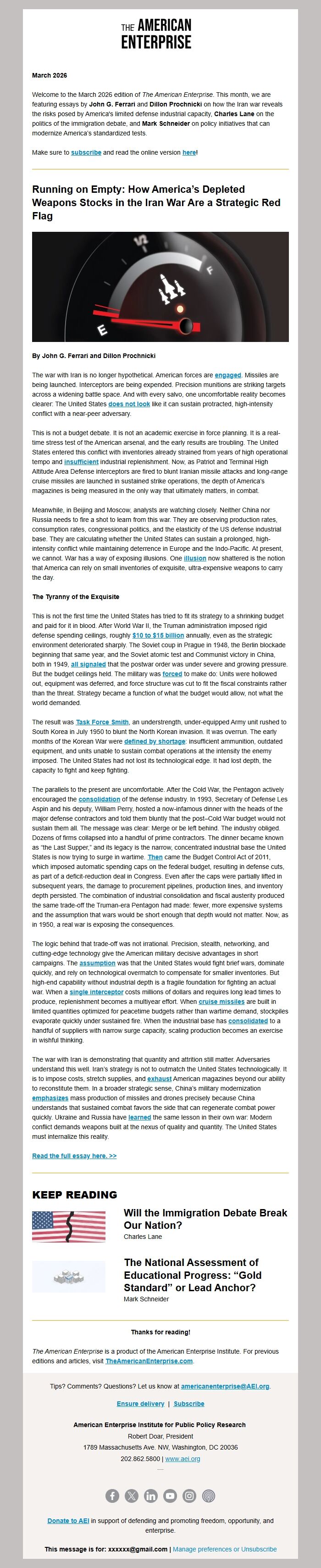
Running on Empty: How America’s Depleted Weapons Stocks in the Iran War Are a Strategic Red Flag ([link removed] )
Ferrari_3.2026 ([link removed] )
By John G. Ferrari ([link removed] ) and Dillon Prochnicki
The war with Iran is no longer hypothetical. American forces are engaged ([link removed] ) . Missiles are being launched. Interceptors are being expended. Precision munitions are striking targets across a widening battle space. And with every salvo, one uncomfortable reality becomes clearer: The United States does not look ([link removed] ) like it can sustain protracted, high-intensity conflict with a near-peer adversary.
This is not a budget debate. It is not an academic exercise in force planning. It is a real-time stress test of the American arsenal, and the early results are troubling. The United States entered this conflict with inventories already strained from years of high operational tempo and insufficient ([link removed] ) industrial replenishment. Now, as Patriot and Terminal High Altitude Area Defense interceptors are fired to blunt Iranian missile attacks and long-range cruise missiles are launched in sustained strike operations, the depth of America’s magazines is being measured in the only way that ultimately matters, in combat.
Meanwhile, in Beijing and Moscow, analysts are watching closely. Neither China nor Russia needs to fire a shot to learn from this war. They are observing production rates, consumption rates, congressional politics, and the elasticity of the US defense industrial base. They are calculating whether the United States can sustain a prolonged, high-intensity conflict while maintaining deterrence in Europe and the Indo-Pacific. At present, we cannot. War has a way of exposing illusions. One illusion ([link removed] ) now shattered is the notion that America can rely on small inventories of exquisite, ultra-expensive weapons to carry the day.
The Tyranny of the Exquisite
This is not the first time the United States has tried to fit its strategy to a shrinking budget and paid for it in blood. After World War II, the Truman administration imposed rigid defense spending ceilings, roughly $10 to $15 billion ([link removed] ) annually, even as the strategic environment deteriorated sharply. The Soviet coup in Prague in 1948, the Berlin blockade beginning that same year, and the Soviet atomic test and Communist victory in China, both in 1949, all signaled ([link removed] ) that the postwar order was under severe and growing pressure. But the budget ceilings held. The military was forced ([link removed] ) to make do: Units were hollowed out, equipment was deferred, and force structure was cut to fit the fiscal constraints rather than the threat. Strategy became a function of what the budget would allow, not what the world demanded.
The result was Task Force Smith ([link removed] ) , an understrength, under-equipped Army unit rushed to South Korea in July 1950 to blunt the North Korean invasion. It was overrun. The early months of the Korean War were defined by shortage ([link removed] ) : insufficient ammunition, outdated equipment, and units unable to sustain combat operations at the intensity the enemy imposed. The United States had not lost its technological edge. It had lost depth, the capacity to fight and keep fighting.
The parallels to the present are uncomfortable. After the Cold War, the Pentagon actively encouraged the consolidation ([link removed] ) of the defense industry. In 1993, Secretary of Defense Les Aspin and his deputy, William Perry, hosted a now-infamous dinner with the heads of the major defense contractors and told them bluntly that the post–Cold War budget would not sustain them all. The message was clear: Merge or be left behind. The industry obliged. Dozens of firms collapsed into a handful of prime contractors. The dinner became known as “the Last Supper,” and its legacy is the narrow, concentrated industrial base the United States is now trying to surge in wartime. Then ([link removed] ) came the Budget Control Act of 2011, which imposed automatic spending caps on the federal budget, resulting in defense cuts, as part of a deficit-reduction deal in Congress. Even after the caps were partially lifted in subsequent years, the damage to procurement pipelines, production lines, and inventory depth persisted. The combination of industrial consolidation and fiscal austerity produced the same trade-off the Truman-era Pentagon had made: fewer, more expensive systems and the assumption that wars would be short enough that depth would not matter. Now, as in 1950, a real war is exposing the consequences.
The logic behind that trade-off was not irrational. Precision, stealth, networking, and cutting-edge technology give the American military decisive advantages in short campaigns. The assumption ([link removed] ) was that the United States would fight brief wars, dominate quickly, and rely on technological overmatch to compensate for smaller inventories. But high-end capability without industrial depth is a fragile foundation for fighting an actual war. When a single interceptor ([link removed] ) costs millions of dollars and requires long lead times to produce, replenishment becomes a multiyear effort. When cruise missiles ([link removed] ) are built in limited quantities optimized for peacetime budgets rather than wartime demand, stockpiles evaporate quickly under sustained fire. When the industrial base has consolidated ([link removed] ) to a handful of suppliers with narrow surge capacity, scaling production becomes an exercise in wishful thinking.
The war with Iran is demonstrating that quantity and attrition still matter. Adversaries understand this well. Iran’s strategy is not to outmatch the United States technologically. It is to impose costs, stretch supplies, and exhaust ([link removed] ) American magazines beyond our ability to reconstitute them. In a broader strategic sense, China’s military modernization emphasizes ([link removed] ) mass production of missiles and drones precisely because China understands that sustained combat favors the side that can regenerate combat power quickly. Ukraine and Russia have learned ([link removed] ) the same lesson in their own war: Modern conflict demands weapons built at the nexus of quality and quantity. The United States must internalize this reality.
Read the full essay here. >> ([link removed] )
KEEP READING
Lane_3.2026 ([link removed] )
Will the Immigration Debate Break Our Nation? ([link removed] )
Charles Lane
Schneider_02.2026 ([link removed] )
The National Assessment of Educational Progress: “Gold Standard” or Lead Anchor? ([link removed] )
Mark Schneider
Thanks for reading!
The American Enterprise is a product of the American Enterprise Institute. For previous editions and articles, visit TheAmericanEnterprise.com ([link removed] ) .
Tips? Comments? Questions? Let us know at [email protected] (mailto:[email protected]) .
Ensure delivery ([link removed] ) | Subscribe ([link removed] )
American Enterprise Institute for Public Policy Research
Robert Doar, President
1789 Massachusetts Ave. NW, Washington, DC 20036
202.862.5800 | www.aei.org ([link removed] )
Unsubscribe from the link below. ([link removed] )
Facebook ([link removed] )
X ([link removed] )
LinkedIn ([link removed] )
YouTube ([link removed] )
Instagram ([link removed] )
Podcast Logo New_Gray ([link removed] )
Donate to AEI ([link removed] ) in support of defending and promoting freedom, opportunity, and enterprise.
This message is for: [email protected] | ([link removed] ) Manage preferences or Unsubscribe ([link removed] )
TheAmericanEnterprise_test3 (1) ([link removed] )
March 2026
Welcome to the March 2026 edition of The American Enterprise. This month, we are featuring essays by John G. Ferrari ([link removed] ) and Dillon Prochnicki on how the Iran war reveals the risks posed by America's limited defense industrial capacity, Charles Lane ([link removed] ) on the politics of the immigration debate, and Mark Schneider ([link removed] ) on policy initiatives that can modernize America’s standardized tests.
Make sure to subscribe ([link removed] ) and read the online version here ([link removed] ) !
Running on Empty: How America’s Depleted Weapons Stocks in the Iran War Are a Strategic Red Flag ([link removed] )
Ferrari_3.2026 ([link removed] )
By John G. Ferrari ([link removed] ) and Dillon Prochnicki
The war with Iran is no longer hypothetical. American forces are engaged ([link removed] ) . Missiles are being launched. Interceptors are being expended. Precision munitions are striking targets across a widening battle space. And with every salvo, one uncomfortable reality becomes clearer: The United States does not look ([link removed] ) like it can sustain protracted, high-intensity conflict with a near-peer adversary.
This is not a budget debate. It is not an academic exercise in force planning. It is a real-time stress test of the American arsenal, and the early results are troubling. The United States entered this conflict with inventories already strained from years of high operational tempo and insufficient ([link removed] ) industrial replenishment. Now, as Patriot and Terminal High Altitude Area Defense interceptors are fired to blunt Iranian missile attacks and long-range cruise missiles are launched in sustained strike operations, the depth of America’s magazines is being measured in the only way that ultimately matters, in combat.
Meanwhile, in Beijing and Moscow, analysts are watching closely. Neither China nor Russia needs to fire a shot to learn from this war. They are observing production rates, consumption rates, congressional politics, and the elasticity of the US defense industrial base. They are calculating whether the United States can sustain a prolonged, high-intensity conflict while maintaining deterrence in Europe and the Indo-Pacific. At present, we cannot. War has a way of exposing illusions. One illusion ([link removed] ) now shattered is the notion that America can rely on small inventories of exquisite, ultra-expensive weapons to carry the day.
The Tyranny of the Exquisite
This is not the first time the United States has tried to fit its strategy to a shrinking budget and paid for it in blood. After World War II, the Truman administration imposed rigid defense spending ceilings, roughly $10 to $15 billion ([link removed] ) annually, even as the strategic environment deteriorated sharply. The Soviet coup in Prague in 1948, the Berlin blockade beginning that same year, and the Soviet atomic test and Communist victory in China, both in 1949, all signaled ([link removed] ) that the postwar order was under severe and growing pressure. But the budget ceilings held. The military was forced ([link removed] ) to make do: Units were hollowed out, equipment was deferred, and force structure was cut to fit the fiscal constraints rather than the threat. Strategy became a function of what the budget would allow, not what the world demanded.
The result was Task Force Smith ([link removed] ) , an understrength, under-equipped Army unit rushed to South Korea in July 1950 to blunt the North Korean invasion. It was overrun. The early months of the Korean War were defined by shortage ([link removed] ) : insufficient ammunition, outdated equipment, and units unable to sustain combat operations at the intensity the enemy imposed. The United States had not lost its technological edge. It had lost depth, the capacity to fight and keep fighting.
The parallels to the present are uncomfortable. After the Cold War, the Pentagon actively encouraged the consolidation ([link removed] ) of the defense industry. In 1993, Secretary of Defense Les Aspin and his deputy, William Perry, hosted a now-infamous dinner with the heads of the major defense contractors and told them bluntly that the post–Cold War budget would not sustain them all. The message was clear: Merge or be left behind. The industry obliged. Dozens of firms collapsed into a handful of prime contractors. The dinner became known as “the Last Supper,” and its legacy is the narrow, concentrated industrial base the United States is now trying to surge in wartime. Then ([link removed] ) came the Budget Control Act of 2011, which imposed automatic spending caps on the federal budget, resulting in defense cuts, as part of a deficit-reduction deal in Congress. Even after the caps were partially lifted in subsequent years, the damage to procurement pipelines, production lines, and inventory depth persisted. The combination of industrial consolidation and fiscal austerity produced the same trade-off the Truman-era Pentagon had made: fewer, more expensive systems and the assumption that wars would be short enough that depth would not matter. Now, as in 1950, a real war is exposing the consequences.
The logic behind that trade-off was not irrational. Precision, stealth, networking, and cutting-edge technology give the American military decisive advantages in short campaigns. The assumption ([link removed] ) was that the United States would fight brief wars, dominate quickly, and rely on technological overmatch to compensate for smaller inventories. But high-end capability without industrial depth is a fragile foundation for fighting an actual war. When a single interceptor ([link removed] ) costs millions of dollars and requires long lead times to produce, replenishment becomes a multiyear effort. When cruise missiles ([link removed] ) are built in limited quantities optimized for peacetime budgets rather than wartime demand, stockpiles evaporate quickly under sustained fire. When the industrial base has consolidated ([link removed] ) to a handful of suppliers with narrow surge capacity, scaling production becomes an exercise in wishful thinking.
The war with Iran is demonstrating that quantity and attrition still matter. Adversaries understand this well. Iran’s strategy is not to outmatch the United States technologically. It is to impose costs, stretch supplies, and exhaust ([link removed] ) American magazines beyond our ability to reconstitute them. In a broader strategic sense, China’s military modernization emphasizes ([link removed] ) mass production of missiles and drones precisely because China understands that sustained combat favors the side that can regenerate combat power quickly. Ukraine and Russia have learned ([link removed] ) the same lesson in their own war: Modern conflict demands weapons built at the nexus of quality and quantity. The United States must internalize this reality.
Read the full essay here. >> ([link removed] )
KEEP READING
Lane_3.2026 ([link removed] )
Will the Immigration Debate Break Our Nation? ([link removed] )
Charles Lane
Schneider_02.2026 ([link removed] )
The National Assessment of Educational Progress: “Gold Standard” or Lead Anchor? ([link removed] )
Mark Schneider
Thanks for reading!
The American Enterprise is a product of the American Enterprise Institute. For previous editions and articles, visit TheAmericanEnterprise.com ([link removed] ) .
Tips? Comments? Questions? Let us know at [email protected] (mailto:[email protected]) .
Ensure delivery ([link removed] ) | Subscribe ([link removed] )
American Enterprise Institute for Public Policy Research
Robert Doar, President
1789 Massachusetts Ave. NW, Washington, DC 20036
202.862.5800 | www.aei.org ([link removed] )
Unsubscribe from the link below. ([link removed] )
Facebook ([link removed] )
X ([link removed] )
LinkedIn ([link removed] )
YouTube ([link removed] )
Instagram ([link removed] )
Podcast Logo New_Gray ([link removed] )
Donate to AEI ([link removed] ) in support of defending and promoting freedom, opportunity, and enterprise.
This message is for: [email protected] | ([link removed] ) Manage preferences or Unsubscribe ([link removed] )
Message Analysis
- Sender: American Enterprise Institute
- Political Party: n/a
- Country: United States
- State/Locality: n/a
- Office: n/a
-
Email Providers:
- HubSpot