
Email
Policy Brief | The Arab Gulf States After the War: Expectations for Washington and Tehran
| From | Center for the National Interest <[email protected]> |
| Subject | Policy Brief | The Arab Gulf States After the War: Expectations for Washington and Tehran |
| Date | March 30, 2026 1:57 PM |
Links have been removed from this email. Learn more in the FAQ.
Links have been removed from this email. Learn more in the FAQ.
[link removed]
** CFTNI Policy Brief
------------------------------------------------------------
** The Arab Gulf States After the War: Expectations for Washington and Tehran
------------------------------------------------------------
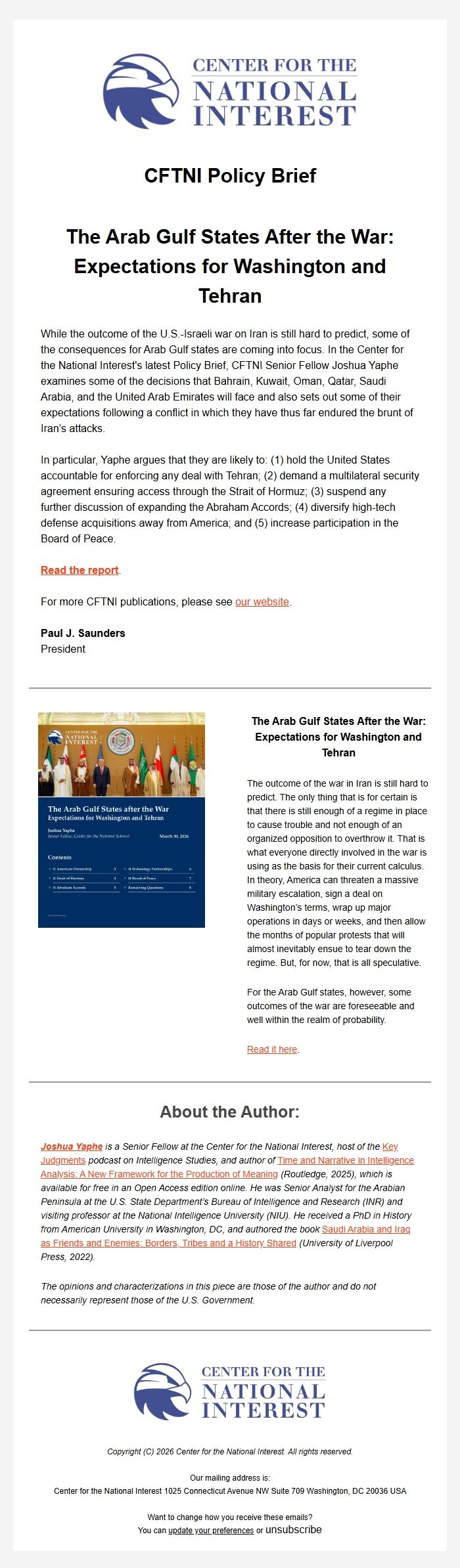
While the outcome of the U.S.-Israeli war on Iran is still hard to predict, some of the consequences for Arab Gulf states are coming into focus. In the Center for the National Interest's latest Policy Brief, CFTNI Senior Fellow Joshua Yaphe examines some of the decisions that Bahrain, Kuwait, Oman, Qatar, Saudi Arabia, and the United Arab Emirates will face and also sets out some of their expectations following a conflict in which they have thus far endured the brunt of Iran’s attacks.
In particular, Yaphe argues that they are likely to: (1) hold the United States accountable for enforcing any deal with Tehran; (2) demand a multilateral security agreement ensuring access through the Strait of Hormuz; (3) suspend any further discussion of expanding the Abraham Accords; (4) diversify high-tech defense acquisitions away from America; and (5) increase participation in the Board of Peace.
Read the report ([link removed]) .
For more CFTNI publications, please see our website ([link removed]) .
Paul J. Saunders
President
[link removed]
The Arab Gulf States After the War: Expectations for Washington and Tehran
The outcome of the war in Iran is still hard to predict. The only thing that is for certain is that there is still enough of a regime in place to cause trouble and not enough of an organized opposition to overthrow it. That is what everyone directly involved in the war is using as the basis for their current calculus. In theory, America can threaten a massive military escalation, sign a deal on Washington’s terms, wrap up major operations in days or weeks, and then allow the months of popular protests that will almost inevitably ensue to tear down the regime. But, for now, that is all speculative.
For the Arab Gulf states, however, some outcomes of the war are foreseeable and well within the realm of probability.
Read it here ([link removed]) .
About the Author:
Joshua Yaphe ([link removed]) is a Senior Fellow at the Center for the National Interest, host of the Key Judgments ([link removed]) podcast on Intelligence Studies, and author of Time and Narrative in Intelligence Analysis: A New Framework for the Production of Meaning ([link removed]) (Routledge, 2025), which is available for free in an Open Access edition online. He was Senior Analyst for the Arabian Peninsula at the U.S. State Department’s Bureau of Intelligence and Research (INR) and visiting professor at the National Intelligence University (NIU). He received a PhD in History from American University in Washington, DC, and authored the book Saudi Arabia and Iraq as Friends and Enemies: Borders, Tribes and a History Shared ([link removed]) (University of Liverpool Press,
2022).
The opinions and characterizations in this piece are those of the author and do not necessarily represent those of the U.S. Government.
Copyright (C) 2026 Center for the National Interest. All rights reserved.
Our mailing address is:
Center for the National Interest
1025 Connecticut Avenue NW
Suite 709
Washington, DC 20036
USA
Want to change how you receive these emails?
You can update your preferences ([link removed]) or unsubscribe ([link removed])
** CFTNI Policy Brief
------------------------------------------------------------
** The Arab Gulf States After the War: Expectations for Washington and Tehran
------------------------------------------------------------
While the outcome of the U.S.-Israeli war on Iran is still hard to predict, some of the consequences for Arab Gulf states are coming into focus. In the Center for the National Interest's latest Policy Brief, CFTNI Senior Fellow Joshua Yaphe examines some of the decisions that Bahrain, Kuwait, Oman, Qatar, Saudi Arabia, and the United Arab Emirates will face and also sets out some of their expectations following a conflict in which they have thus far endured the brunt of Iran’s attacks.
In particular, Yaphe argues that they are likely to: (1) hold the United States accountable for enforcing any deal with Tehran; (2) demand a multilateral security agreement ensuring access through the Strait of Hormuz; (3) suspend any further discussion of expanding the Abraham Accords; (4) diversify high-tech defense acquisitions away from America; and (5) increase participation in the Board of Peace.
Read the report ([link removed]) .
For more CFTNI publications, please see our website ([link removed]) .
Paul J. Saunders
President
[link removed]
The Arab Gulf States After the War: Expectations for Washington and Tehran
The outcome of the war in Iran is still hard to predict. The only thing that is for certain is that there is still enough of a regime in place to cause trouble and not enough of an organized opposition to overthrow it. That is what everyone directly involved in the war is using as the basis for their current calculus. In theory, America can threaten a massive military escalation, sign a deal on Washington’s terms, wrap up major operations in days or weeks, and then allow the months of popular protests that will almost inevitably ensue to tear down the regime. But, for now, that is all speculative.
For the Arab Gulf states, however, some outcomes of the war are foreseeable and well within the realm of probability.
Read it here ([link removed]) .
About the Author:
Joshua Yaphe ([link removed]) is a Senior Fellow at the Center for the National Interest, host of the Key Judgments ([link removed]) podcast on Intelligence Studies, and author of Time and Narrative in Intelligence Analysis: A New Framework for the Production of Meaning ([link removed]) (Routledge, 2025), which is available for free in an Open Access edition online. He was Senior Analyst for the Arabian Peninsula at the U.S. State Department’s Bureau of Intelligence and Research (INR) and visiting professor at the National Intelligence University (NIU). He received a PhD in History from American University in Washington, DC, and authored the book Saudi Arabia and Iraq as Friends and Enemies: Borders, Tribes and a History Shared ([link removed]) (University of Liverpool Press,
2022).
The opinions and characterizations in this piece are those of the author and do not necessarily represent those of the U.S. Government.
Copyright (C) 2026 Center for the National Interest. All rights reserved.
Our mailing address is:
Center for the National Interest
1025 Connecticut Avenue NW
Suite 709
Washington, DC 20036
USA
Want to change how you receive these emails?
You can update your preferences ([link removed]) or unsubscribe ([link removed])
Message Analysis
- Sender: Center for the National Interest
- Political Party: n/a
- Country: United States
- State/Locality: n/a
- Office: n/a
-
Email Providers:
- MailChimp