Image

Dear Friends,

Last week, the House returned to Washington in the midst of a partial government shutdown — resulting from overly aggressive tactics by ICE and Border Patrol agents across the nation that led to the deaths of Renee Good and Alex Pretti. The House passed Senate amendments to a consolidated funding bill that extended current funding for the Department of Homeland Security (DHS) through this Friday, February 13th. I voted no because the bill does not include any reforms to reign in an out-of-control DHS, ICE and Border Patrol.

I fully support the common-sense reforms outlined by House and Senate Democratic leadership last week as part of their negotiations with the White House and Republican Leadership. These reforms will protect constitutional rights and ensure responsible law enforcement. Time will tell whether Republicans will address the public safety crisis their ICE and Border Patrol agents and reckless DHS have created.

Rather than negotiating much-needed guardrails on ICE and Border Patrol, some Congressional Republicans prefer to use this time revisiting their attempts to impose a modern-day poll tax through the SAVE Act, which requires all persons to provide documents proving citizenship — all of which cost money — before registering to vote.

I joined Sunrise on the Hill to discuss why I oppose the SAVE Act and DHS funding without reforms.

Video
Play Button

Keep reading for more of what you may have missed since my last newsletter.

ENERGY & COMMERCE COMMITTEE UPDATE: FIGHTING TO LOWER ENERGY COSTS AND BIPARTISAN PRIORITIES

The Energy & Commerce Committee has been hard at work, and I’ve continued to pursue legislative wins in spite of partisan gridlock.

In an Energy Subcommittee hearing last Tuesday, I questioned commissioners at the Federal Energy Regulatory Commission (FERC) to ensure that approved energy projects benefit all ratepayers without putting historically disadvantaged communities at risk. Low income, minority and vulnerable communities historically have been forced to bear the brunt of the health and environmental impacts of energy projects for far too long with little to no input on those projects. 

Video
Play Button

The Communications & Technology Subcommittee considered bipartisan bills that I co-sponsor to address critical public safety infrastructure and technology priorities.

First, to address safety threats in our rural communities, I joined Rep. Mariannette Miller-Meeks to introduce the Rural and Municipal Utility Cybersecurity Act, which invests in our energy sector’s ability to respond to cybersecurity threats. In a rapidly changing technological landscape, we must continue to protect our most vulnerable communities from attack. 

Video
Play Button

The Subcommittee advanced the bill to the full committee last week. You can read more about the RMUC Act here.

Second, the Subcommittee held a hearing to consider a bill I co-sponsor with Rep. Neal Dunn to reauthorize and strengthen FirstNet, a critical dedicated communications network for public safety agencies and first responders. Born out of the lessons learned during the tragic terrorist attacks of September 11th, FirstNet has allowed public safety agencies and first responders to continue communicating in the midst of significant emergency events. As we see more and more severe tropical and winter storms, we must not only maintain the effectiveness of FirstNet, but improve it for years to come.

Video
Play Button

Last week, I also introduced the National Commission on Robotics Act alongside Reps. Jay Obernolte and Bob Latta to help ensure the United States remains a competitive leader in global robotics development through effective policy. This bill would create a commission to assess the implications of our existing robotics sector on the economy and make policy recommendations. You can read more about the bill here.

Though there is still chaos in Washington, I remain committed to passing legislation that helps our communities by boosting our economy and bolstering security in our infrastructure.

INTRODUCING THE GRAD ACT TO INVEST IN HIGHER EDUCATION

On Wednesday, I introduced the Growing Reputable Academic Department (GRAD) Act, legislation which would expand federal funding to graduate-level STEM programs at Historically Black Colleges and Universities (HBCUs) and Predominantly Black Institutions (PBIs).

Our nation’s HBCUs and PBIs have served as key academic, social and cultural institutions for Black Americans since our first HBCU was founded nearly 200 years ago. Since then, these colleges and universities have generated billions of dollars for the American economy and given quality educational opportunities to millions of students, many being the first in their family to go to college. While HBCUs have suffered from chronic underfunding for decades, this legislation will help to address this disparity by investing in graduate education and boosting representation in STEM fields.

I am thrilled to have the opportunity to work alongside dedicated fellow members of the Congressional Black Caucus to support these crucial institutions at such an exciting time for scientific research and technological development. HBCUs and PBIs are not just a bright spot in my week: they are a bright spot for our country.

Find out more information on the GRAD Act here.

MY BRIGHT SPOT: 100 YEARS OF NATIONAL BLACK HISTORY COMMEMORATIONS

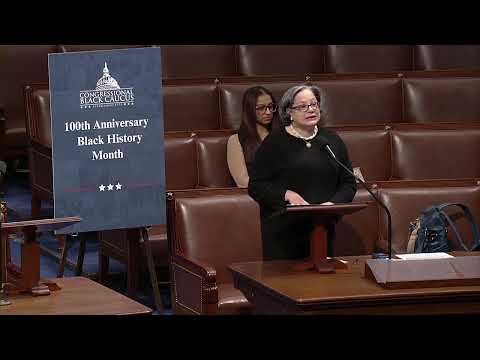
Last week, the Congressional Black Caucus kicked off our Black History Month celebration with a special order hour. I anchored these efforts to commemorate 100 years of national Black History Month celebrations since Carter G. Woodson established Negro History Week in 1926.

President Gerald R. Ford officially recognized Black History Month in February 1976 as part of the United States Bicentennial, urging Americans to “seize the opportunity to honor the too-often neglected accomplishments of Black Americans.” Now, 50 years later, we see President Trump trying to erase much of Black history from our public spaces. However, the Congressional Black Caucus, as the conscience of the Congress, remains committed to telling the full story of America and the resilience of Black Americans and communities throughout American history.

Video
Play Button

REMINDERS

We have extended the deadline for the 2026 Black History Month Essay Contest, open to middle and high school students across Virginia’s Fourth! Essays can be submitted to [email protected] by Friday, February 13th. You can find more information here.

Stay tuned for more updates and keep the faith, friends!

Make sure to follow me on FacebookTwitterInstagram, Threads, Bluesky, and YouTube to stay up-to-date on my work in Washington and Virginia’s Fourth!

Sincerely,
Image


Rep. Jennifer McClellan

Member of Congress


Image Image Image Image Image Image


Unsubscribe from future messages.

imageimage