|
 |



Welcome to The Corner. In this issue, we explore the legal and economic impact of OpenAI’s deals to lock up supply of memory chips.
 |
Open AI’s Memory Chip RAMpage Drives Up Prices Across the Economy
George Colville
Random Access Memory chips are everywhere — in your phone, computer, car, TV, digital camera, gaming console, and smartwatch. Even though you may have never heard of them, these semiconductors enable devices to temporarily store and access the data they need to run programs. A recent move by OpenAI has made these components a whole lot more expensive. And everyone is going to feel it, because more wafers allocated to AI server stacks means fewer wafers left over for smartphones and laptops.
In October 2025, OpenAI made simultaneous announcements that shocked the electronics industry. Open AI had separately signed letters of intent for enormous deals with Samsung and SK Hynix, two of the world’s three largest producers of dynamic random access memory (DRAM). Through these, it reserved itself 900,000 of the wafers necessary to produce DRAM per month over the next few years. This amounts to around 40% of the world’s production of the most widely used form of RAM. The announcement reportedly took both Samsung and SK Hynix by surprise, as each claimed to have no knowledge of the other’s deal.
Thus far, no competition regulator has announced plans to investigate the deals. Whether OpenAI’s actions amount to illegal anticompetitive conduct or not, the economic consequences are evident. By using its enormous financial power to corner a foundational resource of the digital economy, one company has shown how easily the costs of a speculative and purely profit-driven AI race can be offloaded onto rivals and consumers alike. In part thanks to the OpenAI deal, Samsung and SK Hynix were able to increase their prices by around 60% in just two months at the end of 2025, and they have already announced intentions to raise them a further 90% in the first quarter of 2026.
OpenAI has a strategic interest in securing the memory chip supply it needs as the AI data center buildout has generated a severe supply squeeze. With fabrication plants for these chips taking years to come online, locking orders in early secures access to this critical input at a known price. What is unprecedented, and potentially problematic, is the scale of the twin deals.
The deals – amid the broader boom in building data centers to power AI – has already increased the pressures on smaller companies producing consumer hardware products, which now must fight over what’s left. Even dominant corporations like Apple – which usually enjoy privileged access to supplies – are feeling the shortage.
This raises two concerns, one legal and one economic.
While the order may simply reflect CEO Sam Altman’s unshakeable commitment to AI boosterism and a prescient recognition that manufacture of memory chips would become a bottleneck, it could also point to something potentially illegal. In buying these wafers raw and uncut, at the stage before they undergo the complex processing steps that turn them into thousands of individual memory chips, OpenAI may effectively be using stockpiling as a strategy to restrict supply. A closely related question is whether Samsung and SK Hynix were aware of Open AI’s broader strategy to lock up future supply.
If this is the case, Open Markets Legal Director Sandeep Vaheesan notes it could raise concerns about exclusionary predatory bidding under antitrust law. By forcing competitors to pay more than it does for memory, OpenAI is setting itself up to outcompete them on price, even if they are catching up on model performance.
The second concern goes far beyond the AI industry alone, as consumer electronics makers absorb the biggest hits. Phones, computers, cars and more will all see significant price hikes in 2026 and beyond due to the AI-driven supply memory supply squeeze.
While AI firms are awash with speculative investor capital and monopoly profits from their other businesses and are also stockpiling memory chip components, most consumer electronics businesses can’t fall back on such massive reserves. PC gaming hobbyists are already feeling the squeeze as prices for DDR5 RAM components have quadrupled since July 2025.
This appears to be just the beginning. Top-end solid state hard drives are now worth more than their weight in gold, and IDC is projecting the consumer PC market and smartphone markets to contract by up to 9% and 5% respectively in 2026 as price hikes of up to 20% leave consumers unable to afford new devices.
The ultimate lesson is clear: unilateral financial power concentrated in a handful of technology firms is now such that it is capable of generating wide-ranging disruption across the entire electronics industry, in the name of highly speculative profits.
 |
Open Markets Files Brief Against Hospital Bed Monopolist
The Open Markets Institute last week filed an amicus brief in Reading Hospital v. Hill-Rom Holdings in the U.S. Court of Appeals for the Third Circuit on behalf of the hospital system’s claim that hospital bed manufacturer Hill-Rom used exclusive dealing to perpetuate its dominance. The OMI brief urged the court to correct a serious doctrinal error that has weakened enforcement of the Clayton Act, which Congress expressly enacted because the Sherman Act was not strong enough in reining in the use of exclusive dealing by dominant firms. Under Section 3 of the Clayton Act, exclusive dealing is unlawful where it substantially forecloses a market, and in this case, the plaintiffs plausibly alleged substantial foreclosure – long recognized as the proper test under Section 3 by the Supreme Court. Read the full brief here.
📝 WHAT WE’RE UP TO
Democracy Journal published an essay coauthored by Open Markets Institute legal director Sandeep Vaheesan and OMI chief economist Brian Callaci arguing that the best way to boost the ability of states to manage economic challenges is not to restrict democratic debate, but to increase it. A “strategy that actively engages and empowers stakeholders like unions, advocates, and aligned companies rather than short-circuiting procedures of democratic accountability will have a better chance at surviving both legislative sausage-making and policy implementation,” they write.
Center for Journalism & Liberty at Open Markets director Courtney Radsch gave the keynote address at DW Akademie‘s conference, “Breaking the News? Global Perspectives On the Future of Journalism in the Age of AI.” “Journalism is a keystone species in an information ecosystem,” Radsch said. “Journalists cannot be replaced and if they disappear, the entire ecosystem will collapse.” She also published an article related to her speech.
Radsch also spoke on a panel, “Content, AI, and Antitrust” at the Digital Competition Conference hosted by the Knight-Georgetown Institute. Her remarks drew from her research on how generative AI is allowing dominant tech firms to cement their monopolies through layered configurations of data that span multiple markets, infrastructures, and stages of the AI lifecycle.
Open Markets Executive Director Barry Lynn late in January spoke at the Rebuilding Europe’s Sovereignty conference in Brussels, on the panel European Rules in the Eye of the Storm. Other speakers on the panel included the top antitrust enforcers of Germany, France, and the Netherlands. Lynn argued that strong enforcement of legal regulations was essential to efforts to develop new European rivals to dominant US corporations.
OMI legal director Sandeep Vaheesan wrote an op-ed for Project Syndicate in which he argued that Europe should avoid following America’s harmful model of competitiveness by embracing effective antitrust policy. “A better approach would not promote any version of competition, but rather encourage firms to compete and succeed in ways that produce broad-based benefits,” Vaheesan wrote.
The Open Markets Institute applauded Europe’s use of its landmark Digital Services Act to crack down on TikTok’s addictive design. The European Commission has ordered TikTok to fundamentally change its business model, including disabling “infinite scroll,” or face fines. “TikTok is far from the only platform that profits from online addiction, and the Commission should move swiftly to impose similar measures on other dominant — and equally dangerous — social media giants,” Open Markets Europe director Max von Thun said.
Open Markets Institute, Article 19, the Balanced Economy Project, and SOMO, called on the European Commission to open an in-depth investigation into Google’s proposed $32 billion acquisition of cloud security firm Wiz, warning the deal could entrench Google’s power over critical cloud infrastructure, reduce competition and innovation, and pose systemic risks to Europe’s digital and economic resilience. Open Markets EU Research Fellow Claire Lavin said, “A full investigation is necessary to gather sufficient evidence, particularly given the central role cloud services play in the core functions of the European economy.” Read the full submission here.
Deutsche Welle quoted CJL@OMI director Courtney Radsch on the challenge of distinguishing real eyewitness footage from AI-generated fakes, which can distort public understanding of news events. “One of the problems with all of the AI-generated content and fake videos circulating among the real videos is it becomes very difficult to distinguish what is real,” said Radsch. Her comments were syndicated in NewsPoint App, Inquirer.net, KNews985, and Yahoo.
Davis Vanguard, the student newspaper at UC Davis, cited the seminal 2024 Harvard Business Review article on the housing crisis by OMI’s Sandeep Vaheesan and Brian Callaci.
🔊 ANTI-MONOPOLY WINS:
The Department of Justice and 13 states have filed notice that they will cross-appeal the remedies decision in their case against Google’s unlawful monopolization of internet search and search advertising. They maintain that the remedies ordered by DC District Court Judge Amit Mehta last year are insufficient to address the 2024 ruling which found Google to have a monopoly in the online search business. (The Verge)
Meta and Google’s YouTube are currently facing trial in California state court over claims their platforms were designed to be addictive to minors. Meta is also facing trial in New Mexico over a similar lawsuit, one of a growing number that accuse Instagram, Facebook, YouTube, TikTok, and Snapchat of engineering features like infinite scroll and auto-play videos to hook kids, which can lead to depression, self-harm, and even suicide. (NPR, The Guardian)
Farmers and grain shippers in Kansas and Colorado filed an antitrust lawsuit against Union Pacific and Kansas & Oklahoma Railroad, alleging the railroads used secret agreements and interchange fees to block competition, inflate transportation costs, and maintain control over westbound grain shipments in violation of federal and state antitrust laws. (Feedstuffs)
The UK’s Competition and Markets Authority has proposed its first behavioral remedy under its 2024 Digital Markets, Competition and Consumers Act, saying news publishers should be able to opt out of Google’s use of their content in AI Overviews without affecting the placement of their news in search engine results. (Press Gazette)
📈 VITAL STAT:
$75 Million
The total amount Amazon spent on acquiring and promoting the “Melania” documentary even as the retail giant lays off 16,000 workers and Amazon owner Jeff Bezos downsizes the Washington Post, which he acquired over a decade ago. (MS Now, Reuters, The Wrap)
📚 WHAT WE’RE READING:
The Adolescence of Technology: Confronting and Overpowering the Risks of Powerful AI: In a 20,000-word essay, Dario Amodei, the CEO of Anthropic, which owns the Claude AI model, warns of a grim future ushered in by AI. He sees AI causing massive job losses, leading to increased terrorism, empowering authoritarians, and potentially brainwashing consumers. Criticizing tech leaders for their “cynical and nihilistic attitude,” Amodei called on wealthy individuals to be part of the solution.
Pre- Order Chief Economist Brian Callaci’s new book
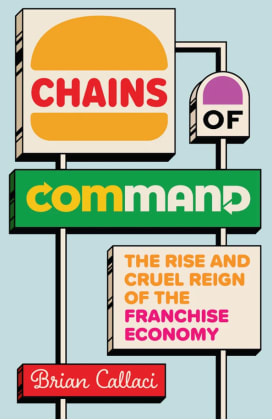 |
Open Markets Institute’s chief economist Brian Callaci will publish his first book Chains of Command: The Rise and Cruel Reign of the Franchise Economy on April 20 through University of Chicago Press. The book offers a sharp critique of the franchise model used by many fast food chains, which has shaped labor markets, corporate power, and inequality in the U.S. In Chains of Command, Callaci shows how franchisors have altered the legal treatment of corporations in their favor through a decades-long crusade of lobbying and litigation, and argues for greater cooperation between workers and small franchise owners. Pre-order the book here.
DISCOUNT CODE: CHAINS2025
Written and edited by: Barry Lynn, George Colville, Ezmeralda Makhamreh, Austin Ahlman, and Anita Jain
Open Markets Institute
655 15th St NW, Suite 310
Washington, DC xxxxxx
We thought you'd like to be in the know about competition policy news. Liked what you read? Please forward to a friend or colleague and subscribe for more updates.
| ||||||||||

