
Email
Add your name: Rocket fuel doesn't belong in our drinking water
| From | U.S. PIRG <[email protected]> |
| Subject | Add your name: Rocket fuel doesn't belong in our drinking water |
| Date | February 10, 2026 3:50 PM |
Links have been removed from this email. Learn more in the FAQ.
Links have been removed from this email. Learn more in the FAQ.
:
John,
When it comes to the toxic chemical perchlorate, we have some good news and some bad news.
The good news is that the Environmental Protection Agency (EPA) has finally proposed a national limit on perchlorate in drinking water.
But the bad news is that the limit the agency put forward is too weak to fully protect public health, especially infants and pregnant women.
Right now, the EPA is accepting public comments before this rule is finalized.[1]
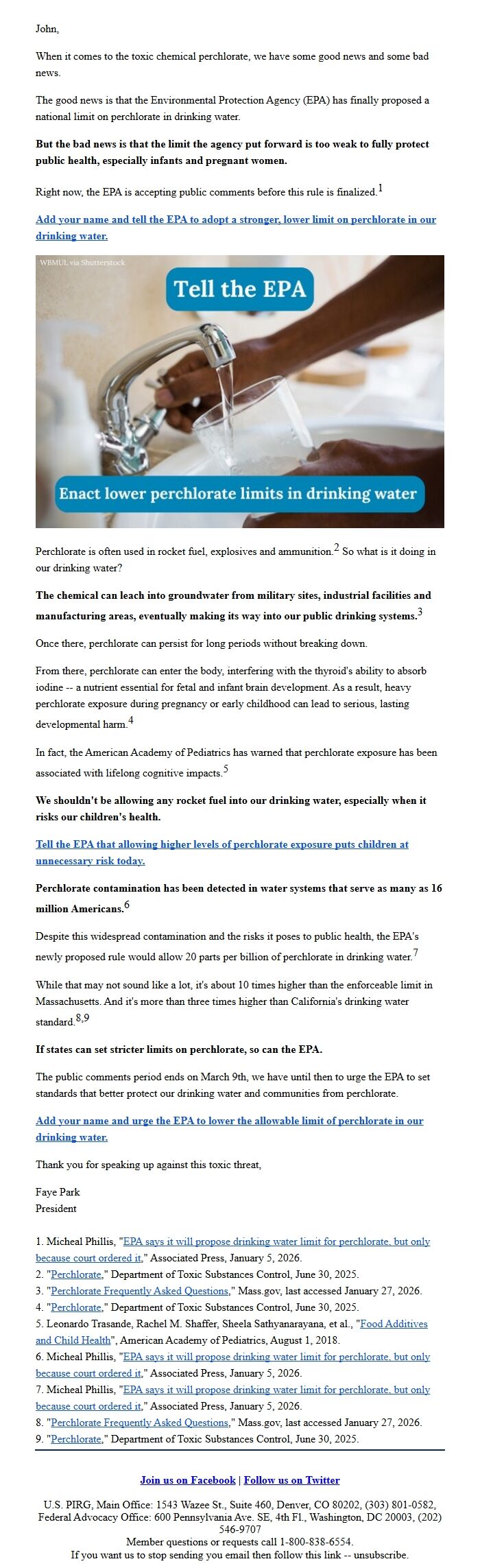
Add your name and tell the EPA to adopt a stronger, lower limit on perchlorate in our drinking water.
[link removed]
Perchlorate is often used in rocket fuel, explosives and ammunition.[2] So what is it doing in our drinking water?
The chemical can leach into groundwater from military sites, industrial facilities and manufacturing areas, eventually making its way into our public drinking systems.[3]
Once there, perchlorate can persist for long periods without breaking down.
From there, perchlorate can enter the body, interfering with the thyroid's ability to absorb iodine -- a nutrient essential for fetal and infant brain development. As a result, heavy perchlorate exposure during pregnancy or early childhood can lead to serious, lasting developmental harm.[4]
In fact, the American Academy of Pediatrics has warned that perchlorate exposure has been associated with lifelong cognitive impacts.[5]
We shouldn't be allowing any rocket fuel into our drinking water, especially when it risks our children's health.
Tell the EPA that allowing higher levels of perchlorate exposure puts children at unnecessary risk today.
[link removed]
Perchlorate contamination has been detected in water systems that serve as many as 16 million Americans.[6]
Despite this widespread contamination and the risks it poses to public health, the EPA's newly proposed rule would allow 20 parts per billion of perchlorate in drinking water.[7]
While that may not sound like a lot, it's about 10 times higher than the enforceable limit in Massachusetts. And it's more than three times higher than California's drinking water standard.[8,9]
If states can set stricter limits on perchlorate, so can the EPA.
The public comments period ends on March 9th, we have until then to urge the EPA to set standards that better protect our drinking water and communities from perchlorate.
Add your name and urge the EPA to lower the allowable limit of perchlorate in our drinking water.
[link removed]
Thank you for speaking up against this toxic threat,
Faye Park
President
1. Micheal Phillis, "EPA says it will propose drinking water limit for perchlorate, but only because court ordered it," Associated Press, January 5, 2026.
[link removed]
2. "Perchlorate," Department of Toxic Substances Control, June 30, 2025.
[link removed]
3. "Perchlorate Frequently Asked Questions," Mass.gov, last accessed January 27, 2026.
[link removed]
4. "Perchlorate," Department of Toxic Substances Control, June 30, 2025.
[link removed]
5. Leonardo Trasande, Rachel M. Shaffer, Sheela Sathyanarayana, et al., "Food Additives and Child Health", American Academy of Pediatrics, August 1, 2018.
[link removed]
6. Micheal Phillis, "EPA says it will propose drinking water limit for perchlorate, but only because court ordered it," Associated Press, January 5, 2026.
[link removed]
7. Micheal Phillis, "EPA says it will propose drinking water limit for perchlorate, but only because court ordered it," Associated Press, January 5, 2026.
[link removed]
8. "Perchlorate Frequently Asked Questions," Mass.gov, last accessed January 27, 2026.
[link removed]
9. "Perchlorate," Department of Toxic Substances Control, June 30, 2025.
[link removed]
-----------------------------------------------------------
U.S. PIRG
[email protected]
Facebook: [link removed]
Twitter: [link removed]
Main Office: 1543 Wazee St., Suite 460, Denver, CO 80202 | (303) 801-0582
Federal Advocacy Office: 600 Pennsylvania Ave. SE, 4th Fl., Washington, DC 20003 | (202) 546-9707
Member Questions or Requests: 1-800-838-6554
If you want us to stop sending you email then follow this link -- [link removed]
John,
When it comes to the toxic chemical perchlorate, we have some good news and some bad news.
The good news is that the Environmental Protection Agency (EPA) has finally proposed a national limit on perchlorate in drinking water.
But the bad news is that the limit the agency put forward is too weak to fully protect public health, especially infants and pregnant women.
Right now, the EPA is accepting public comments before this rule is finalized.[1]
Add your name and tell the EPA to adopt a stronger, lower limit on perchlorate in our drinking water.
[link removed]
Perchlorate is often used in rocket fuel, explosives and ammunition.[2] So what is it doing in our drinking water?
The chemical can leach into groundwater from military sites, industrial facilities and manufacturing areas, eventually making its way into our public drinking systems.[3]
Once there, perchlorate can persist for long periods without breaking down.
From there, perchlorate can enter the body, interfering with the thyroid's ability to absorb iodine -- a nutrient essential for fetal and infant brain development. As a result, heavy perchlorate exposure during pregnancy or early childhood can lead to serious, lasting developmental harm.[4]
In fact, the American Academy of Pediatrics has warned that perchlorate exposure has been associated with lifelong cognitive impacts.[5]
We shouldn't be allowing any rocket fuel into our drinking water, especially when it risks our children's health.
Tell the EPA that allowing higher levels of perchlorate exposure puts children at unnecessary risk today.
[link removed]
Perchlorate contamination has been detected in water systems that serve as many as 16 million Americans.[6]
Despite this widespread contamination and the risks it poses to public health, the EPA's newly proposed rule would allow 20 parts per billion of perchlorate in drinking water.[7]
While that may not sound like a lot, it's about 10 times higher than the enforceable limit in Massachusetts. And it's more than three times higher than California's drinking water standard.[8,9]
If states can set stricter limits on perchlorate, so can the EPA.
The public comments period ends on March 9th, we have until then to urge the EPA to set standards that better protect our drinking water and communities from perchlorate.
Add your name and urge the EPA to lower the allowable limit of perchlorate in our drinking water.
[link removed]
Thank you for speaking up against this toxic threat,
Faye Park
President
1. Micheal Phillis, "EPA says it will propose drinking water limit for perchlorate, but only because court ordered it," Associated Press, January 5, 2026.
[link removed]
2. "Perchlorate," Department of Toxic Substances Control, June 30, 2025.
[link removed]
3. "Perchlorate Frequently Asked Questions," Mass.gov, last accessed January 27, 2026.
[link removed]
4. "Perchlorate," Department of Toxic Substances Control, June 30, 2025.
[link removed]
5. Leonardo Trasande, Rachel M. Shaffer, Sheela Sathyanarayana, et al., "Food Additives and Child Health", American Academy of Pediatrics, August 1, 2018.
[link removed]
6. Micheal Phillis, "EPA says it will propose drinking water limit for perchlorate, but only because court ordered it," Associated Press, January 5, 2026.
[link removed]
7. Micheal Phillis, "EPA says it will propose drinking water limit for perchlorate, but only because court ordered it," Associated Press, January 5, 2026.
[link removed]
8. "Perchlorate Frequently Asked Questions," Mass.gov, last accessed January 27, 2026.
[link removed]
9. "Perchlorate," Department of Toxic Substances Control, June 30, 2025.
[link removed]
-----------------------------------------------------------
U.S. PIRG
[email protected]
Facebook: [link removed]
Twitter: [link removed]
Main Office: 1543 Wazee St., Suite 460, Denver, CO 80202 | (303) 801-0582
Federal Advocacy Office: 600 Pennsylvania Ave. SE, 4th Fl., Washington, DC 20003 | (202) 546-9707
Member Questions or Requests: 1-800-838-6554
If you want us to stop sending you email then follow this link -- [link removed]
Message Analysis
- Sender: n/a
- Political Party: n/a
- Country: n/a
- State/Locality: n/a
- Office: n/a
-
Email Providers:
- ActionKit