|
Dear Members and Friends,
"Good morning, ladies and gentlemen, from a super cold day with snow everywhere here in Alexandria on a super cold weekend. I do want to, before we start, I do want to shout out to my teammate Roger Craig, my draft mate from being inducted in the NFL Hall of Fame. He joins nine of our teammates in the Hall of Fame for the Super Bowl Sunday.
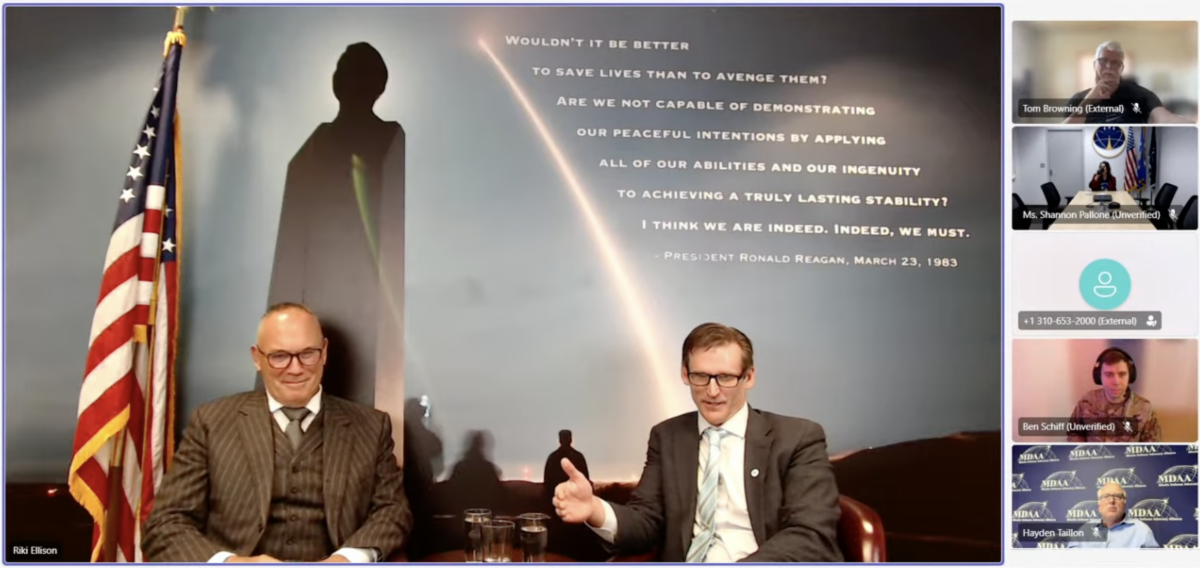
I'm Riki Ellison, I'm the founder and chairman of the Missile Defense Advocacy Alliance. I've been involved with missile defense since 1980 in lectures from Edward Teller and with the national security team of Ronald Reagan way, way back. And our mission over those 40 years has been to be able to educate and advocate for missile defense to make our nation a safer place and our world a safer place. And we are seeing that in all spectrums in today's world, how important this issue is. This is our 90th Congressional Roundtable that we're doing, and it's on clouds, making clouds reign for missile defense, on it.
So the reality in today's world right now, clouds are being used. You just go right to today, yesterday, last week in Ukraine, every single day on their ability to defend their nation and their key infrastructures from Russian capabilities. We also saw last week the use of cloud with the F-35 in the Arabian Sea, being able to intercept an Iranian drone, and using the CSC and the missile defense leadership in that battle group to do that. And we're going to see it on Sunday. We're going to have things, the Department of Homeland Security will have cloud data, will have capability to defeat and detect drones around in Santa Clara, California. So it's real.
We are at a massive juncture in where we have to go, because it is a massive challenge. If you're going to defend the United States from all air, space, missile threats. It's going to require trillions of data points. It's going to require sensors from all over to be able to collect this massive amount of data, store it, process it, put it in AI supercomputers and spit it out. So a decision maker can make a decision accurately enough that the fatal thing of going to war, not going to war. And if you're going to go in a direction, then you have to resend all that data out to your effectors to do it.
So it certainly is real in today's world. And data is data. Data doesn't care if it's offense, defense. It doesn't care if it's just for the Air Force or just for the Navy or for the Army. It doesn't care. And the civilian part of the world has developed this maybe better than our military on how to collect that data and how to use that data. And we are at a point where you can't possibly be able to do this without civilian support and civilian being a main partner with your ability to do that essential system.
As a country, we've struggled with integration, especially with our military services. And that could go all the way back to World War II. Went back, you know, when Chairman David Jones in February 1983 started the Goldwater-Nichols Act. We struggled integrating as a joint service. And we see it all the time. And whether it's services, fighting for funds, for that. And we all come together for a fight, a real war fight situation. But outside of that, it has been a challenge. And we've created phenomenal C2 systems for each of the services. They're unprecedented. The CSC for Aegis is unprecedented in what it can do defensively from the surface all the way up to space to do that.
So we are very good at our own service C2 capabilities on doing it. But it's bringing all those things together. And we've tried it, you know, with the JADC2. We'll continue to try to move it, Joint Fires Network. But last January, when the President of the United States put an executive order for the Golden Dome of America, this is what the number one thing that the Golden Dome will do, and has to do. It's more important and a lot harder to do than making space interceptors or innovating new sensors or innovating cheaper missiles, all that. The hardest thing to do is to integrate all this data together. And that is the challenge for Mike Guetlein, to be able to do this. And that's the only way you're going to be able to defend the United States of America, to be able to have that kind of data capability to share, integrate, and go forward around it.
So we're in a discussion. We're going to admire the problem a little bit, but we really have to take a look at solutions, breaking some glass here, playing linebackers, shooting the gap here, and looking at how can we make this better? How can we get this to where it has to be?
And we have four outstanding perspectives coming to you today. We have one from the big holistic picture, the Assault Breaker and JFN creator. From a big aspect of it, we have the best, well, the best, the only architect for the Air Force, for Battle Management Command and Control. So we've got an Air Force perspective. We've got Space Force perspective that's brand new on how they're going to create their C2 systems with that. And then we've got someone right on the edge, the Army right on the edge of the fight in Ukraine using cloud today. And I've got, we had to get the other service in. So I do have our questions and answers coming from a Navy specialist who's been involved with missile defense since about 20 years ago."
-- Riki Ellison, 90th MDAA Virtual CRT
Executive Summary
I. Introduction
The Virtual CRT “Making Clouds Reign for Missile Defense: Cloud C2 & Data Fabric on the Edge” convened senior defense and operational leaders to examine how cloud-enabled command and control can accelerate U.S. and allied missile defense integration—especially as Golden Dome demands a unified, data-centric architecture. Hosted by MDAA Chairman Riki Ellison, the discussion featured Tom “Shotgun” Browning (former senior DoD R&D leader and Joint Fires Network contributor), Dr. Bryan Tipton (DAF PAE C3BM), Major Benjamin Schiff (U.S. Army Europe & Africa software operations), and Shannon Pallone (Space Force/space enterprise battle management leadership).
II. Strategic Context: Missile Defense Is Becoming a Data Problem
Ellison framed the core reality: homeland and theater defense against air, missile, and space threats will require integrating “trillions” of data points across sensors, domains, and services, then processing and distributing that data fast enough to support decision and fire-control timelines. The discussion emphasized that cloud is no longer theoretical—Ukraine, carrier strike group operations, and domestic counter-UAS security examples illustrate that cloud-enabled data fusion is already shaping real-world defense outcomes.
III. The Central Challenge: Integration Across Services, Domains, and Allies
A consistent theme was that the hardest problem is not building individual service C2 systems—those already exist and are powerful—but integrating them into a shared architecture that transcends service “stovepipes.” Participants linked this directly to Golden Dome’s success: integration of the data layer and decision layer is the enabling requirement that makes every other capability (space sensing, interceptors, cheaper munitions, AI) actually usable as a single defense system.
IV. Cloud Value Proposition: Speed, Scale, and Modernization
Dr. Tipton argued cloud simplifies integration by centralizing critical data and software into standardized environments with stronger, more manageable cybersecurity controls—replacing brittle point-to-point connections that do not scale. He highlighted the Air Force’s cloud-based command-and-control efforts and described a rapid fielding cycle (project start in 2022, useful operational capability in ~18 months for an air defense sector), emphasizing that cloud accelerates data-feed integration and enables faster software upgrades and AI insertion.
V. Cloud Risks and Constraints: Comms Dependency, Security Policy, and Vendor Lock
Browning, speaking from a joint-architecture and historical perspective, endorsed cloud’s necessity but warned that cloud “means you have comms,” and comms cannot be assumed in conflict. He identified three structural barriers:
Communications dependency (cloud unreachable = capability degraded),
Security policy that prevents effective aggregation and even blocks movement onto commercial cloud in some cases, and
Proprietary cloud architectures that can make integration or migration across providers extremely difficult.
His conclusion: the technology exists, but success depends on policy modernization, government rights to move data/software, and architecture choices that prevent lock-in.
VI. Edge + Cloud: Lessons from Ukraine and the “Cloud-Native” Imperative
Major Schiff described Ukraine’s advantage as more than “running in the cloud”—it is cloud-native, forward-deployed, open, event-driven warfighting software. He contrasted U.S. legacy approaches (migrating old systems into hosted environments) with Ukraine’s ability to design systems around elastic compute, rapid iteration, and scalable mass. He emphasized that the true inhibitor is not technical integration but policy, and argued for multi-provider designs using open standards so the same system can run across sovereign clouds, cloud-to-edge, and coalition environments.
Browning reiterated that both exquisite systems and scalable mass must be utilized, and that cloud C2 must operate to enable both.
VII. Data Architecture for Coalition Defense: Pub/Sub, Sovereign Clouds, and “Disaggregate to Share”
A major operational insight was a proposed shift in how allied data should be shared: instead of forcing everything “up” into higher classification systems before sharing, Schiff argued for connecting at the lowest feasible classification, keeping data close to where it is produced, and using a publish/subscribe model so partners subscribe to relevant updates without duplicating entire datasets. This approach was presented as a practical path for building an allied “data backbone” across borders, particularly for wide-area threats and counter-UAS early warning.
VIII. Space Scaling and the Unified Data Library: Cloud as the Only Viable Path
Pallone emphasized that space introduces exponential growth in objects, sensors, and track data—making cloud-enabled architectures essential for scaling fusion and battle management. She pointed to “unified data library” efforts built on cloud structures and argued that security challenges are solvable through modern approaches (e.g., tagging data at ingest, policy applied at the message level, and zero-trust architectures). She also cautioned against the illusion of “all data everywhere all at once,” noting physics and latency constraints require smart placement and retrieval strategies.
IX. Policy as the Bottleneck: Security, Data Rights, and Lethality Assurance
Across speakers, the dominant constraint was policy—especially security rules that slow sharing, restrict cloud use, and inhibit integration. Browning further warned that for lethal decisions, “fusing fused data” can be dangerous unless the force can trace data pedigree (what source produced what element of the picture) to prevent misidentification and catastrophic outcomes. The group broadly agreed: cloud can accelerate speed and situational awareness, but lethal-force workflows require rigorous provenance and accountability.
X. Industry Model: Control the Core, Enable the Ecosystem
In discussing “consortium vs. edge-driven innovation,” participants converged on a hybrid model:
Maintain tight control over a government-defined core (the “OS” or fabric) to ensure interoperability and jointness,
Allow a competitive, modular marketplace of applications and capabilities around it, enabling rapid innovation and new entrants, and
Ensure government has the rights and flexibility to move data and software as mission demands evolve.
This approach was framed as a way to harness commercial speed while preserving operational sovereignty and coalition scalability.
XI. Implications and Way Ahead
The roundtable concluded that cloud-enabled missile defense C2 is both feasible and urgent—but only if the U.S. modernizes policy, secures resilient comms and edge fallback, and builds a joint, open, multi-provider architecture that can integrate allied data at scale. Golden Dome’s decisive advantage will come less from any single interceptor or sensor than from a shared “data fabric” that can fuse inputs, apply AI, and deliver decision-quality information—from the tactical edge to homeland defense—fast enough to matter.
Speakers:
Thomas Browning
Former acting Assistant Secretary of Defense for Mission Capabilities under the Office of the Undersecretary of Defense for Research and Engineering
Dr. Bryan Tipton
Chief of Architecture and Engineering at the Department of the Air Force Portfolio Acquisition Executive office for Command, Control, Communications and Battle Management (DAF PAE C3BM), Assistance Secretary of the Air Force for Acquisition, Technology and Logistics
Major Benjamin Schiff
Software Operations Officer for the Operational Data Team (ODT) at U.S. Army Europe and Africa (USAREUR-AF)
Shannon Pallone
Program Executive Officer (PEO) for Battle Management Command, Control & Communications, United States Space Force
Riki Ellison
MDAA Founder & Chairman
Click here to view transcript
Click here to view recording
Winners Associate with Winners to Win!
Fight on!
|