The Government has launched a new National Plan to End Homelessness, aiming to halve long‑term rough sleeping and prevent more households from becoming homeless. Backed by £3.5 billion over the next three years, the plan focuses on stopping homelessness before it happens and improving support for people already at risk.
Key pledges include ending the unlawful use of B&Bs for families, boosting the supply of good‑quality temporary homes and introducing a new duty for public services to work together to prevent homelessness. The plan is shaped by people with lived experience and frontline workers, reflecting real challenges faced across the country.
This strategy follows the new Renters’ Rights Act, which ends no‑fault evictions—an important step in helping people stay securely housed.
|
|
Following its consultation on improving energy efficiency, the government has confirmed new Minimum Energy Efficiency Standards (MEES) for socially rented homes:
-
All new and existing social rented properties must reach EPC C or equivalent by 1 April 2030, unless a valid exemption is registered
- By 2030, landlords must meet EPC C using one reformed EPC metric, choosing between Fabric Performance, Heating System or Smart Readiness
- Providers will then be required to meet EPC C against a second metric by 1 April 2039, again with flexibility over which metric to use.
Homes that already meet the current EPC C standard will remain compliant for the life of their certificate. Maximum a provider would be required to spend to comply with MEES between now and 1 April 2030 is £10,000 per property.
Further detail, including the statutory documentation and guidance on how the new standards and exemptions will operate in practice, will be set out in forthcoming legislation and supporting guidance.
|

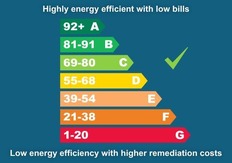
An Energy Performance Certificate (EPC) rating shows how energy efficient a home is, using a scale from A (most efficient) to G (least efficient). Higher EPC ratings mean homes are cheaper to heat, produce fewer carbon emissions, and are better equipped for a low-carbon future.
Nottingham has committed to achieving EPC C ratings across all our social housing by 2030, as set out in the Housing Strategy 2024–2028.
The Council has already secured £18.2 million Social Housing Decarbonisation Fund (SHDF) Wave 3 funding which, matched by a further £18.2 million from the Housing Revenue Account, gives us £36.4 million for energy efficiency improvements between now and March 2028.
This investment enables us to pilot and roll out innovative retrofit solutions, adopt modern energy-saving technologies, and build the skills and supply chains needed for long-term delivery.
|

The government is moving ahead with changes to Energy Performance Certificates (EPCs), with new-style EPCs expected from October 2026. In future, an EPC will be required when a property is marketed, rather than when it is sold or let. The rules will also be clearer about which homes need an EPC, including whole-property EPCs for HMOs, short-term lets, and heritage buildings, which will no longer be exempt. EPCs will continue to be valid for ten years.
Instead of a single overall score, new EPCs will show four headline ratings covering energy cost, building fabric, heating systems and smart readiness. They will also include a new energy demand measure, showing modelled energy use, while retaining carbon information and the existing Energy Efficiency Rating (EER) so comparisons can still be made with current EPCs.
|

The Boiler Upgrade Scheme gives homeowners in England a government grant to help pay for greener heating, like heat pumps or biomass boilers, instead of old fossil-fuel boilers. Under the scheme, you can get £7,500 toward an air-source or ground-source heat pump, or £5,000 toward a biomass boiler.
To qualify you need to own the property, be replacing an existing fossil-fuel heating system (like gas, oil or electric), and have a valid Energy Performance Certificate (EPC). Your installer must be MCS-certified and will check eligibility and apply for the grant on your behalf.
Once you agree a quote with an eligible installer, they apply for the grant through Ofgem, and the value is taken off your installation bill.
|

|
A new Government research report has shed light on the experiences of people renting in the private sector in England. The study surveyed over 1,500 tenants to understand their satisfaction, housing conditions, and confidence in the complaints process. Overall, most renters reported positive experiences, but many still face problems such as damp and mould, with 77% experiencing at least one property issue.
While 61% were satisfied with their property’s condition, nearly half said issues weren’t always resolved effectively. Fear of rent increases or eviction stops many tenants from complaining, particularly disabled tenants and financially vulnerable renters, who reported worse experiences overall.
|

The Council will move its Independent Living schemes to a Home Care model, aiming to give residents greater flexibility and personalised support.
The change means that instead of receiving care from one onsite provider, residents will be able to choose from a wider range of accredited home‑care agencies. This approach is designed to improve choice, raise care quality and ensure the service meets individual needs more effectively.
The transition will be carefully managed and all current residents will receive support throughout the process so no one is left without essential care. The shift reflects ongoing efforts to modernise adult social care and offer people greater control over how support is delivered.
|

Plans for 113 new homes near Nottingham City Hospital have been put on hold after the developer pulled out of a key funding programme. The scheme, led by MyPad in partnership with Nottingham Community Housing Association, had been selected to receive about £1.1 million from the East Midlands Combined Authority’s Brownfield Housing Fund — money set aside to support stalled developments on previously used land.
However, after reassessing the project’s viability it was found no longer eligible for funding, and the developer withdrew from the process. As a result, the grant may have to be returned. EMCCA officials say they are seeking a replacement scheme before the government’s funding deadline in March, but time is tight.
|


Network Rail has launched Platform4, a new government‑owned company created to turn disused railway land into new homes and vibrant mixed‑use communities. The initiative aims to deliver up to 40,000 homes over the next decade, including 15,000 in the first five years, helping the Government meet its commitment to build 1.5 million homes.
Platform4 will redevelop brownfield rail sites, bringing forward new neighbourhoods that include homes, green spaces, shops and hotels. Major locations already identified include Manchester, Newcastle, Cambridge and Nottingham. The project is expected to generate £1 billion in development value and create thousands of new jobs. By merging two existing rail‑property teams, Platform4 will speed up delivery, attract investment and support long‑term community regeneration.
|

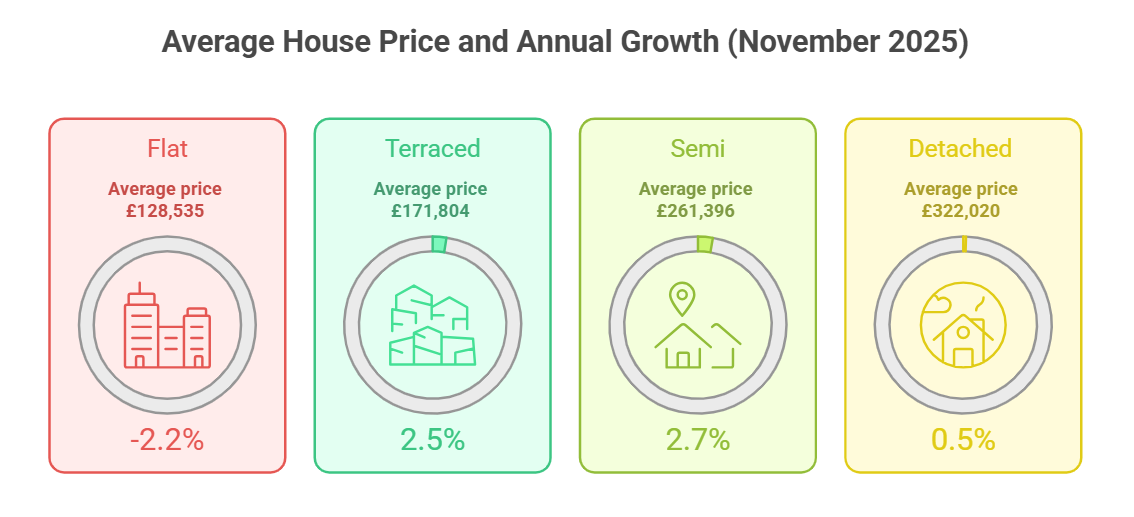
Nottingham’s housing market continued to show mixed but relatively subdued movement in November 2025, with price trends varying notably by property type. Flats recorded the weakest performance, with average prices at £128,535, reflecting a 2.2% annual decline, underperforming the national fall of 1.2%. This points to softer demand for smaller properties locally compared with the wider market.
By contrast, terraced (£171,804) and semi-detached (£261,396) homes saw steady annual growth of 2.5% and 2.7% respectively, broadly in line with, though slightly below, national averages (3.1% and 3.3%) . Detached homes in Nottingham rose modestly by 0.5% to £322,020, significantly trailing national detached growth of 2.5%, suggesting a less pressured and more balanced local market than seen across England.
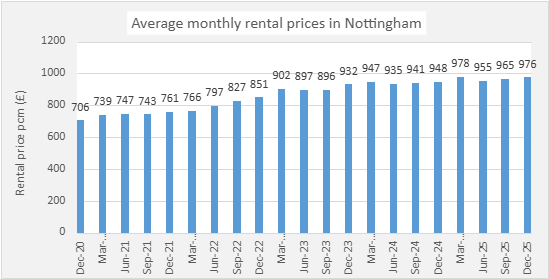
Nottingham’s rental market showed signs of softening in the year to October 2025, with annual rent change slipping to -0.4 %, a rare decline compared with national performance. While UK rents broadly climbed 2.2 % over the same period, the City’s negative trend suggests increased stock and weakening demand are outweighing local upward pressure.
The average property rental price in Nottingham was £976 in December, £11 higher than the previous quarter. With rental choice increasing and properties taking longer to let, this modest uplift suggests an environment of softening competitive pressure rather than one of acute shortage.

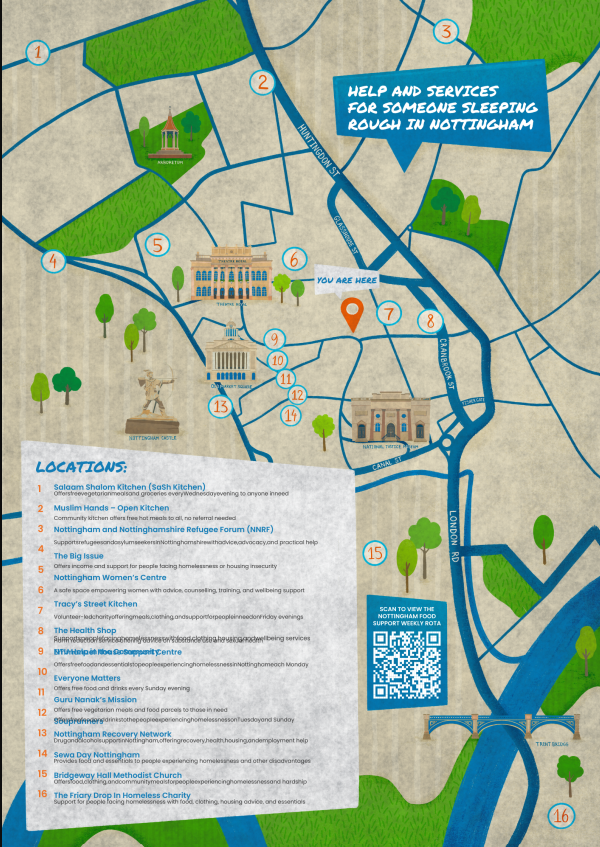
A neglected phone box in Hockley has been transformed into a “Hope Box”, offering vital support to people facing homelessness. Officially opened on 19 January by Framework and It’s in Nottingham, it features a citywide map showing where to find food, clothing, wellbeing services and harm‑reduction support.
Artwork inside the box was created by people supported by the Nottingham Recovery Network and women living at Grove House, each sharing powerful messages of hope and recovery.
The Hope Box also displays Framework’s freephone number so the public can alert the outreach team to anyone sleeping rough. A QR‑code donation campaign will help fund birth certificates, enabling people to access essential services.

Equation's film 'Why you should ask about abuse' has been entered for the Smiley Charity Film Awards - and they need YOUR vote!
Last year Equation coordinated a project about developing responses to domestic abuse in health settings and has created an animation encouraging health settings (and all other settings) to ask about domestic abuse.
This was followed up with animation on how to ask about domestic abuse. The video aims to improves understanding of the importance of asking about domestic abuse.
|

|
NCHA in collaboration with Access Training are offering free training support to adults aged 19+ who are unemployed and receiving benefits, or earning below £25,750 per year.
Available courses will support individuals to boost their confidence and enhance their employment skills.
|

National Numeracy, in partnership with Experian UK, is offering a fully funded, CPD-accredited programme designed to help people build confidence with numbers.
This online training (two 2-hour session) contributes to employability, financial wellbeing and broader community resilience by encouraging positive attitudes to numeracy and addressing barriers to using numbers in daily life.
|
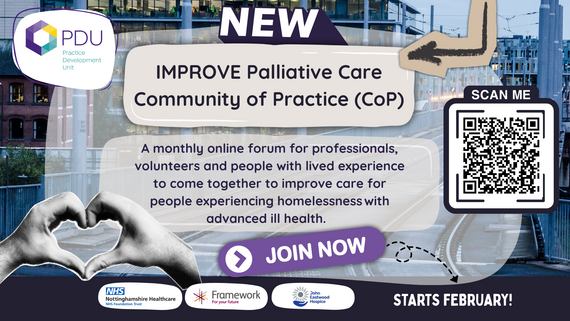 The PDU, in partnership with Framework, Nottinghamshire Healthcare Trust and John Eastwood Hospice, are launching a new community of practice for professionals, volunteers and people with lived experience to come together to improve palliative care and support offered to people experiencing homelessness and advanced ill health.
Meetings will be held online on a monthly basis, on Tuesday’s 1-3pm, starting on the 3rd February.
Planned topics for discussion include:
- Identifying people who would benefit from a palliative care approach
- Challenges & good practice in delivering palliative care
- Complex psychological trauma, and challenging assumptions
- Pain and medication management, an example of integrated team working
- Planning for the future with clients
- Bereavement and support for clients and staff
|