
Email
HB1665: A Prescription for Bigger Government, Not Lower Costs
| From | Dana Criswell <[email protected]> |
| Subject | HB1665: A Prescription for Bigger Government, Not Lower Costs |
| Date | February 9, 2026 1:05 PM |
Links have been removed from this email. Learn more in the FAQ.
Links have been removed from this email. Learn more in the FAQ.
View this post on the web at [link removed]
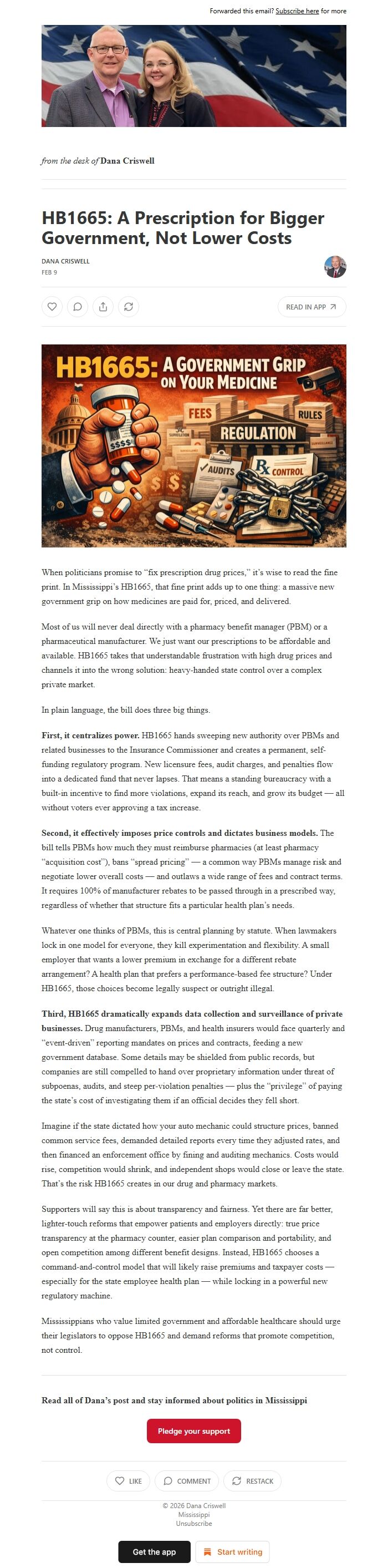
When politicians promise to “fix prescription drug prices,” it’s wise to read the fine print. In Mississippi’s HB1665, that fine print adds up to one thing: a massive new government grip on how medicines are paid for, priced, and delivered.
Most of us will never deal directly with a pharmacy benefit manager (PBM) or a pharmaceutical manufacturer. We just want our prescriptions to be affordable and available. HB1665 takes that understandable frustration with high drug prices and channels it into the wrong solution: heavy-handed state control over a complex private market.
In plain language, the bill does three big things.
First, it centralizes power. HB1665 hands sweeping new authority over PBMs and related businesses to the Insurance Commissioner and creates a permanent, self-funding regulatory program. New licensure fees, audit charges, and penalties flow into a dedicated fund that never lapses. That means a standing bureaucracy with a built-in incentive to find more violations, expand its reach, and grow its budget — all without voters ever approving a tax increase.
Second, it effectively imposes price controls and dictates business models. The bill tells PBMs how much they must reimburse pharmacies (at least pharmacy “acquisition cost”), bans “spread pricing” — a common way PBMs manage risk and negotiate lower overall costs — and outlaws a wide range of fees and contract terms. It requires 100% of manufacturer rebates to be passed through in a prescribed way, regardless of whether that structure fits a particular health plan’s needs.
Whatever one thinks of PBMs, this is central planning by statute. When lawmakers lock in one model for everyone, they kill experimentation and flexibility. A small employer that wants a lower premium in exchange for a different rebate arrangement? A health plan that prefers a performance-based fee structure? Under HB1665, those choices become legally suspect or outright illegal.
Third, HB1665 dramatically expands data collection and surveillance of private businesses. Drug manufacturers, PBMs, and health insurers would face quarterly and “event-driven” reporting mandates on prices and contracts, feeding a new government database. Some details may be shielded from public records, but companies are still compelled to hand over proprietary information under threat of subpoenas, audits, and steep per-violation penalties — plus the “privilege” of paying the state’s cost of investigating them if an official decides they fell short.
Imagine if the state dictated how your auto mechanic could structure prices, banned common service fees, demanded detailed reports every time they adjusted rates, and then financed an enforcement office by fining and auditing mechanics. Costs would rise, competition would shrink, and independent shops would close or leave the state. That’s the risk HB1665 creates in our drug and pharmacy markets.
Supporters will say this is about transparency and fairness. Yet there are far better, lighter-touch reforms that empower patients and employers directly: true price transparency at the pharmacy counter, easier plan comparison and portability, and open competition among different benefit designs. Instead, HB1665 chooses a command-and-control model that will likely raise premiums and taxpayer costs — especially for the state employee health plan — while locking in a powerful new regulatory machine.
Mississippians who value limited government and affordable healthcare should urge their legislators to oppose HB1665 and demand reforms that promote competition, not control.
Unsubscribe [link removed]?
When politicians promise to “fix prescription drug prices,” it’s wise to read the fine print. In Mississippi’s HB1665, that fine print adds up to one thing: a massive new government grip on how medicines are paid for, priced, and delivered.
Most of us will never deal directly with a pharmacy benefit manager (PBM) or a pharmaceutical manufacturer. We just want our prescriptions to be affordable and available. HB1665 takes that understandable frustration with high drug prices and channels it into the wrong solution: heavy-handed state control over a complex private market.
In plain language, the bill does three big things.
First, it centralizes power. HB1665 hands sweeping new authority over PBMs and related businesses to the Insurance Commissioner and creates a permanent, self-funding regulatory program. New licensure fees, audit charges, and penalties flow into a dedicated fund that never lapses. That means a standing bureaucracy with a built-in incentive to find more violations, expand its reach, and grow its budget — all without voters ever approving a tax increase.
Second, it effectively imposes price controls and dictates business models. The bill tells PBMs how much they must reimburse pharmacies (at least pharmacy “acquisition cost”), bans “spread pricing” — a common way PBMs manage risk and negotiate lower overall costs — and outlaws a wide range of fees and contract terms. It requires 100% of manufacturer rebates to be passed through in a prescribed way, regardless of whether that structure fits a particular health plan’s needs.
Whatever one thinks of PBMs, this is central planning by statute. When lawmakers lock in one model for everyone, they kill experimentation and flexibility. A small employer that wants a lower premium in exchange for a different rebate arrangement? A health plan that prefers a performance-based fee structure? Under HB1665, those choices become legally suspect or outright illegal.
Third, HB1665 dramatically expands data collection and surveillance of private businesses. Drug manufacturers, PBMs, and health insurers would face quarterly and “event-driven” reporting mandates on prices and contracts, feeding a new government database. Some details may be shielded from public records, but companies are still compelled to hand over proprietary information under threat of subpoenas, audits, and steep per-violation penalties — plus the “privilege” of paying the state’s cost of investigating them if an official decides they fell short.
Imagine if the state dictated how your auto mechanic could structure prices, banned common service fees, demanded detailed reports every time they adjusted rates, and then financed an enforcement office by fining and auditing mechanics. Costs would rise, competition would shrink, and independent shops would close or leave the state. That’s the risk HB1665 creates in our drug and pharmacy markets.
Supporters will say this is about transparency and fairness. Yet there are far better, lighter-touch reforms that empower patients and employers directly: true price transparency at the pharmacy counter, easier plan comparison and portability, and open competition among different benefit designs. Instead, HB1665 chooses a command-and-control model that will likely raise premiums and taxpayer costs — especially for the state employee health plan — while locking in a powerful new regulatory machine.
Mississippians who value limited government and affordable healthcare should urge their legislators to oppose HB1665 and demand reforms that promote competition, not control.
Unsubscribe [link removed]?
Message Analysis
- Sender: n/a
- Political Party: n/a
- Country: n/a
- State/Locality: n/a
- Office: n/a