|
Goldstein For Congress - Please Subscribe and also visit us at www.goldsteinforcongress.com



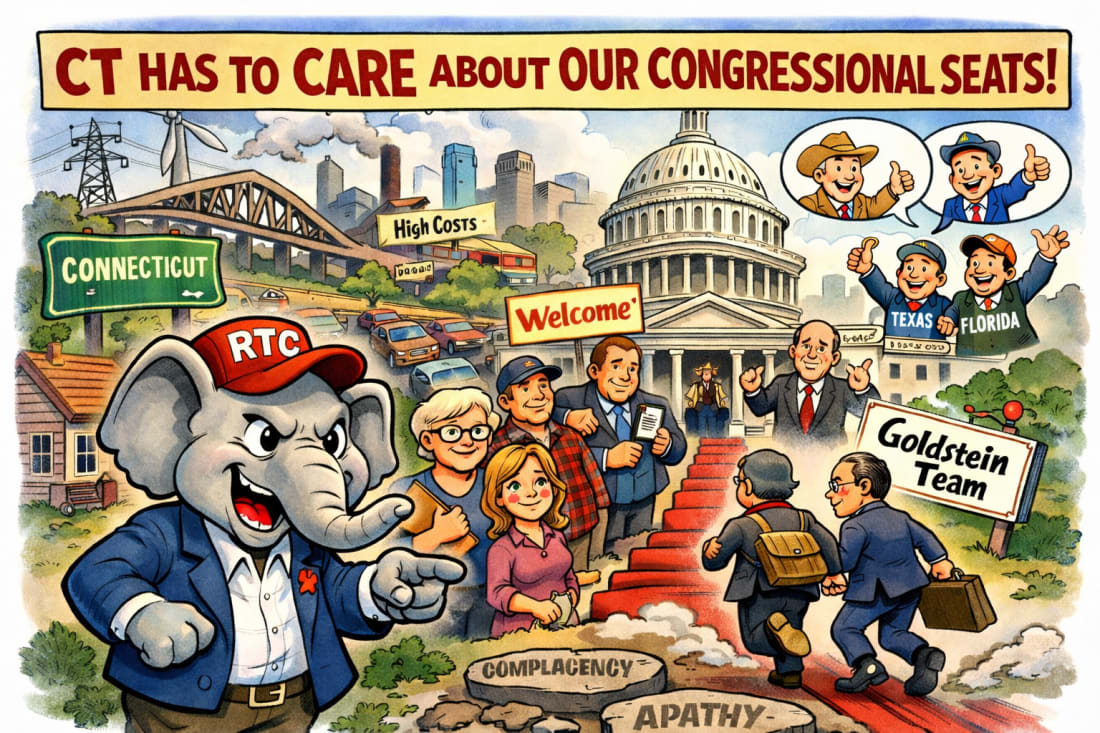 |
Most Republican Town Committees in Connecticut have given up on congressional elections.
The reasons are familiar. Unlike state legislative races, which are publicly funded, congressional elections are not and are often underfunded. After years without a Republican Congressman or U.S. Senator—and losses in all five congressional districts—a sense of defeat has taken hold.
But that resignation comes at a real cost. Congressional representation matters deeply to Connecticut, and abandoning federal races has consequences that affect everyday life across the state.
Why Members of Congress Matter in Connecticut
Energy: Cost, Reliability, and Economic Survival
Federal law determines what energy sources we use, how electricity is generated, and how much consumers pay. The United States is approaching a national electricity crisis, driven by the rapid expansion of data centers, AI computing, and electrification mandates.
Connecticut is a double loser:
We already have some of the highest electricity costs in the country
Energy-intensive industries and the jobs they create will not locate here
Our aging electric grid faces real risks of shortages and brownouts
The most cost-effective and cleanest fossil fuel is natural gas, with clean coal also playing a role. Connecticut does not produce natural gas and must import it by pipeline.
There is abundant natural gas in Pennsylvania, but under current federal law, New York’s governor has veto authority over new or expanded pipelines that could bring that gas to Connecticut.
Connecticut’s congressional delegation has taken no serious action to remove or reform this veto power. Instead, they promote offshore wind—one of the most expensive and unreliable methods of electricity generation.
Removing this veto power is essential to Connecticut’s economic survival. Solar and wind are intermittent and cannot meet rising demand on their own.
Nuclear Energy
Nuclear power is clean, reliable, and carbon-free. Connecticut’s Millstone plants are aging, yet outdated federal regulations make building new nuclear facilities slow and prohibitively expensive.
Federal law must be modernized to expedite small modular and next-generation nuclear reactors, which could provide safe, affordable, long-term power. Without Republicans in Congress, this will not happen.
Transportation: I-95 Is a Federal Failure
Interstate 95 in Fairfield County is one of the most congested highways in the nation. Roughly 80% of funding to expand and modernize I-95 comes from the federal government.
Yet Connecticut’s congressional delegation has consistently resisted highway expansion in favor of forcing commuters into mass transit. In Fairfield County, that means relying on one rail line with two northbound spurs—an unrealistic alternative for most residents.
Better highways would:
Reduce commute times
Lower fuel consumption
Improve productivity
Increase quality of life
Traffic congestion is a hidden tax on time, health, and economic output. When Washington ignores the problem, nothing improves. Every day spent stuck on I-95 is a reminder that federal representation matters.
Healthcare: Government Is Driving the Crisis
Healthcare costs continue to rise faster than inflation while physician burnout increases and patient satisfaction declines.
The fundamental problem is too much government regulation and too little competition. A full federal takeover of healthcare would require trillions in new entitlements and would worsen waste, inefficiency, and access problems.
Many Democrats support Medicare for All. The predictable outcome would be an expansion of concierge medicine for the wealthy and greater healthcare disparities for everyone else.
When taxes and regulation rise too high, incentives to work, innovate, and provide care disappear.
Housing Costs: Congress Shapes Affordability
Mortgage interest rates are driven by federal spending, inflation, and economic policy—areas where Congress has enormous influence.
I have proposed a Modern Homestead Act to help middle- and working-class families become homeowners by rehabilitating cities, creating new paths to ownership, and allowing families to build equity.
Combined with school choice and voucher systems, this approach would help families build wealth without sacrificing their children’s education.
Job Training: A Missed Federal Opportunity
Congress can help finance training programs for construction trades, mechanics, healthcare professionals, and other skilled labor. These are real jobs with real pay that strengthen Connecticut’s economy and reduce dependency on government assistance.
Foreign Policy: Why It Matters at Home
Foreign policy affects Connecticut residents directly—through energy prices, supply chains, national security, and immigration pressures. Weak leadership abroad creates instability that comes home in the form of higher costs and greater risk.
Congress controls sanctions, trade policy, military funding, and foreign aid. Serious representation in Washington is essential to restoring strength, deterrence, and realism in U.S. foreign policy.
The Hard Truth Connecticut Republicans Need to Hear
The Goldstein Team has been going to Washington without holding office—meeting with policymakers, advocates, and national leaders—raising Connecticut issues on energy, infrastructure, housing, healthcare, and workforce policy.
What we have seen should be a wake-up call:
There is real interest in Connecticut
There is openness to federal reforms that would benefit this state
There is frustration in Washington that Connecticut never shows up organized or unified
In fact, there is more excitement for Connecticut solutions outside Connecticut than among Republicans inside the state.
Washington responds to organized constituencies.
When Connecticut shows no interest, it gets ignored.
RTCs Are the Missing Link
Republican Town Committees are the only institutions close enough to voters to connect local pain to federal power.
When Washington sees:
Engaged RTCs
Consistent messaging from towns
Grassroots validation behind federal priorities
Doors open. Conversations change. Momentum builds.
The Goldstein Team already has national relationships and credibility.
What has been missing is local activation from Connecticut itself.
Call to Action
If you are an RTC chair, officer, or active member:
Reach out to us
Bring your town’s federal issues forward
Engage in coordinated federal advocacy
Help show that Connecticut Republicans are awake, organized, and serious
This is not about endorsements.
It is not about money.
It is not about ego.
It is about representation.
The Goldstein Team is already doing the work in Washington.
Now Connecticut Republicans must meet the moment.
Final Thought: A Wake-Up Call
Other states fight for their interests every day.
Connecticut waits—and pays the price.
If Republican Town Committees stay on the sidelines, nothing changes.
If they engage—even imperfectly—everything starts to move.
Federal representation starts town by town.
It starts with RTCs.
It starts now.
 | A guest post by
|
The Goldstein Substack is free today. But if you enjoyed this post, you can tell The Goldstein Substack that their writing is valuable by pledging a future subscription. You won't be charged unless they enable payments.
| ||||||||||

