
| From | The Progressive <[email protected]> |
| Subject | Remembering, learning, and commemorating |
| Date | February 7, 2026 5:31 PM |
Links have been removed from this email. Learn more in the FAQ.
Links have been removed from this email. Learn more in the FAQ.
View this email in your browser ([link removed])
Dear Progressive Reader,
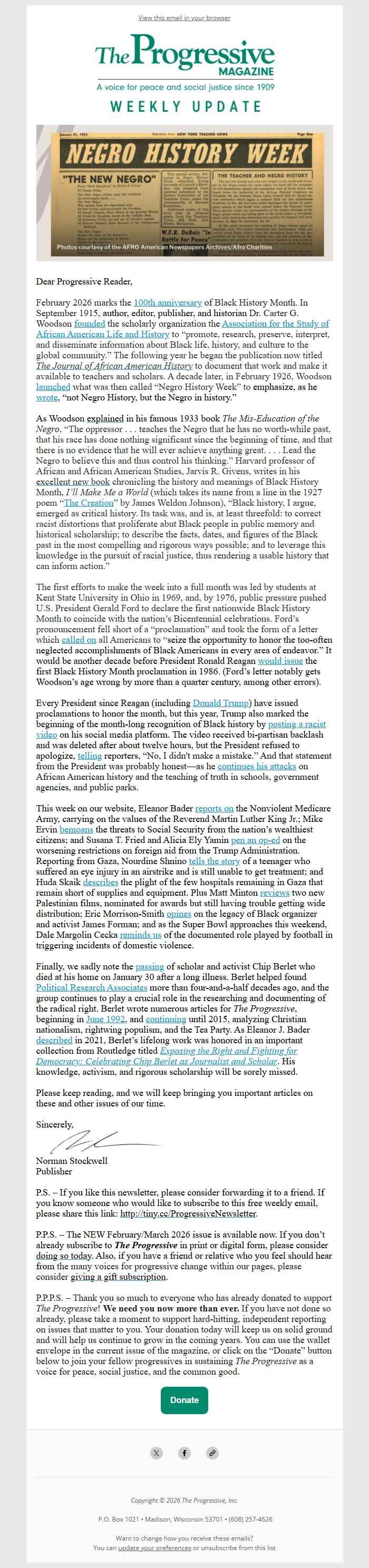
February 2026 marks the 100th anniversary ([link removed]) of Black History Month. In September 1915, author, editor, publisher, and historian Dr. Carter G. Woodson founded ([link removed]) the scholarly organization the Association for the Study of African American Life and History ([link removed]) to “promote, research, preserve, interpret, and disseminate information about Black life, history, and culture to the global community.” The following year he began the publication now titled The Journal of African American History ([link removed]) to document that work and make it available to teachers and scholars. A decade later, in February 1926, Woodson launched ([link removed]) what was then called “Negro History Week” to emphasize, as he wrote
([link removed]) , “not Negro History, but the Negro in history.”
As Woodson explained ([link removed]) in his famous 1933 book The Mis-Education of the Negro, “The oppressor . . . teaches the Negro that he has no worth-while past, that his race has done nothing significant since the beginning of time, and that there is no evidence that he will ever achieve anything great. . . . Lead the Negro to believe this and thus control his thinking.” Harvard professor of African and African American Studies, Jarvis R. Givens, writes in his excellent new book ([link removed]) chronicling the history and meanings of Black History Month, I’ll Make Me a World (which takes its name from a line in the 1927 poem “The Creation ([link removed]) ” by James Weldon Johnson), “Black history, I argue, emerged as critical history. Its task was, and is, at least threefold: to correct racist distortions that proliferate abut Black people in public memory and historical scholarship; to describe
the facts, dates, and figures of the Black past in the most compelling and rigorous ways possible; and to leverage this knowledge in the pursuit of racial justice, thus rendering a usable history that can inform action.”
The first efforts to make the week into a full month was led by students at Kent State University in Ohio in 1969, and, by 1976, public pressure pushed U.S. President Gerald Ford to declare the first nationwide Black History Month to coincide with the nation’s Bicentennial celebrations. Ford’s pronouncement fell short of a “proclamation” and took the form of a letter which called on ([link removed]) all Americans to “seize the opportunity to honor the too-often neglected accomplishments of Black Americans in every area of endeavor.” It would be another decade before President Ronald Reagan would issue ([link removed]) the first Black History Month proclamation in 1986. (Ford’s letter notably gets Woodson’s age wrong by more than a quarter century, among other errors).
Every President since Reagan (including Donald Trump ([link removed]) ) have issued proclamations to honor the month, but this year, Trump also marked the beginning of the month-long recognition of Black history by posting a racist video ([link removed]) on his social media platform. The video received bi-partisan backlash and was deleted after about twelve hours, but the President refused to apologize, telling ([link removed]) reporters, “No, I didn't make a mistake.” And that statement from the President was probably honest—as he continues his attacks ([link removed]) on African American history and the teaching of truth in schools, government agencies, and public parks.
This week on our website, Eleanor Bader reports on ([link removed]) the Nonviolent Medicare Army, carrying on the values of the Reverend Martin Luther King Jr.; Mike Ervin bemoans ([link removed]) the threats to Social Security from the nation’s wealthiest citizens; and Susana T. Fried and Alicia Ely Yamin pen an op-ed ([link removed]) on the worsening restrictions on foreign aid from the Trump Administration. Reporting from Gaza, Nourdine Shnino tells the story ([link removed]) of a teenager who suffered an eye injury in an airstrike and is still unable to get treatment; and Huda Skaik describes
([link removed]) the plight of the few hospitals remaining in Gaza that remain short of supplies and equipment. Plus Matt Minton reviews ([link removed]) two new Palestinian films, nominated for awards but still having trouble getting wide distribution; Eric Morrison-Smith opines ([link removed]) on the legacy of Black organizer and activist James Forman; and as the Super Bowl approaches this weekend, Dale Margolin Cecka reminds us ([link removed]) of the documented role played by football in triggering incidents of domestic violence.
Finally, we sadly note the passing ([link removed]) of scholar and activist Chip Berlet who died at his home on January 30 after a long illness. Berlet helped found Political Research Associates ([link removed]) more than four-and-a-half decades ago, and the group continues to play a crucial role in the researching and documenting of the radical right. Berlet wrote numerous articles for The Progressive, beginning in June 1992 ([link removed]) , and continuing ([link removed]) until 2015, analyzing Christian nationalism, rightwing populism, and the Tea Party. As Eleanor J. Bader described ([link removed]) in 2021, Berlet’s lifelong work was honored in an important collection from Routledge titled Exposing the Right and Fighting for Democracy: Celebrating Chip
Berlet as Journalist and Scholar ([link removed]) . His knowledge, activism, and rigorous scholarship will be sorely missed.
Please keep reading, and we will keep bringing you important articles on these and other issues of our time.
Sincerely,
Norman Stockwell
Publisher
P.S. – If you like this newsletter, please consider forwarding it to a friend. If you know someone who would like to subscribe to this free weekly email, please share this link: [link removed].
P.P.S. – The NEW February/March 2026 issue is available now. If you don’t already subscribe to The Progressive in print or digital form, please consider doing so today ([link removed]) . Also, if you have a friend or relative who you feel should hear from the many voices for progressive change within our pages, please consider giving a gift subscription ([link removed]) .
P.P.P.S. – Thank you so much to everyone who has already donated to support The Progressive! We need you now more than ever. If you have not done so already, please take a moment to support hard-hitting, independent reporting on issues that matter to you. Your donation today will keep us on solid ground and will help us continue to grow in the coming years. You can use the wallet envelope in the current issue of the magazine, or click on the “Donate” button below to join your fellow progressives in sustaining The Progressive as a voice for peace, social justice, and the common good.
Donate ([link removed])
============================================================
** Twitter ([link removed])
** Facebook ([link removed])
** Website ([link removed])
Copyright © 2026 The Progressive, Inc.
P.O. Box 1021 • Madison, Wisconsin 53701 • (608) 257-4626
Want to change how you receive these emails?
You can ** update your preferences ([link removed])
or ** unsubscribe from this list ([link removed])
Dear Progressive Reader,
February 2026 marks the 100th anniversary ([link removed]) of Black History Month. In September 1915, author, editor, publisher, and historian Dr. Carter G. Woodson founded ([link removed]) the scholarly organization the Association for the Study of African American Life and History ([link removed]) to “promote, research, preserve, interpret, and disseminate information about Black life, history, and culture to the global community.” The following year he began the publication now titled The Journal of African American History ([link removed]) to document that work and make it available to teachers and scholars. A decade later, in February 1926, Woodson launched ([link removed]) what was then called “Negro History Week” to emphasize, as he wrote
([link removed]) , “not Negro History, but the Negro in history.”
As Woodson explained ([link removed]) in his famous 1933 book The Mis-Education of the Negro, “The oppressor . . . teaches the Negro that he has no worth-while past, that his race has done nothing significant since the beginning of time, and that there is no evidence that he will ever achieve anything great. . . . Lead the Negro to believe this and thus control his thinking.” Harvard professor of African and African American Studies, Jarvis R. Givens, writes in his excellent new book ([link removed]) chronicling the history and meanings of Black History Month, I’ll Make Me a World (which takes its name from a line in the 1927 poem “The Creation ([link removed]) ” by James Weldon Johnson), “Black history, I argue, emerged as critical history. Its task was, and is, at least threefold: to correct racist distortions that proliferate abut Black people in public memory and historical scholarship; to describe
the facts, dates, and figures of the Black past in the most compelling and rigorous ways possible; and to leverage this knowledge in the pursuit of racial justice, thus rendering a usable history that can inform action.”
The first efforts to make the week into a full month was led by students at Kent State University in Ohio in 1969, and, by 1976, public pressure pushed U.S. President Gerald Ford to declare the first nationwide Black History Month to coincide with the nation’s Bicentennial celebrations. Ford’s pronouncement fell short of a “proclamation” and took the form of a letter which called on ([link removed]) all Americans to “seize the opportunity to honor the too-often neglected accomplishments of Black Americans in every area of endeavor.” It would be another decade before President Ronald Reagan would issue ([link removed]) the first Black History Month proclamation in 1986. (Ford’s letter notably gets Woodson’s age wrong by more than a quarter century, among other errors).
Every President since Reagan (including Donald Trump ([link removed]) ) have issued proclamations to honor the month, but this year, Trump also marked the beginning of the month-long recognition of Black history by posting a racist video ([link removed]) on his social media platform. The video received bi-partisan backlash and was deleted after about twelve hours, but the President refused to apologize, telling ([link removed]) reporters, “No, I didn't make a mistake.” And that statement from the President was probably honest—as he continues his attacks ([link removed]) on African American history and the teaching of truth in schools, government agencies, and public parks.
This week on our website, Eleanor Bader reports on ([link removed]) the Nonviolent Medicare Army, carrying on the values of the Reverend Martin Luther King Jr.; Mike Ervin bemoans ([link removed]) the threats to Social Security from the nation’s wealthiest citizens; and Susana T. Fried and Alicia Ely Yamin pen an op-ed ([link removed]) on the worsening restrictions on foreign aid from the Trump Administration. Reporting from Gaza, Nourdine Shnino tells the story ([link removed]) of a teenager who suffered an eye injury in an airstrike and is still unable to get treatment; and Huda Skaik describes
([link removed]) the plight of the few hospitals remaining in Gaza that remain short of supplies and equipment. Plus Matt Minton reviews ([link removed]) two new Palestinian films, nominated for awards but still having trouble getting wide distribution; Eric Morrison-Smith opines ([link removed]) on the legacy of Black organizer and activist James Forman; and as the Super Bowl approaches this weekend, Dale Margolin Cecka reminds us ([link removed]) of the documented role played by football in triggering incidents of domestic violence.
Finally, we sadly note the passing ([link removed]) of scholar and activist Chip Berlet who died at his home on January 30 after a long illness. Berlet helped found Political Research Associates ([link removed]) more than four-and-a-half decades ago, and the group continues to play a crucial role in the researching and documenting of the radical right. Berlet wrote numerous articles for The Progressive, beginning in June 1992 ([link removed]) , and continuing ([link removed]) until 2015, analyzing Christian nationalism, rightwing populism, and the Tea Party. As Eleanor J. Bader described ([link removed]) in 2021, Berlet’s lifelong work was honored in an important collection from Routledge titled Exposing the Right and Fighting for Democracy: Celebrating Chip
Berlet as Journalist and Scholar ([link removed]) . His knowledge, activism, and rigorous scholarship will be sorely missed.
Please keep reading, and we will keep bringing you important articles on these and other issues of our time.
Sincerely,
Norman Stockwell
Publisher
P.S. – If you like this newsletter, please consider forwarding it to a friend. If you know someone who would like to subscribe to this free weekly email, please share this link: [link removed].
P.P.S. – The NEW February/March 2026 issue is available now. If you don’t already subscribe to The Progressive in print or digital form, please consider doing so today ([link removed]) . Also, if you have a friend or relative who you feel should hear from the many voices for progressive change within our pages, please consider giving a gift subscription ([link removed]) .
P.P.P.S. – Thank you so much to everyone who has already donated to support The Progressive! We need you now more than ever. If you have not done so already, please take a moment to support hard-hitting, independent reporting on issues that matter to you. Your donation today will keep us on solid ground and will help us continue to grow in the coming years. You can use the wallet envelope in the current issue of the magazine, or click on the “Donate” button below to join your fellow progressives in sustaining The Progressive as a voice for peace, social justice, and the common good.
Donate ([link removed])
============================================================
** Twitter ([link removed])
** Facebook ([link removed])
** Website ([link removed])
Copyright © 2026 The Progressive, Inc.
P.O. Box 1021 • Madison, Wisconsin 53701 • (608) 257-4626
Want to change how you receive these emails?
You can ** update your preferences ([link removed])
or ** unsubscribe from this list ([link removed])
Message Analysis
- Sender: The Progressive
- Political Party: n/a
- Country: United States
- State/Locality: n/a
- Office: n/a
-
Email Providers:
- MailChimp