
| From | Hudson Institute Weekend Reads <[email protected]> |
| Subject | Reducing Russia’s Influence in Syria |
| Date | February 7, 2026 2:00 PM |
Links have been removed from this email. Learn more in the FAQ.
Links have been removed from this email. Learn more in the FAQ.
No images? Click here [link removed]
Weekend Reads
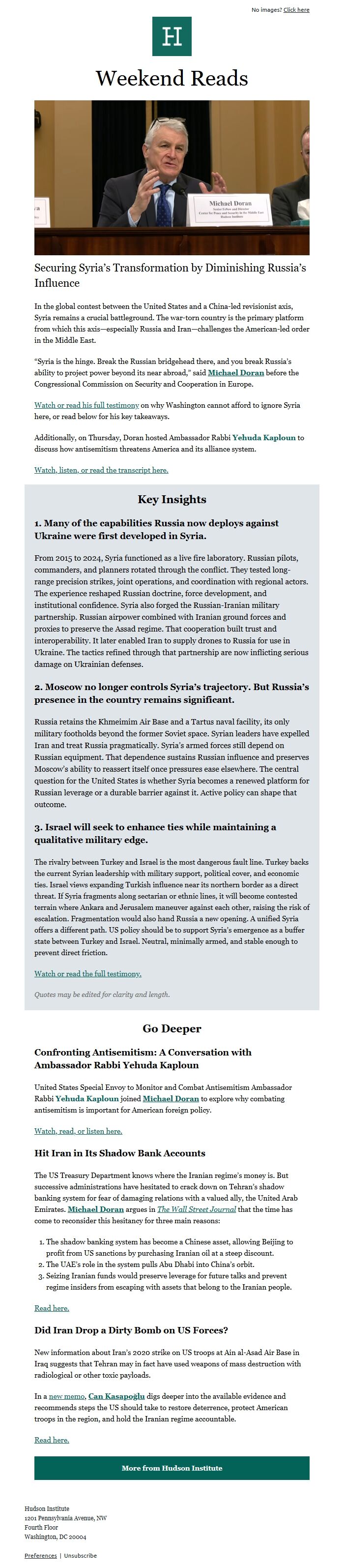
Securing Syria’s Transformation by Diminishing Russia’s Influence [[link removed]]
In the global contest between the United States and a China-led revisionist axis, Syria remains a crucial battleground. The war-torn country is the primary platform from which this axis—especially Russia and Iran—challenges the American-led order in the Middle East.
“Syria is the hinge. Break the Russian bridgehead there, and you break Russia’s ability to project power beyond its near abroad,” said Michael Doran [[link removed]] before the Congressional Commission on Security and Cooperation in Europe.
Watch or read his full testimony [[link removed]] on why Washington cannot afford to ignore Syria here, or read below for his key takeaways.
Additionally, on Thursday, Doran hosted Ambassador Rabbi Yehuda Kaploun to discuss how antisemitism threatens America and its alliance system.
Watch, listen, or read the transcript here. [[link removed]]
Key Insights
1. Many of the capabilities Russia now deploys against Ukraine were first developed in Syria.
From 2015 to 2024, Syria functioned as a live fire laboratory. Russian pilots, commanders, and planners rotated through the conflict. They tested long-range precision strikes, joint operations, and coordination with regional actors. The experience reshaped Russian doctrine, force development, and institutional confidence. Syria also forged the Russian-Iranian military partnership. Russian airpower combined with Iranian ground forces and proxies to preserve the Assad regime. That cooperation built trust and interoperability. It later enabled Iran to supply drones to Russia for use in Ukraine. The tactics refined through that partnership are now inflicting serious damage on Ukrainian defenses.
2. Moscow no longer controls Syria’s trajectory. But Russia’s presence in the country remains significant.
Russia retains the Khmeimim Air Base and a Tartus naval facility, its only military footholds beyond the former Soviet space. Syrian leaders have expelled Iran and treat Russia pragmatically. Syria’s armed forces still depend on Russian equipment. That dependence sustains Russian influence and preserves Moscow’s ability to reassert itself once pressures ease elsewhere. The central question for the United States is whether Syria becomes a renewed platform for Russian leverage or a durable barrier against it. Active policy can shape that outcome.
3. Israel will seek to enhance ties while maintaining a qualitative military edge.
The rivalry between Turkey and Israel is the most dangerous fault line. Turkey backs the current Syrian leadership with military support, political cover, and economic ties. Israel views expanding Turkish influence near its northern border as a direct threat. If Syria fragments along sectarian or ethnic lines, it will become contested terrain where Ankara and Jerusalem maneuver against each other, raising the risk of escalation. Fragmentation would also hand Russia a new opening. A unified Syria offers a different path. US policy should be to support Syria’s emergence as a buffer state between Turkey and Israel. Neutral, minimally armed, and stable enough to prevent direct friction.
Watch or read the full testimony. [[link removed]]
Quotes may be edited for clarity and length.
Go Deeper
Confronting Antisemitism: A Conversation with Ambassador Rabbi Yehuda Kaploun [[link removed]]
United States Special Envoy to Monitor and Combat Antisemitism Ambassador Rabbi Yehuda Kaploun joined Michael Doran [[link removed]] to explore why combating antisemitism is important for American foreign policy.
Watch, read, or listen here. [[link removed]]
Hit Iran in Its Shadow Bank Accounts [[link removed]]
The US Treasury Department knows where the Iranian regime’s money is. But successive administrations have hesitated to crack down on Tehran’s shadow banking system for fear of damaging relations with a valued ally, the United Arab Emirates. Michael Doran [[link removed]] argues in The Wall Street Journal [[link removed]] that the time has come to reconsider this hesitancy for three main reasons:
The shadow banking system has become a Chinese asset, allowing Beijing to profit from US sanctions by purchasing Iranian oil at a steep discount.The UAE’s role in the system pulls Abu Dhabi into China’s orbit.Seizing Iranian funds would preserve leverage for future talks and prevent regime insiders from escaping with assets that belong to the Iranian people.
Read here. [[link removed]]
Did Iran Drop a Dirty Bomb on US Forces? [[link removed]]
New information about Iran’s 2020 strike on US troops at Ain al-Asad Air Base in Iraq suggests that Tehran may in fact have used weapons of mass destruction with radiological or other toxic payloads.
In a new memo [[link removed]], Can Kasapoğlu [[link removed]] digs deeper into the available evidence and recommends steps the US should take to restore deterrence, protect American troops in the region, and hold the Iranian regime accountable.
Read here. [[link removed]]
More from Hudson Institute [[link removed]]
Hudson Institute
1201 Pennsylvania Avenue, NW
Fourth Floor
Washington, DC 20004
Preferences [link removed] | Unsubscribe [link removed]
Weekend Reads
Securing Syria’s Transformation by Diminishing Russia’s Influence [[link removed]]
In the global contest between the United States and a China-led revisionist axis, Syria remains a crucial battleground. The war-torn country is the primary platform from which this axis—especially Russia and Iran—challenges the American-led order in the Middle East.
“Syria is the hinge. Break the Russian bridgehead there, and you break Russia’s ability to project power beyond its near abroad,” said Michael Doran [[link removed]] before the Congressional Commission on Security and Cooperation in Europe.
Watch or read his full testimony [[link removed]] on why Washington cannot afford to ignore Syria here, or read below for his key takeaways.
Additionally, on Thursday, Doran hosted Ambassador Rabbi Yehuda Kaploun to discuss how antisemitism threatens America and its alliance system.
Watch, listen, or read the transcript here. [[link removed]]
Key Insights
1. Many of the capabilities Russia now deploys against Ukraine were first developed in Syria.
From 2015 to 2024, Syria functioned as a live fire laboratory. Russian pilots, commanders, and planners rotated through the conflict. They tested long-range precision strikes, joint operations, and coordination with regional actors. The experience reshaped Russian doctrine, force development, and institutional confidence. Syria also forged the Russian-Iranian military partnership. Russian airpower combined with Iranian ground forces and proxies to preserve the Assad regime. That cooperation built trust and interoperability. It later enabled Iran to supply drones to Russia for use in Ukraine. The tactics refined through that partnership are now inflicting serious damage on Ukrainian defenses.
2. Moscow no longer controls Syria’s trajectory. But Russia’s presence in the country remains significant.
Russia retains the Khmeimim Air Base and a Tartus naval facility, its only military footholds beyond the former Soviet space. Syrian leaders have expelled Iran and treat Russia pragmatically. Syria’s armed forces still depend on Russian equipment. That dependence sustains Russian influence and preserves Moscow’s ability to reassert itself once pressures ease elsewhere. The central question for the United States is whether Syria becomes a renewed platform for Russian leverage or a durable barrier against it. Active policy can shape that outcome.
3. Israel will seek to enhance ties while maintaining a qualitative military edge.
The rivalry between Turkey and Israel is the most dangerous fault line. Turkey backs the current Syrian leadership with military support, political cover, and economic ties. Israel views expanding Turkish influence near its northern border as a direct threat. If Syria fragments along sectarian or ethnic lines, it will become contested terrain where Ankara and Jerusalem maneuver against each other, raising the risk of escalation. Fragmentation would also hand Russia a new opening. A unified Syria offers a different path. US policy should be to support Syria’s emergence as a buffer state between Turkey and Israel. Neutral, minimally armed, and stable enough to prevent direct friction.
Watch or read the full testimony. [[link removed]]
Quotes may be edited for clarity and length.
Go Deeper
Confronting Antisemitism: A Conversation with Ambassador Rabbi Yehuda Kaploun [[link removed]]
United States Special Envoy to Monitor and Combat Antisemitism Ambassador Rabbi Yehuda Kaploun joined Michael Doran [[link removed]] to explore why combating antisemitism is important for American foreign policy.
Watch, read, or listen here. [[link removed]]
Hit Iran in Its Shadow Bank Accounts [[link removed]]
The US Treasury Department knows where the Iranian regime’s money is. But successive administrations have hesitated to crack down on Tehran’s shadow banking system for fear of damaging relations with a valued ally, the United Arab Emirates. Michael Doran [[link removed]] argues in The Wall Street Journal [[link removed]] that the time has come to reconsider this hesitancy for three main reasons:
The shadow banking system has become a Chinese asset, allowing Beijing to profit from US sanctions by purchasing Iranian oil at a steep discount.The UAE’s role in the system pulls Abu Dhabi into China’s orbit.Seizing Iranian funds would preserve leverage for future talks and prevent regime insiders from escaping with assets that belong to the Iranian people.
Read here. [[link removed]]
Did Iran Drop a Dirty Bomb on US Forces? [[link removed]]
New information about Iran’s 2020 strike on US troops at Ain al-Asad Air Base in Iraq suggests that Tehran may in fact have used weapons of mass destruction with radiological or other toxic payloads.
In a new memo [[link removed]], Can Kasapoğlu [[link removed]] digs deeper into the available evidence and recommends steps the US should take to restore deterrence, protect American troops in the region, and hold the Iranian regime accountable.
Read here. [[link removed]]
More from Hudson Institute [[link removed]]
Hudson Institute
1201 Pennsylvania Avenue, NW
Fourth Floor
Washington, DC 20004
Preferences [link removed] | Unsubscribe [link removed]
Message Analysis
- Sender: Hudson Institute
- Political Party: n/a
- Country: United States
- State/Locality: n/a
- Office: n/a
-
Email Providers:
- Campaign Monitor