|
 |
The “Schedule F” Attack On Professionalism And Knowledge-Seeking
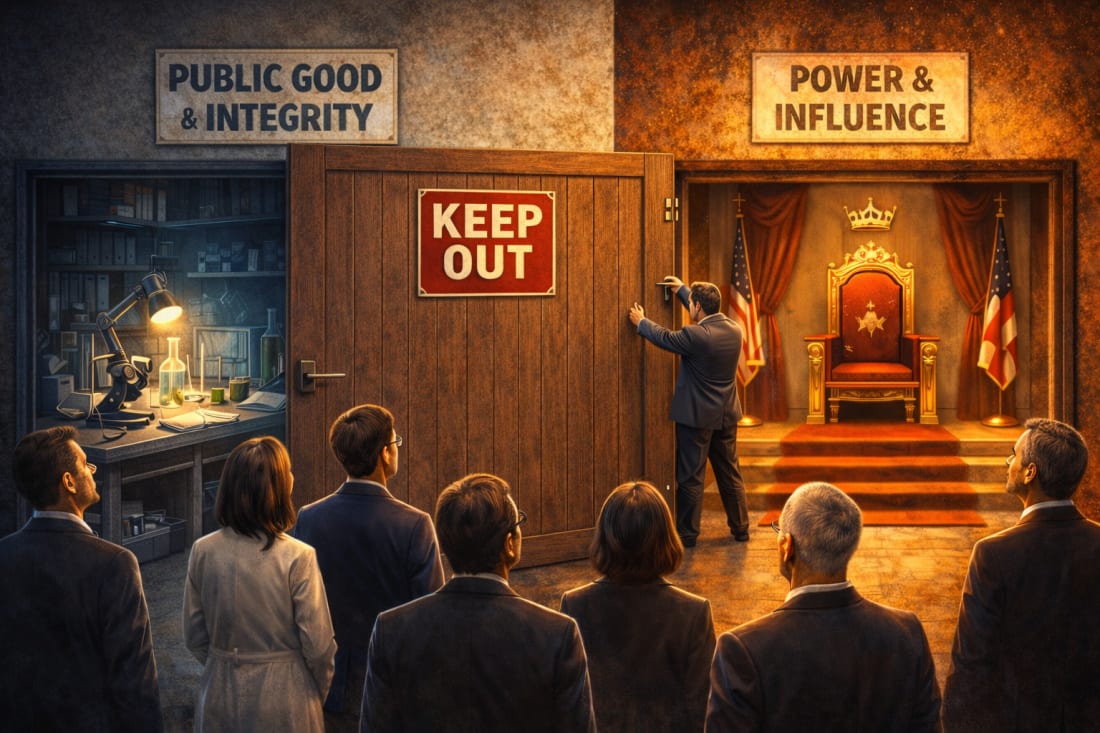
How much should the views of economists and other professionals be for sale?
|

| |||||||||||||||


 |
President Trump recently announced his intention to strip approximately 50,000 federal employees in “policy-related” positions of their civil service protections. He wants to convert them to Schedule F employees, whom any president can fire at will. Like Don Moynihan, one of the most informative writers on this subject, I see the politicization of public service as an extraordinary threat to the functioning of government. It disregards competence, skills, and merit as the basis for hiring, retaining, and promoting. Multiple layers of political appointees also block information flows within government, preventing the most informed from breaking through with even the best of ideas.
Here, I want to add how this move by the President poses a significant threat to the integrity of many professions engaged in both government and the private sector. Economics, my own field, is especially at risk, since many economists work in government in “policy-related” roles, want to work in government at least occasionally, or do contract work for the government. Much of their training and many of their jobs focus on evaluating the pros and cons of various policies. Silencing them, removing them, or replacing them with charlatans leaves us with a government that operates on whim rather than in pursuit of knowledge. Yet knowledge about policy often advances only through critical thinking that weighs costs against benefits and exposes the illogic of various ideas and propositions—information that many politicians don’t like to hear.
It’s not even clear how many types of jobs the President might treat as “policy-related.” President Trump fired the head of the Bureau of Labor Statistics after claiming that she had rigged a standard statistical report on employment “to make ME [him] look bad.” I worked for many years in the Treasury’s Office of Tax Analysis (OTA) within the Office of Tax Policy, whose strength and reputation mainly depended on its professionalism. While OTA usually has only one economist in a political position, often a former civil servant or academic, it has several dozen economists studying tax policy.
How do standards of integrity, critical thinking, and professionalism advance? In 2021, Jonathan Rauch wrote a brilliant book, The Constitution of Knowledge, about the “institutional and communitarian foundations of collective inquiry.” Concerned especially about the spread of disinformation, which was then mostly right-wing, and a cancel culture of conformity, then mainly left-wing, he highlighted how societies advance through networks of groups such as scientists, journalists, and lawyers who develop and operate under various norms, values, rules, and practices. He compared their “constitution of knowledge” to a political constitution, each functioning within processes and boundaries— the former to challenge and broaden our understanding of reality, and the latter to shape our ideas of good government.
Given today’s extreme binary and tribal thinking on political issues, from debates over mainstream media versus Fox News to scientists versus COVID-19 vs shot skeptics, you might think that many American professions lack integrity standards.
If so, you are mistaken. I know many people who have made great sacrifices to maintain high standards of integrity in their fields. However, you would be right to notice that personal and professional motivations often conflict. Economists, for example, share many traits with most workers. They need to be paid for their work. To influence policy, they must be heard. To gain political appointments, they need the support of those who make the appointments. And so on.
You can see where I am going. Economists, who spend much of their lives studying how others respond to incentives, face a wide range of incentives that influence their own behavior. The incentives for personal survival, profit, fame, and success often conflict with broader ethical and professional ones. Most, I believe, try to apply the professional tools they’ve learned effectively and with as little bias as possible. Some compromise more than others. Even then, much is beyond their control. When and how they use those tools are often limited by those who pay, listen to, and appoint them.
But that’s true for most of us. Few workers can accept pay from an employer and openly criticize that employer in public. Most workers understand that the product or service they help produce or sell might not always be the very best, but they convince themselves they are doing the best they can within those limits. Your Chevy salesperson doesn’t encourage customers to buy a Toyota, even if the Toyota has a higher rating on Consumer Reports. I have a good friend who didn’t last long selling admission to a nursing home because she always wanted to help the customer find the best nursing home for their situation.
Consider President Trump’s nomination of Kevin Warsh as the new head of the Federal Reserve’s Board of Governors. A variety of economists and writers on economics have entered the debate over whether his views are based on his analysis or on the incentives he faced to take stances favored by the Republican Party over time. If the latter, how would that influence the Fed’s independence? Paul Krugman has been especially skeptical, while Jeffrey Brown at the University of Illinois is quite optimistic (personal correspondence). Oren Cass, Jason Furman, and Natasha Sarin seem to hold a lukewarm to positive view of his appointment.
Based on these and other assessments of Warsh, I don’t see him as an outlier compared to many high-level appointments in recent administrations or some other Fed chairs. However, imagine if our concern about integrity and capability multiplies from an already extensive number of political positions to tens of thousands more. Then consider the likely continuing scenario in which the Democratic and Republican parties engage in widespread hiring and firing as political power shifts, with each side accusing the other of further retribution at each stage.
The negative consequences go far beyond good governance. They weaken the integrity of experts and professionals while destroying public trust in the professions themselves. Meanwhile, hundreds of thousands of young people hoping to serve in government see that partisanship and political connections, rather than ability, become their main routes to power.
Rauch emphasizes “constitution-like” norms and practices shared by both professions and government as a key way to develop knowledge and advance society. In the medium term, I hope we can revive a traditional public administration debate about how to build on these private and public “norms,” whether legal or social, so they complement each other in strengthening public service. For example, how much better could the civil service, bipartisan or nonpartisan boards, and Congressional, not just Executive Branch, agencies be made to function?
For now, we need to limit movement in the opposite direction and address the serious harm caused by aligning success for so many public servants with a specific political party, clique, individual, or ideology.
Please read and share my recent book, Abandoned: How Republicans And Democrats Have Deserted The Working Class, The Young, And The American Dream. It lays out the long-term issues that have led to today’s political morass and how efforts to promote upward mobility and wealth building for all must form a significant part of tomorrow’s agenda.
Please also recommend this column to others. Less importantly, if you’re a free subscriber, you can upgrade to paid.
| ||||||||||

