|

|
Report: Most Americans Have Less than $1,000 in Retirement Savings |
|
.png)
|
The median amount of retirement savings across the U.S. workforce is $955, according to a new report – entitled “Retirement in America” – from the National Institute on Retirement Security. |
|
Researchers pinpointed several reasons that help explain why working Americans are struggling to save for retirement. Almost half of all workers do not have access to employer-sponsored retirement plans. Those workers who do have access to an employer-sponsored plan typically contribute five to six percent of their income to a defined contribution (such as a 401(k) plan) while employers contribute at a rate of just under three percent of salary. Only 17 percent of working Americans have access to defined benefit pension (DB) plans.
The report illustrates the importance of Social Security for American retirees. On average, older Americans rely on Social Security benefits for half of their income, while income from retirement plans – both defined benefit and defined contribution – represents about a fifth of retirees’ income on average.
“It’s clear from this report that we've got our work cut out for us. All Americans deserve a secure retirement after a lifetime of work,” said Robert Roach, Jr., President of the Alliance. “Lawmakers should take steps to increase access to defined benefit pension plans for workers, strengthen Social Security and increase benefits, and make housing, health care, and long-term care more affordable.”
Click here to register for an educational webinar about the research. |
|
CMS Administrator Dr. Oz Says Americans Should Delay Retirement or Start Work Earlier in Life to Reduce Federal Debt |
|
Centers for Medicare and Medicaid Services (CMS) Administrator Mehmet Oz urged Americans to work longer during a press conference with HHS Secretary Robert F. Kennedy, Jr. Monday.
Oz asserted—without offering evidence—that the campaign’s success could be measured by healthier Americans staying in the workforce longer. He claimed that if people worked either a year earlier or delayed retirement by a year, the economy would gain roughly $3 trillion, arguing that “the taxes on that three-trillion dollars would allow us to keep Medicare Part A solvent … [and] make Social Security healthier.”
“We’re not surprised, but this is a bad idea,” said Richard Fiesta, Executive Director of the Alliance. “We oppose this, and any other scheme that will cut the benefits Americans have worked a lifetime to earn.” |
|
HHS Advisory Vaccine Committee Reconsidering all Vaccine Recommendations |
|
Department of Health and Human Services (HHS) Advisory Committee on Immunization Practices (ACIP) Chair Kirk Milhoan says the committee will re-evaluate – and possibly revamp – all of its current vaccine recommendations. The Committee makes recommendations for vaccines that prevent or lessen the impact of diseases that affect older Americans, including shingles and Respiratory Syncytial Virus (RSV), COVID, and the flu.
ACIP isn’t the ultimate authority on vaccine recommendations. The Food and Drug Administration (FDA) and Centers for Disease Control and Prevention (CDC) approve vaccines and state and local officials decide how to apply requirements for their residents. However, ACIP’s recommendations determine whether insurance – both Medicare and some private plans – are required to pay for vaccines.
The next planned meeting for ACIP is supposed to take place later this month.
“Vaccines dramatically lower the risk of disease complications and death for older patients,” said Joseph Peters, Jr., Secretary-Treasurer of the Alliance. “Seniors who are concerned about ACIP’s decision can learn how to proceed and discuss current vaccine recommendations for their area with trusted health providers.” |
|
It’s Time to Register for the Alliance’s National Membership Meeting this April |
|
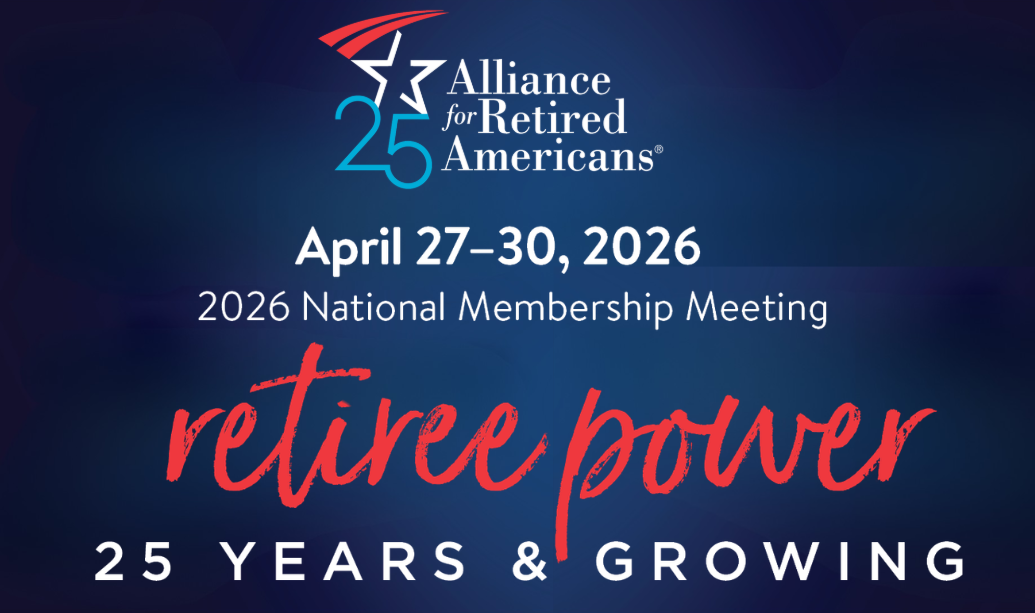
The Alliance invites you to attend our National Membership Meeting from April 27 to April 30 at the Sahara Hotel in Las Vegas, Nevada.
|
|
|
Attendees will elect the Alliance’s officers, participate in special workshops, learn about emerging issues and what’s at stake in the 2026 elections, and develop ways to grow our retiree activism. They will also attend a special “Senior Prom Ball and Dinner” celebrating the Alliance’s 25th anniversary.
Please contact Joni Jones at [email protected] or 888-373-6497 with any questions. |
|
KFF Health News: Your Next Primary Care Doctor Could Be Online Only, Accessed Through an AI Tool |
|
When her doctor died suddenly in August, Tammy MacDonald found herself among the roughly 17% of adults in America without a primary care physician.
MacDonald wanted to find a new doctor right away. She needed refills for her blood pressure medications and wanted to book a follow-up appointment after a breast cancer scare.
She called 10 primary care practices near her home in Westwood, Massachusetts. None of the doctors, nurse practitioners, or physician assistants was taking new patients. A few offices told her that a doctor could see her in a year and a half or two years.
“I was just shocked by that, because we live in Boston and we’re supposed to have this great medical care,” said MacDonald, who is in her late 40s and has private health insurance. “I couldn’t get my mind around the fact that we didn’t have any doctors.”
The shortage of primary care providers is a national problem, but it’s particularly acute in Massachusetts. The state’s primary care workforce is shrinking faster than in most states, according to a January 2025 report.
|

|
Thanks for reading. Every day, we're fighting to lower prescription drug prices and protect retirees' earned benefits and health care. But we can't do it without your help. Please support our work by donating below. |
|
|
|
|




Alliance for Retired Americans | 815 16th Street, NW | Washington, DC 20006 | www.retiredamericans.org
