
Email
Stop Using the Made-Up Name “West Bank”—It Erases the Truth of Jewish Judea/Samaria — WSJ
| From | Zionist Organization of America <[email protected]> |
| Subject | Stop Using the Made-Up Name “West Bank”—It Erases the Truth of Jewish Judea/Samaria — WSJ |
| Date | February 6, 2026 5:46 PM |
Links have been removed from this email. Learn more in the FAQ.
Links have been removed from this email. Learn more in the FAQ.
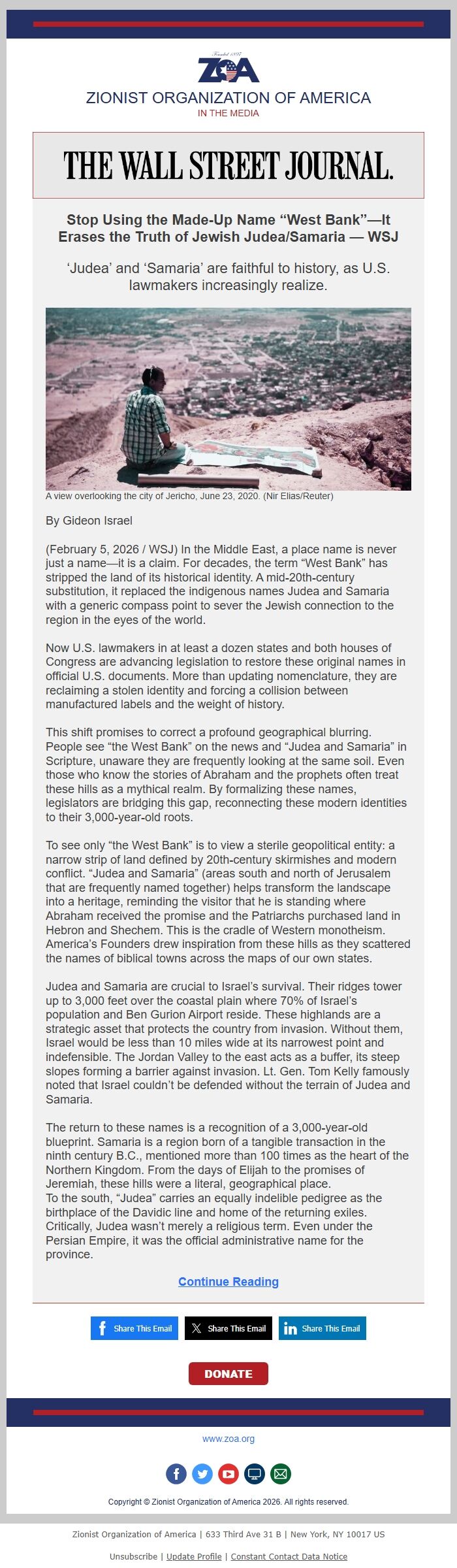
Email from Zionist Organization of America ZIONIST ORGANIZATION OF AMERICA IN THE MEDIA Stop Using the Made-Up Name “West Bank”—It Erases the Truth of Jewish Judea/Samaria — WSJ ‘Judea’ and ‘Samaria’ are faithful to history, as U.S. lawmakers increasingly realize. A view overlooking the city of Jericho, June 23, 2020. (Nir Elias/Reuter) By Gideon Israel (February 5, 2026 / WSJ) In the Middle East, a place name is never just a name—it is a claim. For decades, the term “West Bank” has stripped the land of its historical identity. A mid-20th-century substitution, it replaced the indigenous names Judea and Samaria with a generic compass point to sever the Jewish connection to the region in the eyes of the world. Now U.S. lawmakers in at least a dozen states and both houses of Congress are advancing legislation to restore these original names in official U.S. documents. More than updating nomenclature, they are reclaiming a stolen identity and forcing a collision between manufactured labels and the weight of history. This shift promises to correct a profound geographical blurring. People see “the West Bank” on the news and “Judea and Samaria” in Scripture, unaware they are frequently looking at the same soil. Even those who know the stories of Abraham and the prophets often treat these hills as a mythical realm. By formalizing these names, legislators are bridging this gap, reconnecting these modern identities to their 3,000-year-old roots. To see only “the West Bank” is to view a sterile geopolitical entity: a narrow strip of land defined by 20th-century skirmishes and modern conflict. “Judea and Samaria” (areas south and north of Jerusalem that are frequently named together) helps transform the landscape into a heritage, reminding the visitor that he is standing where Abraham received the promise and the Patriarchs purchased land in Hebron and Shechem. This is the cradle of Western monotheism. America’s Founders drew inspiration from these hills as they scattered the names of biblical towns across the maps of our own states. Judea and Samaria are crucial to Israel’s survival. Their ridges tower up to 3,000 feet over the coastal plain where 70% of Israel’s population and Ben Gurion Airport reside. These highlands are a strategic asset that protects the country from invasion. Without them, Israel would be less than 10 miles wide at its narrowest point and indefensible. The Jordan Valley to the east acts as a buffer, its steep slopes forming a barrier against invasion. Lt. Gen. Tom Kelly famously noted that Israel couldn’t be defended without the terrain of Judea and Samaria. The return to these names is a recognition of a 3,000-year-old blueprint. Samaria is a region born of a tangible transaction in the ninth century B.C., mentioned more than 100 times as the heart of the Northern Kingdom. From the days of Elijah to the promises of Jeremiah, these hills were a literal, geographical place. To the south, “Judea” carries an equally indelible pedigree as the birthplace of the Davidic line and home of the returning exiles. Critically, Judea wasn’t merely a religious term. Even under the Persian Empire, it was the official administrative name for the province. Continue Reading Share This Email Share This Email Share This Email DONATE www.zoa.org Copyright © Zionist Organization of America 2026. All rights reserved. Zionist Organization of America | 633 Third Ave 31 B | New York, NY 10017 US Unsubscribe | Update Profile | Constant Contact Data Notice
Message Analysis
- Sender: Zionist Organization of America
- Political Party: n/a
- Country: United States
- State/Locality: n/a
- Office: n/a
-
Email Providers:
- Constant Contact