If you're having trouble viewing this email, you cansee it online.
Hey friends,
This week's update is a doozy. We are digging into how trust is being tested, protected, and occasionally stretched thin — let's get into it.
Hey Chad, get these ads off my feed
OpenAI has officially announced plans to introduce advertising in the coming weeks across its free and lower-paid tiers. It's a massive move towards traditional ad-supported monetization despite the fact that OpenAI once suggested it was an avenue that it would never pursue.
In the coming weeks, ads will appear only for logged-in folks over the age of 18 and won’t appear “near sensitive or regulated topics like health, mental health or politics.” OpenAI says that ads will not interfere with ChatGPT’s responses. They also claim that ads generally will relate to the questions being asked, embedding the ad experiencing within a conversation to propel consumers to make a purchase decision. From the advertiser side of things, it's reported that OpenAI will charge a minimum spend of $200,000, meaning that this is only a realistic option for a shortlist of enterprise companies with big budgets. This is why our COO told Business Insider that while it’s great that OpenAI is hiring an ads integrity lead and thinking about advertiser know-your-customer (KYC) vetting from the jump, "the materiality of the risk of a large volume of scam ads in the early days is far lower," Garcia said.
The truth is that advertiser KYC is only one small part of ads integrity, and while the job listing says that the role will help determine where and how ads are shown, that's a pretty broad mandate, so it will be interesting to see how OpenAI will address advertiser expectations on transparency, suitability, and measurement.
Still, beyond advertisers, there is a really delicate and unavoidable tension with this decision. Users have shared deeply personal information with ChatGPT, treating it like a confidante, forging a certain implicit level of trust that is not often awarded to tech companies, especially not adtech ones. OpenAI's foray into ads marks the beginning of the new era of digital advertising. OpenAI must now walk a fine line between generating revenue and protecting users' privacy. It's far from the only AI platform to to make this foray into ad-supported monetization: Perplexity has already had ads in beta for some time.
Let's applaud for Claude
In a true role model move, Anthropic's Claude has stood 10 toes down on refusing a move to ad-supported monetization — now and in the future. After running a private and user-anonymized internal analysis, Claude's team found that many conversations had with the chatbot are sensitive and personal in nature — conversations that should never be sold, shared, or stored.
As Anthropic puts it: When people use search engines or social media, they’ve come to expect a mixture of organic and sponsored content. Filtering signal from noise is part of the interaction. Conversations with AI assistants are meaningfully different. The format is open-ended; users often share context and reveal more than they would in a search query. This openness is part of what makes conversations with AI valuable, but it’s also what makes them susceptible to influence in ways that other digital products are not.
Nevertheless, there is a valid question here about whether a subscription-only model would deprive users not in a position to pay for these services in a way that a freemium model with a free ad-supported tier would not.
We hope that Anthropic has a stronger resolve than OpenAI in this commitment to remain ads-free, and can prove out the benefits of differentiating on trust. Ultimately, though, we think there is room for both approaches, and if OpenAI wants to prove that they're committed to ad-based monetization that is fair to brands, publishers, and people, we're here for it.
There's nothing better than a good race-to-the-top - especially on customer trust, and this is exactly why competition matters.
You can't put a Nespresso pod in a Keurig machine
Last week, we submitted comments to the IAB on version 1 of the Deals API (application programming interface). The goal of the Deals API is to streamline operations and reduce manual data entry — areas where both intentional and unintentional inaccuracies often occur. We applaud the steps taken by the industry to simplify and create greater transparency in the real-time bidding process by soliciting feedback from industry stakeholders. We decided to weigh in to the open comment period to share our vision for how the Deals API could be a powerful tool for publishers and advertisers.
Our comments lay out areas for improvement and clarification between the the buy side (advertisers and agencies) and sell side (supply side platforms and publishers) for future versions.
Our first point was a recommendation to clarify the notes given to buyers for Deals API implementation. In the notes, buyers are cautioned have to match and apply identical targeting in their platforms to mirror what a deal broker has curated. This makes a lot of sense, where if a brand wanted to reach users over 35, it makes sense to apply a segment targeting users over 35 in the buying platform, but also for a supply side platform or publisher to apply a segment targeting users over 35 too.
However, in practice, mismatches are common because companies often have different targeting sources — it's like trying to use Nespresso pods in a Keurig machine. When mismatches occur, publishers and advertisers both lose, because the mismatch means that the bidding process can't move forward. Publishers lose revenue and advertisers miss out on reaching their targeting audience.
We also call for increasing transparency for publishers if they are included in a third-party brokered deal, as the current setup offers publishers no visibility at all if they are not the deal broker. This is because the current API configuration is limited to two-way communication.
Lastly, we highlight the importance of advertisers being made aware of when a deal's inventory may be updated or revised. In version 1 of the Deals API, advertisers wouldn't be necessarily aware when sites and apps are added on the backend to a deal. Including timestamps indicating when a deal is edited offers a solution that would alleviate confusion and promote transparency.
In other industry news, the IAB UK has launched a Measurement Advisory Board made up of senior leaders from major tech platforms, advertisers, agencies, and publishers. The stated goal of this advisory board is to drive transparency and consistency forward, at a time when the industry is struggling with opaque and often overinflated reporting. The companies represented as members of the board are in a tricky spot: do they play by the new rules, or is this a new space for opacity, big tech capture, and friction?
This point about progress and best practices raises many questions. Meta, who is on the Measurement Advisory Board, has been sued in the US for misrepresenting its metrics figures to advertisers. The elephant in the room is this: how will organizations like the IAB provide the necessary checks and balances on Big Tech’s input on and shaping of the standards that they’ll be held to - and ensure that standards are equally imposed? We raised a similar point in our previous comments to the Media Rating Council on their Auction Transparency Standards. Further, if Google, Meta, or Amazon refuse to adopt what their compatriots on the Measurement Advisory Board vote to implement, what consequences, if any, will be taken by the IAB?
In more Google news
Google may be in the business of deciding which price you see, meaning each individual consumer could see different prices.
Google’s very intimate access to you is about to get real alarming, real quick. In a recent announcement, Google shared that its AI chatbot, Gemini, will soon tap into users Gmail, YouTube, Google Photos, and Google Search data. On top of that, Google has cut a deal with Apple to incorporate Google’s Gemini into Apple products. And to tie it all together, Google is launching a Gemini-powered ad service that could use this data to set personalized prices.
Online scams, malvertising, and bot fraud aren’t an accident. They are enabled by ad systems built for profit, costing consumers, publishers, and advertisers tens of millions every year. But this report isn't just a doom-and-gloom analysis - CAMP has plenty of recommendations on how to turn the tide, with great policy solutions on how stronger data protection, platform accountability, and enforcement can help keep Canadians safe.
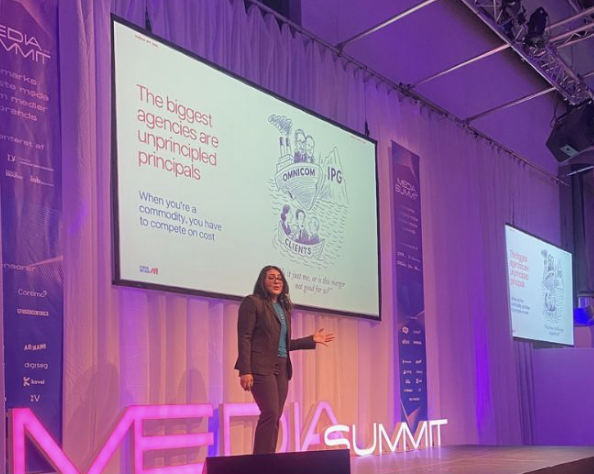
🎤 Arielle was on stage at STEP Network's #MediaSummit2026 in Copenhagen! This conference, led by a leading Danish publisher network, brought together advertisers, publishers, and independent adtech companies to shape the future of digital advertising. As Arielle said, in an industry where Google, Meta and Amazon are premier sponsors, driving the agenda of most of these types of gatherings, this is so refreshing, and cause for optimism for local brands and local media companies alike.
In her keynote, Arielle breaks down the ad systems that quietly funnel money into low-quality AI-generated content, hurting advertisers, publishers, and the public. The risks are real: brands end up wasting their ad budgets on AI slop while using fake data, all while legitimate publishers struggle to survive. We shared our roadmap, and asked brands and publishers to join us in creating a healthier digital advertising market that really works for the brands, publishers, and people that it exists to serve.
We also joined STEP Network and the Dansk Annoncørforening - the Danish Advertisers Association - for a pre-conference dinner, where Arielle shared more fireside insight with an intimate group of CMOs and senior publishing executives. We LOVE to see an evening without middlemen!