ClearPath Action Rundown
February 6th, 2026
|
|
Congratulations to Greg Beard on
his appointment
to Director of DOE’s Office of Energy Dominance Financing!
The Rundown will be back at the
top of your inbox on February 20th.
|
1. Put American Jobs
First and Take U.S. Energy Global |
|
|
If America does not lead the future
of energy technologies, China will. ClearPath CEO Jeremy
Harrell outlines
how Congress can modernize the Export-Import Bank (EXIM) to better
support American workers and energy leadership abroad in a recent
National
Interest
op-ed.
Key takeaways:
- China
has financed $446 billion in global energy infrastructure since 2015,
nearly 10 times U.S.-backed investment;
- Congress
recently expanded the Development Finance Corporation’s lending
capacity from $60 billion to $205 billion for strategic energy and
critical minerals projects;
- Every $1
billion in EXIM financing supports roughly 4,100 American jobs;
and
- EXIM
reauthorization can strengthen domestic manufacturing, secure supply
chains and support industries of the future.
What’s clear: Modernizing EXIM will level the playing field and give U.S.
companies the tools to compete and win abroad. Competing with
state-subsidized rivals requires strategic export finance that backs
American innovation, manufacturing and energy leadership.
Plug in: Read
ClearPath’s report Energy
Financing Power: America vs. China, which outlines reforms to strengthen
EXIM’s toolkit.
|
2. Project Vault: U.S.
announces critical minerals stockpile |
|
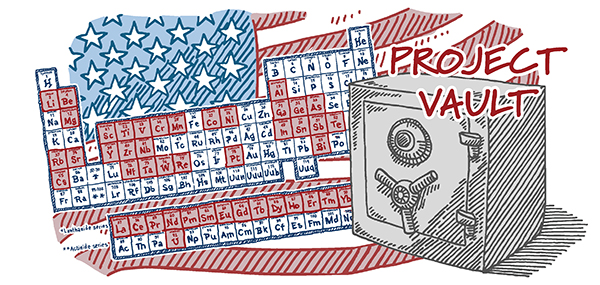
President Trump announced a $12
billion plan to reduce the U.S. reliance on China's control of the
critical minerals supply chain. Project
Vault will
stockpile 60 days’ worth of minerals for emergencies, funded by a $2
billion private sector investment and a $10 billion EXIM Bank
loan.
What to know:
- China
controls 70% of the critical minerals refining market;
and
- Project
Vault reduces dependence on foreign-controlled supply chains and
strengthens America’s industrial base.
What’s clear: At
the Critical Minerals Ministerial, Vice
President JD Vance
emphasized, “With these moves, we intend to build an ironclad network
of new industrial supply chains to span the entire
nation.”
Plug in: Read
Jeremy Harrell’s recent op-ed in RealClear Energy on why the U.S. must
secure critical minerals for defense, manufacturing, clean energy and
advanced tech.
|
3. Farm waste
increasing American crop yields |

|
|
American investment in agricultural
R&D has declined by one-third over the past 20 years, while China
now spends twice as much as the U.S. ClearPath’s Tech
101 outlines how
biochar can support farmers, increase American crop yields and remove
carbon emissions.
Why biochar matters:
- Biochar
helps boost crop yields by 16%, which is why the market is expected to
exceed $2 billion by 2032;
- It
removes 2.68 tons of carbon dioxide for every ton produced while
improving soil water and nutrient retention; and
- U.S.
companies are developing regionally tailored innovation, including
mobile systems that produce biochar directly in fields.
What’s clear: If
America wants to lead the world in agricultural production, it’s
important to stay ahead with innovation. Biochar strengthens soil
health, cuts emissions and creates new markets, but scaling it will
require federal coordination and targeted investment towards R&D
through policies like the Biochar
Research Network Act, which creates a national biochar research network to
understand how biochar can be utilized across different
environments.
|
4. Tigers geaux for
deal with DOE labs |
|
|
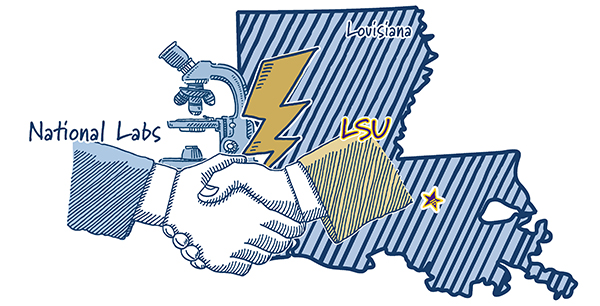
American energy dominance requires
bridging the gap between fundamental research and deployment-ready
innovation. This week, Louisiana State University (LSU) signed
research
agreements with
the U.S. Department of Energy Office of Science laboratories, Argonne
and Oak Ridge, to accelerate American innovation in advanced nuclear,
critical materials and grid-enhancing technologies.
What to know:
- LSU will
serve as a bridge between national lab innovation, Gulf Coast energy
and chemical industries;
- The
agreements focus on nuclear energy, chemical manufacturing, materials
supply chains and deployable energy technologies; and
- It
establishes exchange programs to accelerate technology transfer and
workforce development.
What's clear:
Winning the global energy competition requires connecting critical
research facilities to deployment challenges. Stronger partnerships
between universities and national labs help secure supply chains,
deploy advanced nuclear and reinforce U.S. energy
leadership.
|
5. Type One Energy
moving on fusion plant |
|
The fusion industry is taking
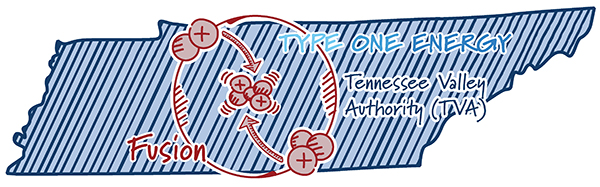
another step to move from the laboratory to the grid. Type One Energy
filed its initial
licensing application to build a fusion power plant at Tennessee Valley Authority’s
(TVA) retired Bull Run coal site, as part of Project
Infinity, marking one of the first formal steps toward
commercial-scale fusion deployment in the U.S.
The details:
- Project
Infinity includes a prototype targeted for 2029 and a proposed 350 MWe
baseload fusion plant;
- TVA
issued a Letter of Intent supporting development, signaling early
utility demand and support for this new technology; and
- Tennessee created a state regulatory framework for fusion and
positioned the retired coal site for advanced energy
redevelopment.
Plug in: Learn how
DOE’s fusion roadmap, new federal coordination and supply chain
investment are moving fusion from research to reality in
The
U.S. Fusion Imperative.
|
6. Growing the grid to
meet demand |
|
|
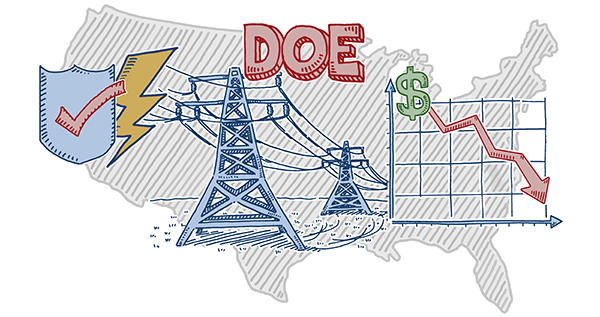
America needs a smarter, more
robust grid to bring new power online and meet surging demand from
data centers and manufacturing. Through its Transmission
Acceleration Grants (TAG) program, DOE is helping states modernize transmission and
deploy innovative solutions faster. DOE announced a TAG investment of
$2.5 million to Johns Hopkins University and the Pennsylvania Public
Utility Commission.
Why it matters:
- New grid
technologies can be deployed quickly and at lower cost than new
infrastructure;
- These
projects with Johns Hopkins University and the Pennsylvania Public
Utility Commission will evaluate opportunities to deploy innovative
grid technologies; and
- These
frameworks can guide other states and planning entities in identifying
and deploying innovative grid technologies.
What’s clear:
Targeted federal support can help states optimize existing
infrastructure and accelerate the interconnection of new power plants
and data centers.
Watch: ClearPath’s
Let
American Energy Move: Modernizing America’s Grid for Growing
Demand video
outlines steps to accelerate transmission buildout, improve
reliability and lower costs.
|
7. States double down
on nuclear |
|
Momentum behind nuclear energy is
accelerating across the country. In 2025, 45
states engaged in nuclear policymaking, introducing more than 350 bills and
enacting over 60 measures.
What’s moving:
- 11
governors highlighted nuclear in their State of the State
addresses.
-
States put up funds to support
existing reactors and accelerate advanced nuclear deployment,
including:
-
Texas authorizing
$350 million for nuclear projects; and
-
Virginia approving up
to $122 million for SMR development.
- States
are removing barriers, expanding their clean energy definitions and
launching feasibility studies for advanced reactor
deployment.
Plug in: Read
ClearPath's
Accelerating Nuclear Energy Through Interstate
Collaboration on
how states can coordinate to accelerate advanced nuclear
deployment.
|
|
|
Jeremy
Harrell delivered
a lecture and participated in a fireside chat at the Harvard Energy
Seminar on the current status and future solutions of American
energy. |
|
Plus… Harrell moderated the Principles and
Compromise: Finding Bipartisan Agreement panel at
BPC’s
Permitting Summit with Reps. Evans
(R-CO) and Peters (D-CA). |
|
|
-
The House Science, Space, and
Technology Committee passed the NASA
Reauthorization Act of 2026. The legislation included an amendment
championed by Rep. Pat Harrigan (R-NC) to develop a science-based
strategy for leveraging NASA's existing methane monitoring
capabilities in a way that strengthens and preserves U.S. energy
leadership in LNG exports.
-
The State
Department
convened the Critical Minerals Ministerial, hosting representatives
from 54 countries and the European Commission. The U.S. signed 11
bilateral critical minerals frameworks or MOUs with countries to
secure mineral supply chains. Secretary Rubio also launched the Forum
on Resource Geostrategic Engagement (FORGE) to collaborate with
partners on critical minerals projects.
-
JPMorgan Chase published a
blog outlining how meeting demand requires
harnessing all of America’s energy advantages.
-
The House passed the
Critical
Mineral Dominance Act (H.R.4090), led by Rep. Stauber (R-MN), to streamline
regulations for mining project approvals and codify elements of
President Trump’s critical minerals executive
orders.
-
Siemens Energy announced a
$1
billion investment to expand U.S. grid and gas turbine
manufacturing,
creating more than 1,500 jobs across NC, AL, NY, TX, FL and MS.
-
The Western Governors’ Association
sent a letter
to the Senate EPW Committee calling
for streamlined permitting processes.
-
Seattle-based fusion startup
Avalanche Energy raised
$29 million to advance its compact modular fusion
technology and
scale FusionWERX, the first commercial fusion test facility in
Richland, Washington.
-
The United Coalition for Advanced
Nuclear Power released recommendations for the Department of War
to build on the President's executive orders to accelerate the
deployment of nuclear reactors for national security.
|

|
ClearPath believes
America must lead the world in innovation over regulation…markets over
mandates…providing affordable, reliable, clean
energy. |
|
That's all from us. Thanks for reading and have a great
weekend!
View this Rundown online
|
|
ClearPath · 300 New Jersey Ave NW, Suite 800, Washington, DC 20001,
United States
This email was sent to
[email protected] · Unsubscribe
Created with NationBuilder.
Build the Future.
|
|
|
|