It's time to rethink academic priorities |
Here’s a question I hope somebody asks anyone who applies to be the next chancellor of the University of Wisconsin-Madison: Why in the world in 2026 should we continue to have an ethnic studies requirement for all undergrads? Here’s another one: Do you even know what it is and what it entails? I’ll help with the second one first. Almost 40 years ago in 1987, the Phi Gamma Delta fraternity, known as the “Fijis,” put up a large caricature of an “island native” as part of their “Fiji Island” theme party, according to a 2002 College of Letters & Sciences report. The Black Student Union called it racist and demanded that the university take action.
The following year, the Letters & Sciences Faculty Senate adopted a three-credit ethnic studies requirement for all students entering the college, and that eventually morphed into what the university has today. All undergraduate students have to take one of the three-credit ethnic studies courses. |
Shaping kind, capable students while retaining dedicated teachers |
Good teachers, the key to effective schools, are leaving their classrooms in droves.
The average teacher loss rate among Wisconsin school districts was higher in the 2022-23 and 2023-24 school years — when it peaked at 15 percent — than at any time since 1996. Nine districts in the state have lost more than 20 percent of their teachers each year on average over a recent five-year span.
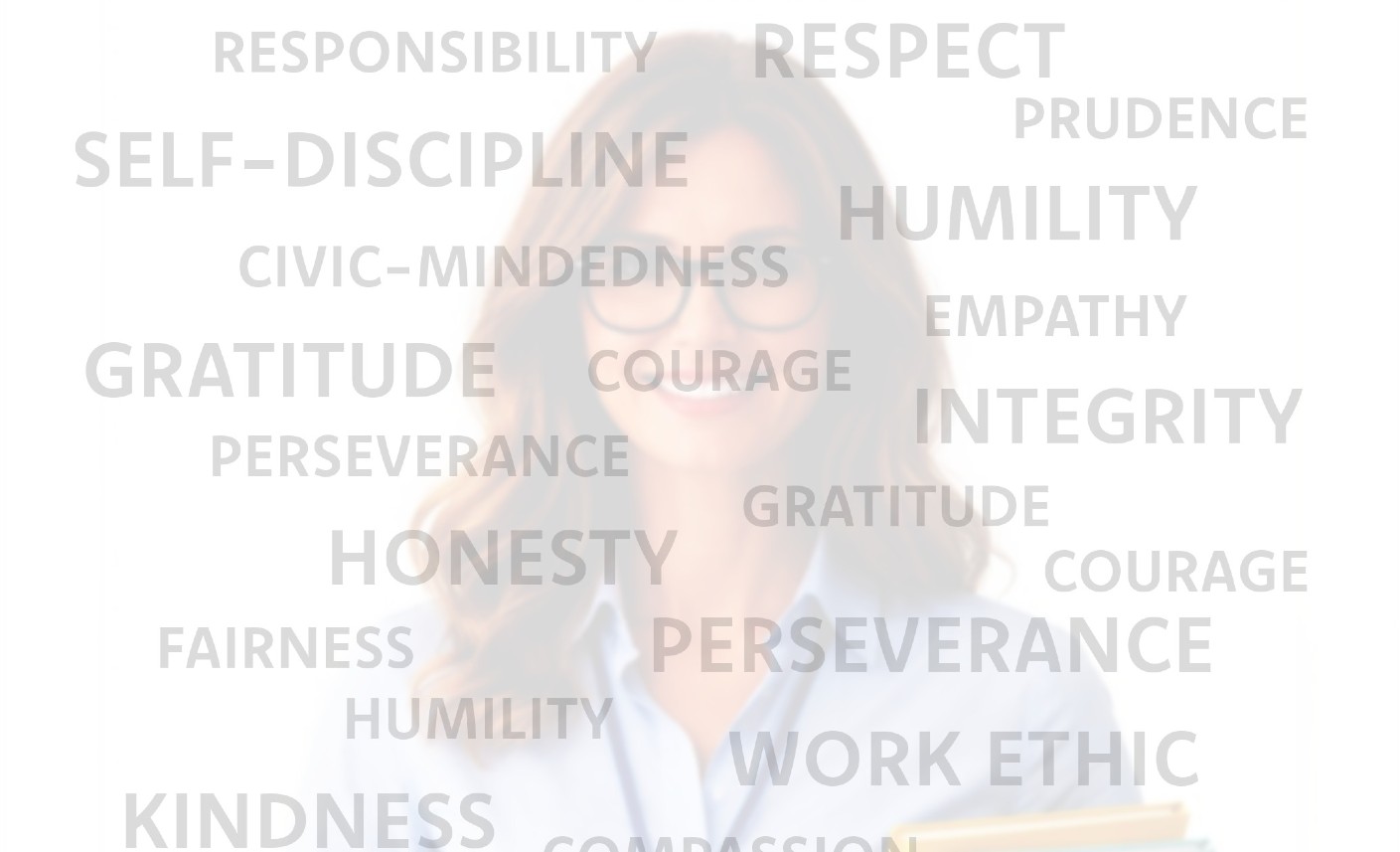
Many of those teachers sought out other schools, and competition is healthy. But it also prompts a key question for districts struggling to retain their best educators: How, especially when money is short, can districts find and keep top staff? One intriguing possibility: character education, the practice of incorporating ethical values and moral formation into schools. |
|
|
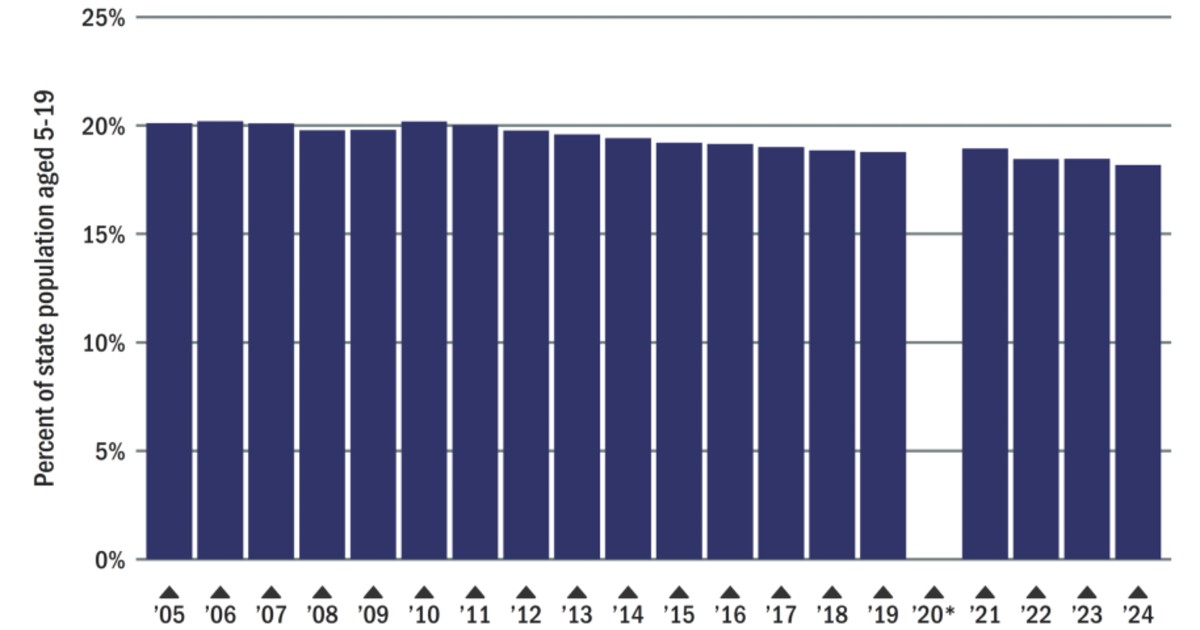
School-aged children make up a steadily falling share of Wisconsin’s population, according to U.S. Census Bureau figures. The share of the state population that is 5 to 19 years old was down to 18.18 percent in 2024. That is the lowest share recorded since the Census began publishing annual data from its American Community Survey in 2005, and it’s down about one-tenth from its peak.
The highest share was in 2006, with almost 20.2 percent of Wisconsin’s population in the 5-to-19 category.
On a county-by-county basis, Clark County topped the list for the highest percentage of school-aged children, at 23.9 percent, followed by Menominee at 23.6 percent and Trempealeau at 21.6 percent. The county with the smallest share of children was Iron, at 13.3 percent, followed by Florence at 13.28 percent and Adams at 12 percent.
In numeric terms, there were total of 1,083,975 school-aged children in Wisconsin in 2024. That is down by 5.6 percent from 2010, when the total reached its peak at 1,148,739 school-aged children, about 20.19 percent of the total population. |
|
|
Take a guess: Which course does UW-Madison not offer? |
|
|
Previous survey question: |
Invest in the Badger Institute |
|
|
|
The Badger Institute has long been at the forefront of the fight for school choice, right to work, welfare reform, tax restructuring, limited government, civil society and so much more. If you appreciate the Institute’s legacy and want to support free markets, opportunity and prosperity, please consider donating today. Your support will help the Institute continue to advocate for conservative principles now and in generations to come.
|
|
|
The Institute never has, and never will, accept government funding. We gratefully welcome your online donation or email Mike Nichols, President. The Badger Institute is a 501(c)(3) tax-exempt nonprofit organization funded solely by the generosity of foundations, companies and individuals. |
|
|
Badger Institute
700 W. Virginia St., Suite 301
Milwaukee, WI 53204 |
|
|
|