
| From | Environment Colorado <[email protected]> |
| Subject | Will baby polar bears be allowed to grow up safely? |
| Date | February 5, 2026 5:06 PM |
Links have been removed from this email. Learn more in the FAQ.
Links have been removed from this email. Learn more in the FAQ.
:
John,
The Arctic can be just as dangerous as it is beautiful, especially for a baby polar bear.
Freezing temperatures, icy seas, scarce prey and rival bears -- with threats like these around every corner, polar bear parents have their work cut out for them to teach their cubs to survive in their Arctic home.
But these amazing animal moms' jobs only get harder when new threats arrive. Drilling for oil brings heavy machinery, new construction, deadly pollution and more into the heart of polar bears' homes.
Let's explore the story of a polar bear family -- and learn about the dangers that might tear it apart:
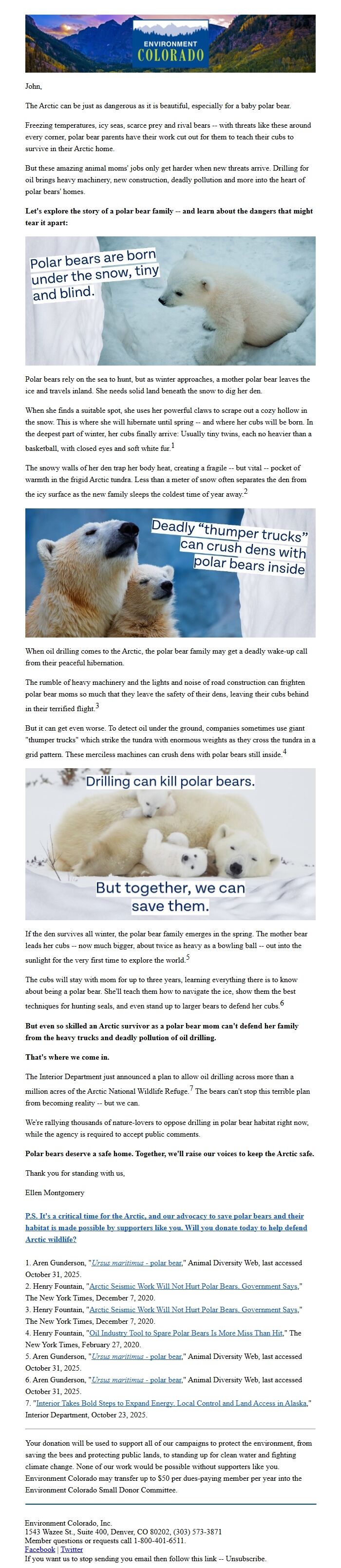
Polar bears rely on the sea to hunt, but as winter approaches, a mother polar bear leaves the ice and travels inland. She needs solid land beneath the snow to dig her den.
When she finds a suitable spot, she uses her powerful claws to scrape out a cozy hollow in the snow. This is where she will hibernate until spring -- and where her cubs will be born. In the deepest part of winter, her cubs finally arrive: Usually tiny twins, each no heavier than a basketball, with closed eyes and soft white fur.[1]
The snowy walls of her den trap her body heat, creating a fragile -- but vital -- pocket of warmth in the frigid Arctic tundra. Less than a meter of snow often separates the den from the icy surface as the new family sleeps the coldest time of year away.[2]
When oil drilling comes to the Arctic, the polar bear family may get a deadly wake-up call from their peaceful hibernation.
The rumble of heavy machinery and the lights and noise of road construction can frighten polar bear moms so much that they leave the safety of their dens, leaving their cubs behind in their terrified flight.[3]
But it can get even worse. To detect oil under the ground, companies sometimes use giant "thumper trucks" which strike the tundra with enormous weights as they cross the tundra in a grid pattern. These merciless machines can crush dens with polar bears still inside.[4]
If the den survives all winter, the polar bear family emerges in the spring. The mother bear leads her cubs -- now much bigger, about twice as heavy as a bowling ball -- out into the sunlight for the very first time to explore the world.[5]
The cubs will stay with mom for up to three years, learning everything there is to know about being a polar bear. She'll teach them how to navigate the ice, show them the best techniques for hunting seals, and even stand up to larger bears to defend her cubs.[6]
But even so skilled an Arctic survivor as a polar bear mom can't defend her family from the heavy trucks and deadly pollution of oil drilling.
That's where we come in.
The Interior Department just announced a plan to allow oil drilling across more than a million acres of the Arctic National Wildlife Refuge.[7] The bears can't stop this terrible plan from becoming reality -- but we can.
We're rallying thousands of nature-lovers to oppose drilling in polar bear habitat right now, while the agency is required to accept public comments.
Polar bears deserve a safe home. Together, we'll raise our voices to keep the Arctic safe.
Thank you for standing with us,
Ellen Montgomery
P.S. It's a critical time for the Arctic, and our advocacy to save polar bears and their habitat is made possible by supporters like you. Will you donate today to help defend Arctic wildlife?
[link removed]
1. Aren Gunderson, "Ursus maritimus - polar bear," Animal Diversity Web, last accessed October 31, 2025.
[link removed]
2. Henry Fountain, "Arctic Seismic Work Will Not Hurt Polar Bears, Government Says," The New York Times, December 7, 2020.
[link removed]
3. Henry Fountain, "Arctic Seismic Work Will Not Hurt Polar Bears, Government Says," The New York Times, December 7, 2020.
[link removed]
4. Henry Fountain, "Oil Industry Tool to Spare Polar Bears Is More Miss Than Hit," The New York Times, February 27, 2020.
[link removed]
5. Aren Gunderson, "Ursus maritimus - polar bear," Animal Diversity Web, last accessed October 31, 2025.
[link removed]
6. Aren Gunderson, "Ursus maritimus - polar bear," Animal Diversity Web, last accessed October 31, 2025.
[link removed]
7. "Interior Takes Bold Steps to Expand Energy, Local Control and Land Access in Alaska," Interior Department, October 23, 2025.
[link removed]
-----------------------------------------------------------
Your donation will be used to support all of our campaigns to protect the environment, from saving the bees and protecting public lands, to standing up for clean water and fighting climate change. None of our work would be possible without supporters like you. Environment Colorado may transfer up to $50 per dues-paying member per year into the Environment Colorado Small Donor Committee.
-----------------------------------------------------------
Join us on Facebook: [link removed]
Follow us on Twitter: [link removed]
Environment Colorado, Inc.
1543 Wazee St., Suite 400, Denver, CO 80202, (303) 573-3871
Member questions or requests call 1-800-401-6511.
If you want us to stop sending you email then follow this link: [link removed]
John,
The Arctic can be just as dangerous as it is beautiful, especially for a baby polar bear.
Freezing temperatures, icy seas, scarce prey and rival bears -- with threats like these around every corner, polar bear parents have their work cut out for them to teach their cubs to survive in their Arctic home.
But these amazing animal moms' jobs only get harder when new threats arrive. Drilling for oil brings heavy machinery, new construction, deadly pollution and more into the heart of polar bears' homes.
Let's explore the story of a polar bear family -- and learn about the dangers that might tear it apart:
Polar bears rely on the sea to hunt, but as winter approaches, a mother polar bear leaves the ice and travels inland. She needs solid land beneath the snow to dig her den.
When she finds a suitable spot, she uses her powerful claws to scrape out a cozy hollow in the snow. This is where she will hibernate until spring -- and where her cubs will be born. In the deepest part of winter, her cubs finally arrive: Usually tiny twins, each no heavier than a basketball, with closed eyes and soft white fur.[1]
The snowy walls of her den trap her body heat, creating a fragile -- but vital -- pocket of warmth in the frigid Arctic tundra. Less than a meter of snow often separates the den from the icy surface as the new family sleeps the coldest time of year away.[2]
When oil drilling comes to the Arctic, the polar bear family may get a deadly wake-up call from their peaceful hibernation.
The rumble of heavy machinery and the lights and noise of road construction can frighten polar bear moms so much that they leave the safety of their dens, leaving their cubs behind in their terrified flight.[3]
But it can get even worse. To detect oil under the ground, companies sometimes use giant "thumper trucks" which strike the tundra with enormous weights as they cross the tundra in a grid pattern. These merciless machines can crush dens with polar bears still inside.[4]
If the den survives all winter, the polar bear family emerges in the spring. The mother bear leads her cubs -- now much bigger, about twice as heavy as a bowling ball -- out into the sunlight for the very first time to explore the world.[5]
The cubs will stay with mom for up to three years, learning everything there is to know about being a polar bear. She'll teach them how to navigate the ice, show them the best techniques for hunting seals, and even stand up to larger bears to defend her cubs.[6]
But even so skilled an Arctic survivor as a polar bear mom can't defend her family from the heavy trucks and deadly pollution of oil drilling.
That's where we come in.
The Interior Department just announced a plan to allow oil drilling across more than a million acres of the Arctic National Wildlife Refuge.[7] The bears can't stop this terrible plan from becoming reality -- but we can.
We're rallying thousands of nature-lovers to oppose drilling in polar bear habitat right now, while the agency is required to accept public comments.
Polar bears deserve a safe home. Together, we'll raise our voices to keep the Arctic safe.
Thank you for standing with us,
Ellen Montgomery
P.S. It's a critical time for the Arctic, and our advocacy to save polar bears and their habitat is made possible by supporters like you. Will you donate today to help defend Arctic wildlife?
[link removed]
1. Aren Gunderson, "Ursus maritimus - polar bear," Animal Diversity Web, last accessed October 31, 2025.
[link removed]
2. Henry Fountain, "Arctic Seismic Work Will Not Hurt Polar Bears, Government Says," The New York Times, December 7, 2020.
[link removed]
3. Henry Fountain, "Arctic Seismic Work Will Not Hurt Polar Bears, Government Says," The New York Times, December 7, 2020.
[link removed]
4. Henry Fountain, "Oil Industry Tool to Spare Polar Bears Is More Miss Than Hit," The New York Times, February 27, 2020.
[link removed]
5. Aren Gunderson, "Ursus maritimus - polar bear," Animal Diversity Web, last accessed October 31, 2025.
[link removed]
6. Aren Gunderson, "Ursus maritimus - polar bear," Animal Diversity Web, last accessed October 31, 2025.
[link removed]
7. "Interior Takes Bold Steps to Expand Energy, Local Control and Land Access in Alaska," Interior Department, October 23, 2025.
[link removed]
-----------------------------------------------------------
Your donation will be used to support all of our campaigns to protect the environment, from saving the bees and protecting public lands, to standing up for clean water and fighting climate change. None of our work would be possible without supporters like you. Environment Colorado may transfer up to $50 per dues-paying member per year into the Environment Colorado Small Donor Committee.
-----------------------------------------------------------
Join us on Facebook: [link removed]
Follow us on Twitter: [link removed]
Environment Colorado, Inc.
1543 Wazee St., Suite 400, Denver, CO 80202, (303) 573-3871
Member questions or requests call 1-800-401-6511.
If you want us to stop sending you email then follow this link: [link removed]
Message Analysis
- Sender: Environment America
- Political Party: n/a
- Country: United States
- State/Locality: n/a
- Office: n/a
-
Email Providers:
- ActionKit