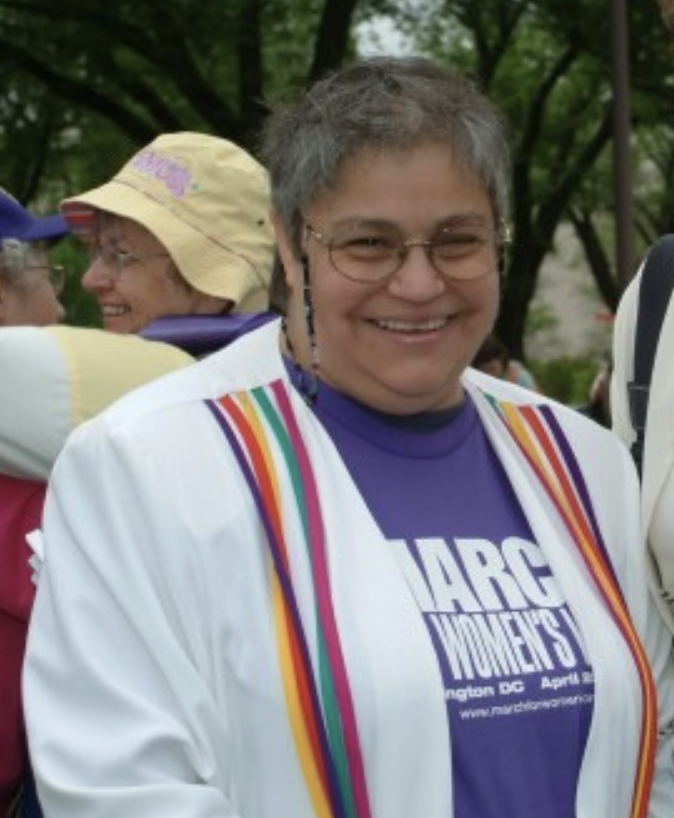
Alice Cohan at the March for Women's Lives |
In Memory of Alice Cohan, Beloved Feminist Leader |
For more than 60 years, Alice Cohan devoted her life to the feminist movement as an activist, political organizer, and long-time Political Director at both the Feminist Majority and the National Organization for Women.
A nationally recognized expert in field organizing, mass mobilization, and electing feminist candidates, Alice began her activism as a teenager and attended her first Democratic National Convention in 1964, later attending every DNC from 1976 through 2020. She traveled extensively across the country, organizing in communities nationwide, and was a force in every sense: a dedicated friend, inspiring mentor, and brilliant strategist whose work helped elect feminist leaders and advance the Equal Rights Amendment.
Alice served as the Feminist Majority’s Political Director and Chief Field Organizer for 20 years, leading major community organizing efforts, mobilizing students for ballot initiatives and congressional campaigns, organizing large-scale national events, and working closely with feminist candidates through endorsements, coalitions, and political action networks. She represented the organization across a wide range of coalitions, from judicial nominations to reproductive rights. In 2004, Alice served as Director of the March for Women’s Lives, bringing 1.15 million people to Washington, D.C. in a historic demonstration to protect abortion rights, reproductive justice, and women’s health. She also remained deeply involved with NOW throughout her life, serving as Chief Field Director and Political Director and receiving NOW’s Lifetime Achievement Award in 2019.
Personally, Alice was a passionate mentor to generations of feminists and believed deeply in the power of community, connection, and humor to sustain movements. Organizing infused every part of her life. As she once said, “Only if we are strong and united can we move closer to equality.” Rest in Power, Alice Cohan. |
|
| Activists protesting outside the Supreme Court on January 13 (Giovanna DeStefanis) |
GIOVANNA DESTEFANIS | JAN 30 |
On January 13, 2026, the U.S. Supreme Court heard oral arguments in two landmark cases that could dramatically reshape the future of transgender rights in education and athletics: Little v. Hecox and West Virginia v. B.P.J. The cases challenge state laws that categorically bar transgender girls and women from participating in school sports, raising fundamental questions about discrimination and equality.
Outside the Court, hundreds of families, athletes, civil rights leaders, faith leaders, and members of Congress rallied both in support of and in opposition to transgender youth.
Inside the Court, attorneys from Lambda Legal, the ACLU, and Legal Voice argued that these bans violate both the Equal Protection Clause of the Fourteenth Amendment and, in the West Virginia case, Title IX’s prohibition on sex discrimination in education. Federal courts have blocked enforcement of these bans in both lawsuits.
In Little v. Hecox, the Court is reviewing Idaho’s 2020 Fairness in Women’s Sports Act, the first statewide law in the nation to impose a blanket ban on transgender women and girls in female athletic competitions. The law defines sex strictly on the basis of reproductive biology and genetics and allows schools to subject students to invasive sex verification procedures if a student’s eligibility is challenged.
Lindsay Hecox, a transgender college student, brought the case after being barred from competing on Boise State University’s women’s track team, arguing that the law unconstitutionally singles out transgender women for discriminatory exclusion.
West Virginia v. B.P.J. centers on Becky Pepper-Jackson, a transgender middle school student who sought to participate in girls’ cross-country and track. West Virginia’s Save Women’s Sports Act restricts participation on girls’ teams exclusively to students assigned female at birth. Lower courts repeatedly ruled in Becky’s favor, finding that the law violated both constitutional equal protection principles and Title IX.
Together, these cases represent the Supreme Court’s most consequential engagement with transgender athlete bans to date. More than twenty states have enacted laws restricting transgender students’ participation in school sports, with dozens more proposing similar legislation.
A decision is expected by late spring or early summer. A ruling upholding these bans would likely accelerate legislative attacks on transgender youth and further erode civil rights protections across education and public accommodations.
This moment marks the latest attack on transgender people in a broader campaign to demonize and exclude this community. Nevertheless, transgender people continue to organize, resist, and achieve historic breakthroughs. In November 2024, Sarah McBride of Delaware became the first openly transgender person elected to the U.S. Congress, a landmark victory for representation and political inclusion.
Across the country, transgender and LGBTQ+ candidates are winning local and state elections, expanding visibility and reshaping political power. While lawmakers seek to marginalize transgender people through fear-driven policy, trans communities continue to build power, claim space, and affirm their belonging in every arena of public life.
|
Afghan woman holds sign saying "Why the world is watching us silently and cruelly?" (Getty Images) |
The ruthless Taliban regime has quietly enacted a sweeping new penal code that fundamentally reshapes Afghanistan’s legal system, formalizing violence, criminalizing dissent, legalizing slavery, and stripping women of legal personhood under the guise of religious law.
On January 7, Taliban leader Hibatullah Akhundzada signed off on the “Penal Principles of Taliban Courts,” a document spanning 119 articles that took effect immediately without public announcement or consultation.
The regulation only became public weeks later after an Afghan human rights organization, Rawadari, published the text in the language, Pashto, raising alarm over provisions that legalize slavery, authorize private violence, and institutionalize repression across nearly every aspect of life.
According to the regulation, absolute obedience to the Taliban’s supreme leader is mandatory, with disobedience punishable by flogging or imprisonment.
Articles within the code criminalize any criticism of Taliban officials, failure to report perceived opposition activity, and even silence in the face of dissent. Even ordinary social interactions, like speaking to an unrelated woman or questioning authority, are treated as criminal acts and are punishable.
The penal code also codifies a rigid social hierarchy, dividing society into four classes and explicitly recognizing individuals as either “free” or “enslaved,” with harsher punishments imposed on those deemed lower status.
Human rights advocates warn this structure institutionalizes discrimination and revives concepts long prohibited under international law.
Women are among the most severely targeted. Under multiple iniquitous provisions, husbands are authorized to punish their wives through discretionary violence, while domestic abuse is only recognized as a crime in limited circumstances and carries a maximum sentence of 15 days imprisonment for the perpetrator.
Regardless of the compounding edicts, this code manages to further criminalize women who leave their homes without permission, mandates imprisonment for women accused of disobeying religious mandate, and allows corporal punishment to be imposed by family members or private individuals under the banner of “preventing vice.” Rights groups warn that these provisions normalize vigilante violence and completely erase women’s autonomy over their bodies, movement, and beliefs as well as state mandated religion.
Perhaps most alarming is Article 16, which authorizes the Taliban leader to approve executions for at least 11 broad categories of people under so-called discretionary punishments. These categories include individuals accused of opposing the Taliban, promoting beliefs deemed un-Islamic, sorcery, repeated “corruption,” and undefined moral offenses. The language is intentionally vague, granting sweeping authority to execute individuals deemed a threat to “public interest,” a term left deliberately undefined.
For Afghan women, this new penal code is not a legal reform but a painful confirmation of what daily life has already become: a system where violence is lawful, obedience is compulsory, and survival itself is criminalized. |
|
|
Act Now: Demand that the UN recognizes gender apartheid as a crime against humanity.
Sign below to add your name to this urgent call — we're delivering this petition directly to the United Nations Secretary-General and to the President of the UN General Assembly to make sure our voices are heard at the highest level. Every signature shows the growing public demand for action. The more names we gather, the stronger our message will be.
António Guterres, Secretary-General, Philémon Yang, President, General Assembly, I, the undersigned, urge the United Nations to take immediate and effective action to stand with Afghan women and girls, who are being forced to live under a system of gender apartheid instituted by the Taliban regime.
The Taliban has issued nearly 150 edicts systematically erasing women and girls from public life. And preventing girls and women from education, work, and taking away their freedom of movement is not only unjust—it violates their fundamental human rights under international law.
Specifically, I call on the United Nations to: 1. Formally recognize gender apartheid as a crime against humanity in international law and include it in the new Crimes Against Humanity Convention. 2. Refuse recognition and prevent the Taliban from occupying Afghanistan's UN seat, as this would confer legitimacy on a regime engaged in crimes against humanity. 3. Increase humanitarian assistance to Afghanistan, with priority given to women and girls as both distributors and recipients of aid. 4. Ensure Afghan women are meaningfully included in all international discussions on Afghanistan's future—political, economic, social, and humanitarian.
These actions constitute systematic oppression and domination of women and girls, committed with the intention of maintaining the dominant regime, and therefore amounting to apartheid and persecution under international law. The United Nations must act with moral clarity and legal resolve. The eyes of the world—and the hopes of Afghan women—are upon you.
Take action today to end gender apartheid. |
|
|
(Unsplash // Zulfugar Karimov) |
Elon Musk’s Grok AI (artificial intelligence) is being used to create nonconsensual, violent, and explicit photos and videos of women and children. These range from photos of people in revealing garments to extremely graphic and violent pornographic material.
Grok AI is “an AI assistant with a twist of humor and a dash of rebellion.” It can be used on X (formerly Twitter) where users can ask questions, generate photos, and perform other tasks—all of which can be publicly posted. Additionally, when Grok is used on its own website or app, it can be used to generate videos and even interact with sexually explicit chatbot companions.
In responding to requests on X, Grok has been manipulating photos of women and children to generate images of them in bikinis, lingerie, remove their clothes, or even pose them in suggestive ways. Ashley St. Clair, the mother of one of Musk’s children, said that Grok has undressed photos of her as a child. On Grok’s standalone website and app, users are using the AI to generate hardcore pornography. These photorealistic videos include women covered in blood, engaging in violent sexual acts, and even child sexual abuse material.
Musk has said his company will take action “against illegal content on X, including Child Sexual Abuse Material (CSAM), by removing it, permanently suspending accounts, and working with local governments and law enforcement as necessary.”
The Grok account on X now limits requests for AI images to subscribers who pay for premium features, but users can subscribe or switch to Grok’s individual site for the limited functions on X. This means that Grok users are still able to create sexually explicit content by directly interacting with the chatbot and are able to share those by posting the image on X or sharing an URL.
Adding a payment feature does not stop nonconsensual content or deepfakes from being created and therefore does not solve the problem. Last year, when Grok praised Hitler, X's AI temporarily disabled the chatbot. This is a solution that could easily be applied to nonconsensual content, yet is not.
In order to protect women, there needs to be stronger regulation and accountability surrounding AI. This issue is not just about “bad users,” there should not be technology readily available that can be misused to create abusive, explicit, and degrading imagery without consent. Just because the content being created is fake, does not mean there isn’t harm. As with any form of sexual abuse, it can cause fear, shame, withdrawal, and self-censorship.
This can not be treated as a tech controversy, because the issue’s foundation is rooted in the absence of consent. Technology should never subject women to this type of harm. AI-based abuse is simply becoming another mechanism through which women are silenced, humiliated, and pushed out of public spaces. |
|
|
Abortion rights protestors outside Supreme Court (Madelyn Amos) |
As of January 6, abortion remains legal in Wyoming after the Wyoming Supreme Court struck down two state laws aimed at banning abortion in State v. Johnson. One of the overturned laws sought to ban abortion except to save a pregnant woman’s life or in cases involving rape or incest. The other would have been the country’s first explicit ban on abortion pills.
In a political landscape where reproductive rights are increasingly uncertain, this decision stands as a clear affirmation of bodily autonomy and a meaningful win for women’s rights. It ensures that women in Wyoming can continue accessing both procedural and medication abortions without being forced to travel out of state for care.
The abortion and abortion pill laws, which were struck down, were originally enacted in March, 2023, and then struck down by the Teton County District Court soon after. The district court ruled that the laws conflicted with a 2012 voter referendum to the state’s constitution which states “each competent adult shall have the right to make his or her own health care decisions.”
The Wyoming Supreme Court used the same reasoning in its decision this week. The justices decision sided 4-1 with Wellspring Health Access, which is the state’s only abortion clinic, an abortion advocacy group, and four women who argued for the bans to be struck down.
On the other side, attorneys for the State of Wyoming argued that abortion is not health care and therefore can not violate the Wyoming constitution, an argument the court rejected. In doing so, the court pushed back against a long-standing effort to exclude women’s reproductive needs from definitions of healthcare.
This ruling highlights the power of states in shaping abortion access in the aftermath of the Dobbs decision, overturning Roe v. Wade. While federal protections no longer exist, state courts can still safeguard reproductive rights, even in politically conservative leaning states such as Wyoming. Legal pathways to protecting women’s autonomy still remain.
Still, the ruling does not guarantee long-term protection for abortion access in Wyoming. In their decision, the justices acknowledge that the amendment they relied on was not originally written with abortion in mind, noting though that they “would not add words to the constitution.” This leaves open the opportunity for Wyoming to enshrine abortion rights into their state constitution.
Already, Wyoming Governor Mark Gordon has called on state lawmakers to meet and pass an amendment banning abortion that would go to voters in the fall. While the amendment would require a two-thirds vote to be introduced, it is likely to have wide support in such a Republican dominated government.
For now, the Wyoming Supreme Court’s decision is a significant and hard-won victory for reproductive rights. At a moment when abortion access is disappearing across much of the country, this ruling shows that legal protections are still possible. While future challenges remain, this decision marks an important step forward and a reminder that progress is worth fighting for. |
|
|
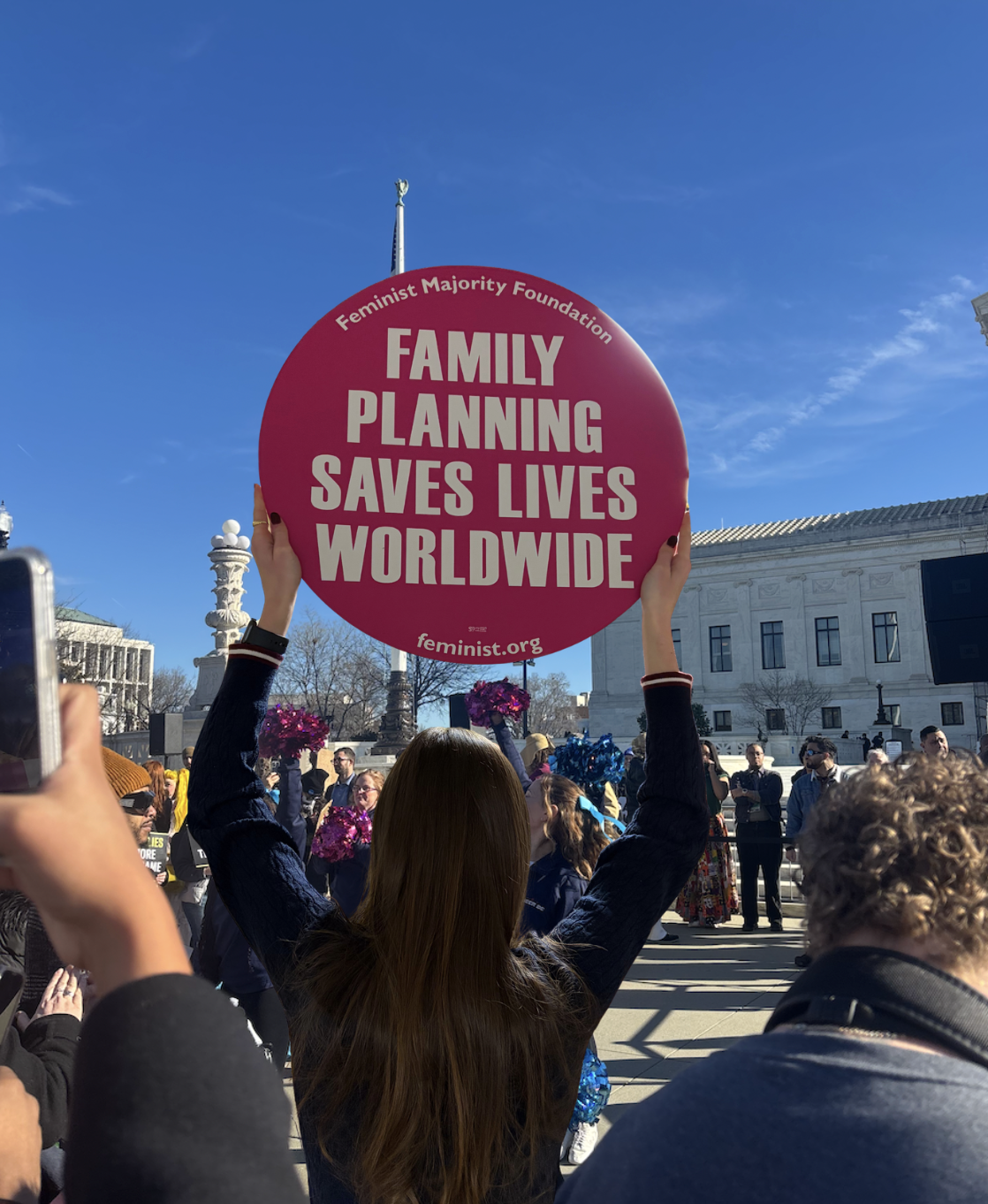
Family planning saves lives (Giovanna DeStefanis) |
JAHARRA ANGLIN STUBBS | JAN 7 |
On January 1st, 2026, China implemented a 13% VAT (value-added tax) on birth control and other forms of contraception to boost birth rates. China, the world’s second-largest economy, has been experiencing a decline in its birth rate, especially over the last three years. This tax move is intended to help boost ‘fertility-friendly’ measures and “love education.”
Before 2015, China had a one-child policy from 1980 to 2015 that limited most urban households to a single child and assigned birth quotas to women and families, with penalties for having more than the allocated quota. However, in 2021, in an effort to address the aging population, low workforce participation, and the state’s economy, the Chinese government abolished the policy. Still, it did not have the intended effect, as birth rates have continued to decline since then.
Because deaths are more frequent than births in the country, even with increasing the number of children that can be born in a single household from one to three, much of the population considers having children to be more costly. The costs of child care, education, and job uncertainty due to the state of the workforce are all contributing factors.
Although the government has made efforts to encourage the alternative, with annual childcare subsidies, lifting restrictions on marriage, offering extended parental leave, and other cash incentives for potential parents, this has proven difficult. Rapid urbanization has left many families already struggling to find space to live and to afford their current lives, making having children more of a burden than a blessing.
Notably, in 2024, the YuWa Population Research Institute reported that China is one of the most expensive countries to raise a child, primarily due to school fees, the competitive nature of education, and the difficulty of balancing work and parenting, especially for women. The cost of raising a child was 6.3% higher than the country’s GDP per capita, a gap that becomes even more apparent for women who take maternity leave and return to the workforce only to experience a 12-17% wage cut.
The report also noted that “some women have to give up having children in exchange for the opportunity to succeed in their careers.” Despite government incentives, the report found that many women see China’s social environment as not conducive with both having children and achieving economic security and career success.
This push for expanding families is in the interest of promoting national economic growth. By imposing a tax on products that were free when the government wanted to curb births, the government is now trying to assert control over the bodies of many Chinese women and make contraceptives less accessible.
China’s decision to tax contraception underscores a troubling pattern: when demographic goals change, women’s bodies become tools of state policy. Instead of addressing the structural barriers that make parenthood unaffordable, housing costs, workplace discrimination, and inadequate childcare, the government has chosen a coercive approach that limits reproductive autonomy. History shows that policies rooted in control, rather than support and choice, are unlikely to reverse declining birth rates.
|
|
|
Hosted by FMF, the 2026 National Young Feminist Leadership Conference brings together hundreds of student activists to build collective power, share strategies of resistance, learn about critical domestic and global feminist issues, and develop hands-on grassroots organizing tactics. Every day, the threats to our basic human rights intensify. Now more than ever, it is so important for us to connect and strategize with other feminist activists and strengthen our community. Our collective power is unstoppable.
Being at a conference with hundreds of other young activists is an indescribable feeling. It’s the recognition that we are a part of something big, a community of dedicated students working for justice across the country and the world. It’s a reminder that young people are powerful beyond measure. And it’s the energy we need to carry our movement forward. |
|
| ENJOYED THIS NEWSLETTER? FORWARD TO A FRIEND!
WAS THIS EMAIL FORWARDED TO YOU BY A FRIEND? SUBSCRIBE HERE. |
Follow us on Instagram @feministmajorityfoundation |
|
|
Feminist Majority Foundation
1600 Wilson Boulevard
Suite 801
Arlington, VA 22209
United States |
|
|
If you believe you received this message in error or wish to no longer receive email from us, please unsubscribe. |
|
|
|