|
 |
Thank you for being a free subscriber to So, Does It Matter? Please support what we do. And also get 100% of our content (right now you get about 60% of it!).
President Trump’s Order On Fire Rebuilding In Los Angeles Brushes Up Against The 10th Amendment
A constitutional line separates federal disaster aid from federal control of local governance. Parts of the order make Constitutional sense, others... Well, read on...
|

| |||||||||||||||


 |
Below this column, beneath the paywall, is a seven-minute monologue by yours truly where I really stress the important issues from this column!
⏱️ 6 min read
Zeldin, Loeffler Are In Los Angeles Today
Today, Lee Zeldin, the Administrator of the Environmental Protection Agency, and Kelly Loeffler, the head of the Small Business Administration, are heading out to California to hold a town hall tomorrow and, no doubt, survey the still-devastated, fire-ravaged communities in and around Los Angeles — as they wrap their arms around the implementation of President Trump’s executive order issued last week, aimed at speeding up rebuilding in fire-devastated parts of Los Angeles. There are some parts of this order that make sense, but other parts of the order, and the remarks made by the President around the Executive Order, that cause a constitutional conservative some pause.
The Amendment Everyone Forgets
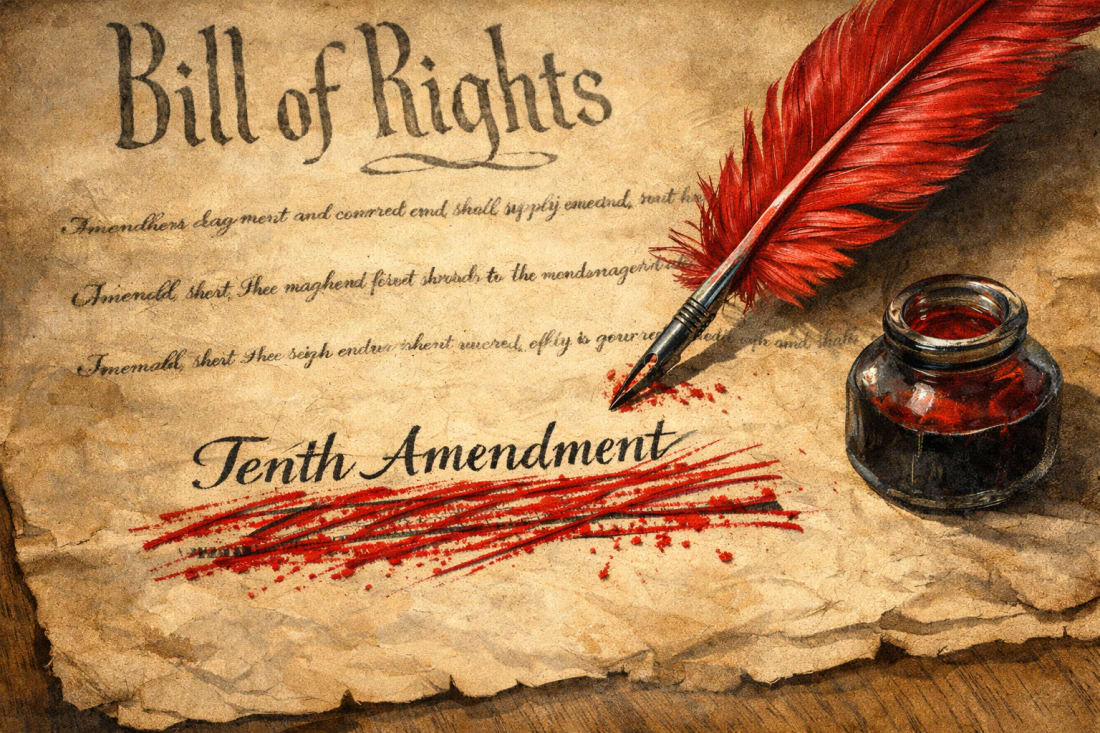
Thousands of families are still waiting to rebuild their homes and lives after the fires in Los Angeles. Most Americans can quote the First Amendment. Some can name the Second. Almost nobody talks about the 10th. Yet it may be the most important when it comes to how power actually works in this country.
“The powers not delegated to the United States by the Constitution, nor prohibited by it to the States, are reserved to the States respectively, or to the people. “
- The 10th Amendment
That is not filler language. It defines our constitutional structure. It says the federal government has limited, listed powers, while the states remain the real governing authorities with broad responsibility for daily life. Washington does not have a general police power. It should act only where the Constitution gives it authority, such as regulating interstate commerce, raising armies, or taxing and spending.
James Madison put it plainly in Federalist 45:
The powers delegated by the proposed Constitution to the federal government are few and defined. Those which are to remain in the State governments are numerous and indefinite.
In other words, the Founders expected most day-to-day governing to remain with the states. That includes land use, zoning, building codes, and permitting.
Which is why President Trump’s executive order aimed at speeding up rebuilding in fire-devastated parts of Los Angeles brushes up against constitutional constraints.
Before I go on, I want to commend the President, Zeldin, and Loeffler for their empathy and strong call to action. They have a column in the California Post worth reading, but I will highlight the very end.
“In the spirit of cooperative federalism, we will ask Los Angeles to join us in the urgent fight to clear the road to recovery and together end bureaucratic roadblocks.
Our goal is to ensure residents get the expeditious and accountable permitting process they have long deserved, along with a clear path to rebuilding that makes their communities stronger and more resilient than ever.”
There is no good excuse for the delays, the poor decision-making, and the lack of progress. Hopefully, some external pressure applied will help kick the local response into gear. Assuming there is enough competency in local government to do anything correctly.
Where Federal Power Clearly Applies
There is nothing constitutionally questionable about the federal government sending disaster relief money. Congress has used its spending power for decades to help states recover from fires, hurricanes, floods, and other disasters. Federal agencies can attach conditions to that money, audit how it is spent, and demand accountability. Aiding in federal loans, through allowing people to self-declare that requirements are met to qualify, is also something in the federal government’s wheelhouse.
But there is a clear legal difference between putting conditions on federal funds and taking over or trying to supplant state and local authority. The Supreme Court has long allowed Congress to attach strings to federal money. At the same time, it has made clear that Washington cannot simply assume control over areas of governance that belong to the states or local governments. Preemption is real, but it must flow from a valid exercise of an enumerated power and clear congressional authorization.
If California has billions in hazard mitigation funds sitting unused or wasted, Washington has every right to ask why. If federal rebuilding dollars are stuck in state or local red tape, Congress can set terms to ensure those funds actually go to rebuilding.
The problem begins when financial leverage turns into direct control.
Where The Order Pushes Into State Authority
The executive order basically says that if the process of permit approvals and similar local procedures delays federal funds from reaching people, then the federal government can “take over” local permitting through preemption. That is not a small procedural tweak; it is a real shift in authority from state and local government to the federal government. Which, in my opinion, would never be sustained at the Supreme Court, nor should it. Separately, as an aside, it is also an executive action, not an act of Congress, which raises an additional question of whether agencies can claim preemptive authority that lawmakers never clearly granted.
Permitting is not just paperwork. It is part of what courts call the police power, meaning the authority to protect health, safety, and welfare. That authority was never handed over to the federal government. It is one of the core responsibilities that states kept under the constitutional design Madison described.
Alexander Hamilton, who believed in a strong national government, still noted in Federalist 17 that:
The administration of private justice between the citizens of the same State… and all those things… which are proper to be provided for by local legislation belong to the states.
Today, land-use decisions, safety inspections, and building approvals fall into the same category of everyday local governance.
Yes, federal law can preempt state law. The Supremacy Clause allows that. But preemption has to be tied to an actual constitutional power that Congress has clearly exercised. It is not a tool Washington gets to use just because it is impatient, or even because a state or local government is demonstrating incompetence.
When the federal government starts replacing local permitting systems across wide categories of private rebuilding, it begins to look less like attaching conditions to spending and more like stepping into a role the Constitution left to the states.
Accountability Still Lives At The State Level
This is not a defense of how California has handled rebuilding. California’s failures are real. Los Angeles officials have and continue to make mistakes. Sacramento politicians have also really messed this up. Voters put those people in office, and voters have the power to remove them.
That is how a democratic republic is supposed to work.
Federalism forces voters to live with the consequences of the leaders they choose. When Washington absorbs state responsibilities, it becomes harder to see who is responsible when things go wrong. Centralization does not eliminate failure. It only makes it harder for voters to know who to blame.
Americans across the political spectrum should be careful about normalizing this kind of federal intervention. Today, the target may be a blue state with policies some dislike. Tomorrow, it could be a red state facing pressure from a Democratic administration that does not like how it handles energy, education, or policing. Precedents for expanded federal power rarely remain confined to a single administration or party.
The Founders understood that states would sometimes govern badly. Their solution was elections and a division of power, not automatic consolidation in the national government.
The Supreme Court Is Shifting The Other Way
For many years, the Supreme Court allowed federal authority to expand through broad readings of the Commerce Clause and other constitutional provisions.
That trend has slowed. The current Court, with a stronger originalist and textualist majority, has shown greater skepticism toward sweeping claims of federal power that lack a clear constitutional foundation. The justices have pushed back on broad agency interpretations of federal power and revived limits on administrative overreach. They have emphasized that Congress must speak clearly when it wants to displace traditional state authority, especially in areas long handled at the state and local level.
A rule allowing federal agencies to displace local permitting systems for large swaths of rebuilding would almost certainly raise the question of where Congress actually authorized that step.
Pointing that out does not excuse California’s mismanagement. It recognizes that the cure for state failure is not automatically federal control.
States Are Supposed To Frustrate Washington
The system the Constitution created was not designed for maximum speed. It was designed to prevent too much power from gathering in one place.
States are not meant to function as branch offices of the federal government. They are meant to be sovereign governments with their own accountability and political choices. That can be frustrating, especially after a disaster when people want immediate results. But decentralization is a safeguard, not an accident.
History shows that powers claimed in an emergency rarely disappear once the emergency ends. The 10th Amendment exists to slow that process and force the country to think carefully before shifting authority upward.
So, Does It Matter?
Federal disaster aid is not the issue. Oversight of federal dollars is not the issue. The real question is whether frustration with Sacramento and Los Angeles becomes an excuse for Washington to step into roles the Constitution left to the states. That boundary is not a technicality. It is one of the structural protections meant to keep power divided and closer to the people who live with the consequences.
We are living in a period when President Trump is pushing hard on a strong, unitary view of executive power, meaning a presidency that presses authority to its outer limits. With a Congress that often struggles to act, the temptation to rely on executive power is easy to understand. There are serious debates about presidential versus congressional power at the national level. But there should be much less confusion about the line between federal authority and the responsibilities of state and local governments in domestic affairs.
We should all applaud the President’s efforts to make sure that things that are squarely under the purview of the federal government are happening quickly, efficiently, and prudently. And I sure hope that the federally appropriate actions taken by the EPA and SBA not only help but also put pressure on state and local actors to step up their game. But it is not in the country's best interests for the federal government to try to supplant the constitutionally appropriate roles of state and local governments on any issue, even in egregious cases of failure, like this one.
Let me close by saying that a discussion like this can sound distant to families who have lost everything and are trying to rebuild their lives. When someone is dealing with insurance claims, contractors, and the stress of displacement, constitutional structure is not the first thing on their mind. That reality should shape the tone of this debate, even if it does not change the importance of the constitutional lines involved.
My thoughts and prayers continue to be with all of those dealing with such grievous loss. And God bless the President, Administrators Zeldin and Lauffler. May their constitutionally appropriate efforts lead to positive outcomes.
But wait, there’s more!
If you enjoy this sort of independent coverage, where I am beholden to no one and able to call balls and strikes, please consider a paid subscription today! And, oh yes, below is a video of mine with even more to say, complementing the column above!
Jon...
Keep reading with a 7-day free trial
Subscribe to FlashReport Presents: So, Does It Matter? On CA Politics! to keep reading this post and get 7 days of free access to the full post archives.
A subscription gets you:
 | Subscriber-only Afternoon Posts. Analysis on breaking News |
| Saturday’s Popular “What is Jon Reading” Column |
| 100% percent of our site content is yours! |
| ||||||||||

