
Email
The “Good Deal for Ohio” That Isn’t: SB 190 Expands Government
| From | Dana Criswell <[email protected]> |
| Subject | The “Good Deal for Ohio” That Isn’t: SB 190 Expands Government |
| Date | February 3, 2026 9:48 PM |
Links have been removed from this email. Learn more in the FAQ.
Links have been removed from this email. Learn more in the FAQ.
View this post on the web at [link removed]
I usually focus on Mississippi, but Ohio’s SB 190 shows the same playbook nationwide, politicians dressing up bigger government to grab more of your money and your freedom. Politicians everywhere have learned an old trick: when you want to grow government, wrap it in something everyone likes. That is exactly what Senate Bill 190 does to Ohio.
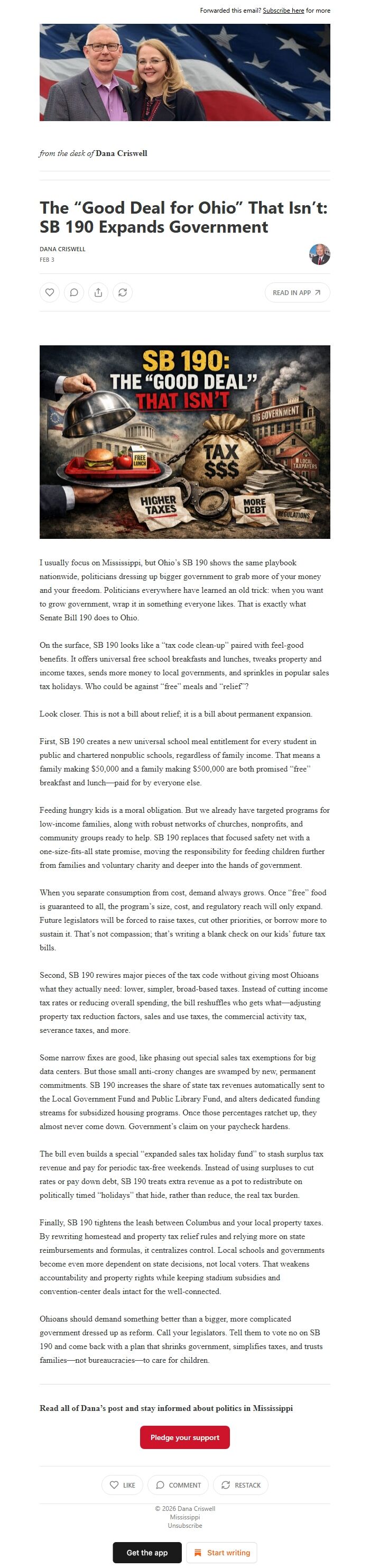
On the surface, SB 190 looks like a “tax code clean‑up” paired with feel‑good benefits. It offers universal free school breakfasts and lunches, tweaks property and income taxes, sends more money to local governments, and sprinkles in popular sales tax holidays. Who could be against “free” meals and “relief”?
Look closer. This is not a bill about relief; it is a bill about permanent expansion.
First, SB 190 creates a new universal school meal entitlement for every student in public and chartered nonpublic schools, regardless of family income. That means a family making $50,000 and a family making $500,000 are both promised “free” breakfast and lunch—paid for by everyone else.
Feeding hungry kids is a moral obligation. But we already have targeted programs for low‑income families, along with robust networks of churches, nonprofits, and community groups ready to help. SB 190 replaces that focused safety net with a one‑size‑fits‑all state promise, moving the responsibility for feeding children further from families and voluntary charity and deeper into the hands of government.
When you separate consumption from cost, demand always grows. Once “free” food is guaranteed to all, the program’s size, cost, and regulatory reach will only expand. Future legislators will be forced to raise taxes, cut other priorities, or borrow more to sustain it. That’s not compassion; that’s writing a blank check on our kids’ future tax bills.
Second, SB 190 rewires major pieces of the tax code without giving most Ohioans what they actually need: lower, simpler, broad‑based taxes. Instead of cutting income tax rates or reducing overall spending, the bill reshuffles who gets what—adjusting property tax reduction factors, sales and use taxes, the commercial activity tax, severance taxes, and more.
Some narrow fixes are good, like phasing out special sales tax exemptions for big data centers. But those small anti‑crony changes are swamped by new, permanent commitments. SB 190 increases the share of state tax revenues automatically sent to the Local Government Fund and Public Library Fund, and alters dedicated funding streams for subsidized housing programs. Once those percentages ratchet up, they almost never come down. Government’s claim on your paycheck hardens.
The bill even builds a special “expanded sales tax holiday fund” to stash surplus tax revenue and pay for periodic tax‑free weekends. Instead of using surpluses to cut rates or pay down debt, SB 190 treats extra revenue as a pot to redistribute on politically timed “holidays” that hide, rather than reduce, the real tax burden.
Finally, SB 190 tightens the leash between Columbus and your local property taxes. By rewriting homestead and property tax relief rules and relying more on state reimbursements and formulas, it centralizes control. Local schools and governments become even more dependent on state decisions, not local voters. That weakens accountability and property rights while keeping stadium subsidies and convention‑center deals intact for the well‑connected.
Ohioans should demand something better than a bigger, more complicated government dressed up as reform. Call your legislators. Tell them to vote no on SB 190 and come back with a plan that shrinks government, simplifies taxes, and trusts families—not bureaucracies—to care for children.
Unsubscribe [link removed]?
I usually focus on Mississippi, but Ohio’s SB 190 shows the same playbook nationwide, politicians dressing up bigger government to grab more of your money and your freedom. Politicians everywhere have learned an old trick: when you want to grow government, wrap it in something everyone likes. That is exactly what Senate Bill 190 does to Ohio.
On the surface, SB 190 looks like a “tax code clean‑up” paired with feel‑good benefits. It offers universal free school breakfasts and lunches, tweaks property and income taxes, sends more money to local governments, and sprinkles in popular sales tax holidays. Who could be against “free” meals and “relief”?
Look closer. This is not a bill about relief; it is a bill about permanent expansion.
First, SB 190 creates a new universal school meal entitlement for every student in public and chartered nonpublic schools, regardless of family income. That means a family making $50,000 and a family making $500,000 are both promised “free” breakfast and lunch—paid for by everyone else.
Feeding hungry kids is a moral obligation. But we already have targeted programs for low‑income families, along with robust networks of churches, nonprofits, and community groups ready to help. SB 190 replaces that focused safety net with a one‑size‑fits‑all state promise, moving the responsibility for feeding children further from families and voluntary charity and deeper into the hands of government.
When you separate consumption from cost, demand always grows. Once “free” food is guaranteed to all, the program’s size, cost, and regulatory reach will only expand. Future legislators will be forced to raise taxes, cut other priorities, or borrow more to sustain it. That’s not compassion; that’s writing a blank check on our kids’ future tax bills.
Second, SB 190 rewires major pieces of the tax code without giving most Ohioans what they actually need: lower, simpler, broad‑based taxes. Instead of cutting income tax rates or reducing overall spending, the bill reshuffles who gets what—adjusting property tax reduction factors, sales and use taxes, the commercial activity tax, severance taxes, and more.
Some narrow fixes are good, like phasing out special sales tax exemptions for big data centers. But those small anti‑crony changes are swamped by new, permanent commitments. SB 190 increases the share of state tax revenues automatically sent to the Local Government Fund and Public Library Fund, and alters dedicated funding streams for subsidized housing programs. Once those percentages ratchet up, they almost never come down. Government’s claim on your paycheck hardens.
The bill even builds a special “expanded sales tax holiday fund” to stash surplus tax revenue and pay for periodic tax‑free weekends. Instead of using surpluses to cut rates or pay down debt, SB 190 treats extra revenue as a pot to redistribute on politically timed “holidays” that hide, rather than reduce, the real tax burden.
Finally, SB 190 tightens the leash between Columbus and your local property taxes. By rewriting homestead and property tax relief rules and relying more on state reimbursements and formulas, it centralizes control. Local schools and governments become even more dependent on state decisions, not local voters. That weakens accountability and property rights while keeping stadium subsidies and convention‑center deals intact for the well‑connected.
Ohioans should demand something better than a bigger, more complicated government dressed up as reform. Call your legislators. Tell them to vote no on SB 190 and come back with a plan that shrinks government, simplifies taxes, and trusts families—not bureaucracies—to care for children.
Unsubscribe [link removed]?
Message Analysis
- Sender: n/a
- Political Party: n/a
- Country: n/a
- State/Locality: n/a
- Office: n/a