|
 |
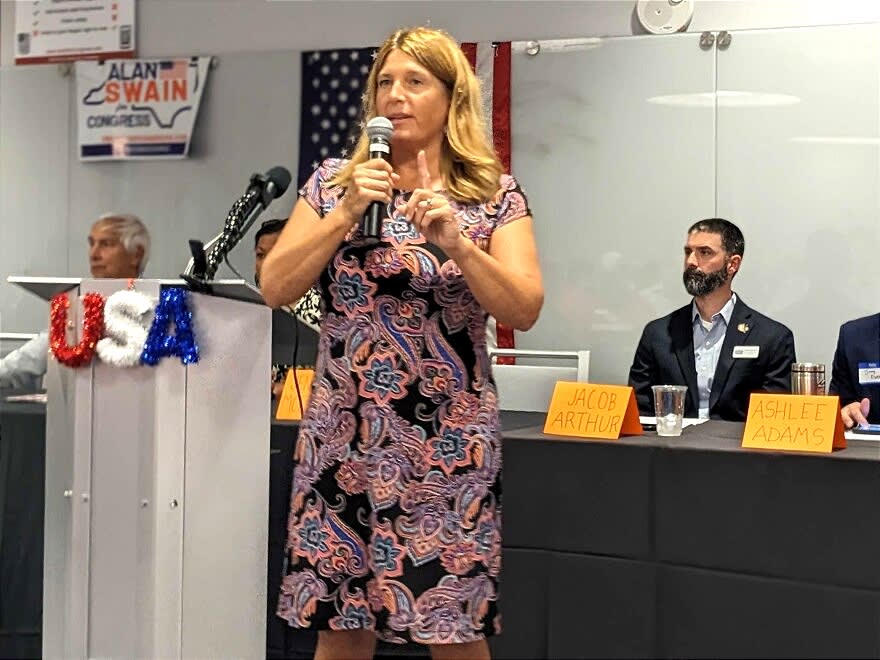
Meet Michele Morrow, the GOP Candidate Running Against Her Own Base
How to lose friends and alienate voters in 10 pages. The Morrow Manifesto.
|

| |||||||||||||||


 |
If you are encountering Michele Morrow for the first time, the backstory matters.
Morrow is not new to statewide politics. In 2024, she ran as the Republican nominee for North Carolina Superintendent of Public Instruction, branding herself as the Christian homeschool mother who would give the state’s public schools “some Jesus.”
It was an explicitly theological campaign aimed less at policy than at cultural combat.
She lost.
After the loss, Morrow did not retreat from public life. Instead, she aggressively pursued a position in President Trump’s Department of Education.
That effort, too, went nowhere.
Now she is back—this time as the last entrant in an already crowded Republican Senate primary.
The race for the GOP Senate nominee already featured two candidates with some knowledge of how politics and governance are supposed to work: Michael Whatley, former chair of the Republican National Committee and emissary of the party’s establishment wing, and grassroots favorite, Don Brown, a Navy veteran, former JAG officer, and military historian.
Morrow arrived late and loud. Very loud.
 |
Over the weekend, she sent a 10-page manifesto to activists across the state. It read like a deposition transcript crossed with a sermon outline.
It was a catalogue of grievances, accusations, professions of righteousness, and visions of singular destiny.
She is persecuted. She is feared. She is opposed not merely by rivals but by liars, manipulators, and, in some cases, the ‘morally wicked’ on her own side.
She is also, we are told, “running for Christ.”
This is where the trouble begins.
Morrow styles herself as the grassroots candidate, the darling of the base, the good Christian who will unite the movement and bring the party to heel. And she chooses to do so by going to war with the grassroots themselves.
Names are named. Motives are impugned. Longtime activists are accused of gossip, sabotage, and bad faith.
For her, ‘unity’ is something that happens after everyone in the grassroots admits she was right all along.
The ironies stack up quickly in her manifesto.
Morrow insists the race “is not about me,” then spends ten pages explaining why it is, in fact, exclusively about her—her courage, her persecution, her moral clarity, her singular electability.
Morrow used the word “I” 186 times.
For Morrow, there’s no category for honest disagreement. There is only her ‘truth’ and treachery.
This is a workable framework for a cult. It is a terrible one for a statewide election.
Morrow also styles herself as an anti-establishment insurgent while demanding loyalty from the very grassroots institutions she claims to represent.
The grassroots, it turns out, are sovereign only so long as they agree with her conclusions. When they do not, they are recast as tools of shadowy interests or victims of rumor and manipulation.
Facts don’t care about your feelings, she reminds us, wielding the phrase like a gavel.
But facts do care about coalition math. They care about turnout. They care about persuasion beyond the faithful. And this letter persuades no one who was not already convinced.
The most revealing feature of Morrow’s Manifesto is not its anger but its confusion. It mistakes indignation for seriousness. It assumes that righteousness, sufficiently asserted, will bend political reality to its will.
That is not how campaigns work.
North Carolina is not a stage prop in a morality play. A Senate race is not an exercise in personal vindication.
Michele Morrow may believe she is leading a charge. She mistakes scorched earth behind her for a path forward.
You're currently a free subscriber to Fault Line Blog With Sloan Rachmuth . For the full experience, upgrade your subscription.
| ||||||||||

