
| From | Environment Colorado <[email protected]> |
| Subject | Tell Aramark: Plastic pollution is harming ocean life |
| Date | February 2, 2026 3:14 PM |
Links have been removed from this email. Learn more in the FAQ.
Links have been removed from this email. Learn more in the FAQ.
:
John,
Every minute, plastic waste pours into our oceans, harming wildlife, contaminating the environment and polluting fragile marine ecosystems.
A lot of this pollution comes from single-use plastic packaging -- bottles, wrappers, bags and other food containers designed to be used once and then thrown away.
One potential source of this waste is large food service providers like Aramark, which serves millions of meals at stadiums, arenas and museums across the country.
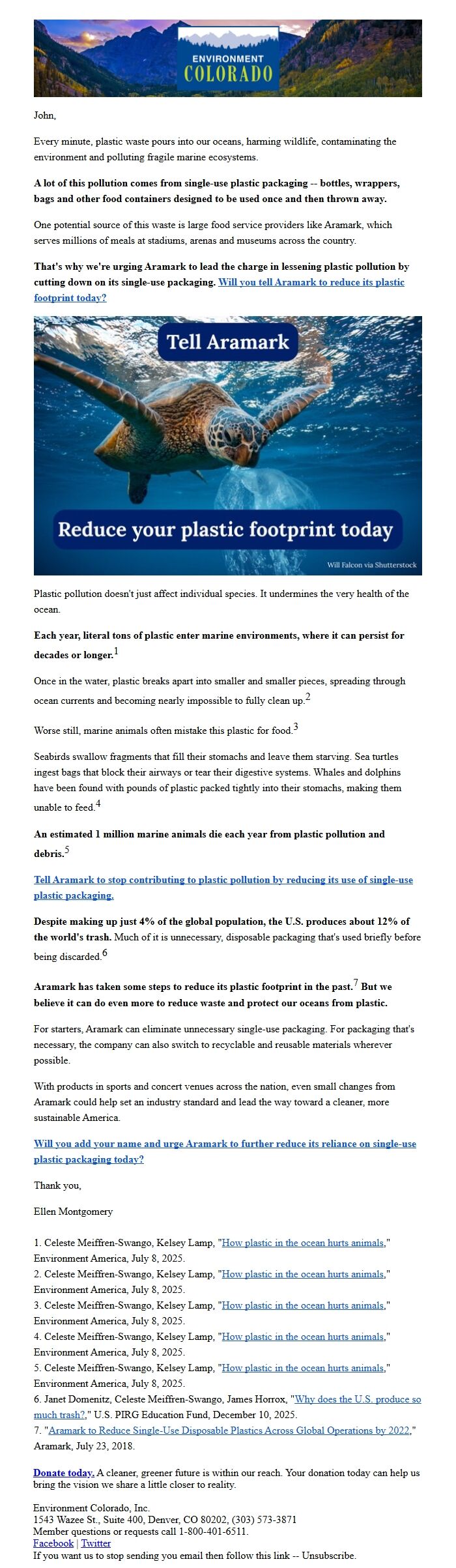
That's why we're urging Aramark to lead the charge in lessening plastic pollution by cutting down on its single-use packaging. Will you tell Aramark to reduce its plastic footprint today?
[link removed]
Plastic pollution doesn't just affect individual species. It undermines the very health of the ocean.
Each year, literal tons of plastic enter marine environments, where it can persist for decades or longer.[1]
Once in the water, plastic breaks apart into smaller and smaller pieces, spreading through ocean currents and becoming nearly impossible to fully clean up.[2]
Worse still, marine animals often mistake this plastic for food.[3]
Seabirds swallow fragments that fill their stomachs and leave them starving. Sea turtles ingest bags that block their airways or tear their digestive systems. Whales and dolphins have been found with pounds of plastic packed tightly into their stomachs, making them unable to feed.[4]
An estimated 1 million marine animals die each year from plastic pollution and debris.[5]
Tell Aramark to stop contributing to plastic pollution by reducing its use of single-use plastic packaging.
[link removed]
Despite making up just 4% of the global population, the U.S. produces about 12% of the world's trash. Much of it is unnecessary, disposable packaging that's used briefly before being discarded.[6]
Aramark has taken some steps to reduce its plastic footprint in the past.[7] But we believe it can do even more to reduce waste and protect our oceans from plastic.
For starters, Aramark can eliminate unnecessary single-use packaging. For packaging that's necessary, the company can also switch to recyclable and reusable materials wherever possible.
With products in sports and concert venues across the nation, even small changes from Aramark could help set an industry standard and lead the way toward a cleaner, more sustainable America.
Will you add your name and urge Aramark to further reduce its reliance on single-use plastic packaging today?
[link removed]
Thank you,
Ellen Montgomery
1. Celeste Meiffren-Swango, Kelsey Lamp, "How plastic in the ocean hurts animals," Environment America, July 8, 2025.
[link removed]
2. Celeste Meiffren-Swango, Kelsey Lamp, "How plastic in the ocean hurts animals," Environment America, July 8, 2025.
[link removed]
3. Celeste Meiffren-Swango, Kelsey Lamp, "How plastic in the ocean hurts animals," Environment America, July 8, 2025.
[link removed]
4. Celeste Meiffren-Swango, Kelsey Lamp, "How plastic in the ocean hurts animals," Environment America, July 8, 2025.
[link removed]
5. Celeste Meiffren-Swango, Kelsey Lamp, "How plastic in the ocean hurts animals," Environment America, July 8, 2025.
[link removed]
6. Janet Domenitz, Celeste Meiffren-Swango, James Horrox, "Why does the U.S. produce so much trash?," U.S. PIRG Education Fund, December 10, 2025.
[link removed]
7. "Aramark to Reduce Single-Use Disposable Plastics Across Global Operations by 2022," Aramark, July 23, 2018.
[link removed]
-----------------------------------------------------------
Donate Today: [link removed]
Join us on Facebook: [link removed]
Follow us on Twitter: [link removed]
Environment Colorado, Inc.
1543 Wazee St., Suite 400, Denver, CO 80202, (303) 573-3871
Member questions or requests call 1-800-401-6511.
If you want us to stop sending you email then follow this link: [link removed]
John,
Every minute, plastic waste pours into our oceans, harming wildlife, contaminating the environment and polluting fragile marine ecosystems.
A lot of this pollution comes from single-use plastic packaging -- bottles, wrappers, bags and other food containers designed to be used once and then thrown away.
One potential source of this waste is large food service providers like Aramark, which serves millions of meals at stadiums, arenas and museums across the country.
That's why we're urging Aramark to lead the charge in lessening plastic pollution by cutting down on its single-use packaging. Will you tell Aramark to reduce its plastic footprint today?
[link removed]
Plastic pollution doesn't just affect individual species. It undermines the very health of the ocean.
Each year, literal tons of plastic enter marine environments, where it can persist for decades or longer.[1]
Once in the water, plastic breaks apart into smaller and smaller pieces, spreading through ocean currents and becoming nearly impossible to fully clean up.[2]
Worse still, marine animals often mistake this plastic for food.[3]
Seabirds swallow fragments that fill their stomachs and leave them starving. Sea turtles ingest bags that block their airways or tear their digestive systems. Whales and dolphins have been found with pounds of plastic packed tightly into their stomachs, making them unable to feed.[4]
An estimated 1 million marine animals die each year from plastic pollution and debris.[5]
Tell Aramark to stop contributing to plastic pollution by reducing its use of single-use plastic packaging.
[link removed]
Despite making up just 4% of the global population, the U.S. produces about 12% of the world's trash. Much of it is unnecessary, disposable packaging that's used briefly before being discarded.[6]
Aramark has taken some steps to reduce its plastic footprint in the past.[7] But we believe it can do even more to reduce waste and protect our oceans from plastic.
For starters, Aramark can eliminate unnecessary single-use packaging. For packaging that's necessary, the company can also switch to recyclable and reusable materials wherever possible.
With products in sports and concert venues across the nation, even small changes from Aramark could help set an industry standard and lead the way toward a cleaner, more sustainable America.
Will you add your name and urge Aramark to further reduce its reliance on single-use plastic packaging today?
[link removed]
Thank you,
Ellen Montgomery
1. Celeste Meiffren-Swango, Kelsey Lamp, "How plastic in the ocean hurts animals," Environment America, July 8, 2025.
[link removed]
2. Celeste Meiffren-Swango, Kelsey Lamp, "How plastic in the ocean hurts animals," Environment America, July 8, 2025.
[link removed]
3. Celeste Meiffren-Swango, Kelsey Lamp, "How plastic in the ocean hurts animals," Environment America, July 8, 2025.
[link removed]
4. Celeste Meiffren-Swango, Kelsey Lamp, "How plastic in the ocean hurts animals," Environment America, July 8, 2025.
[link removed]
5. Celeste Meiffren-Swango, Kelsey Lamp, "How plastic in the ocean hurts animals," Environment America, July 8, 2025.
[link removed]
6. Janet Domenitz, Celeste Meiffren-Swango, James Horrox, "Why does the U.S. produce so much trash?," U.S. PIRG Education Fund, December 10, 2025.
[link removed]
7. "Aramark to Reduce Single-Use Disposable Plastics Across Global Operations by 2022," Aramark, July 23, 2018.
[link removed]
-----------------------------------------------------------
Donate Today: [link removed]
Join us on Facebook: [link removed]
Follow us on Twitter: [link removed]
Environment Colorado, Inc.
1543 Wazee St., Suite 400, Denver, CO 80202, (303) 573-3871
Member questions or requests call 1-800-401-6511.
If you want us to stop sending you email then follow this link: [link removed]
Message Analysis
- Sender: Environment America
- Political Party: n/a
- Country: United States
- State/Locality: n/a
- Office: n/a
-
Email Providers:
- ActionKit