|
 |
Upgrade Now to get all-access for 25% off our regular subscription rate. You’re getting expert commentary, strategy, and analysis you need to join the counter-offensive and fuel the pro-democracy media machine needed to combat MAGA lies.


 |
The day after Christmas gave rise to one of the most remarkable social media posts you are likely to see.
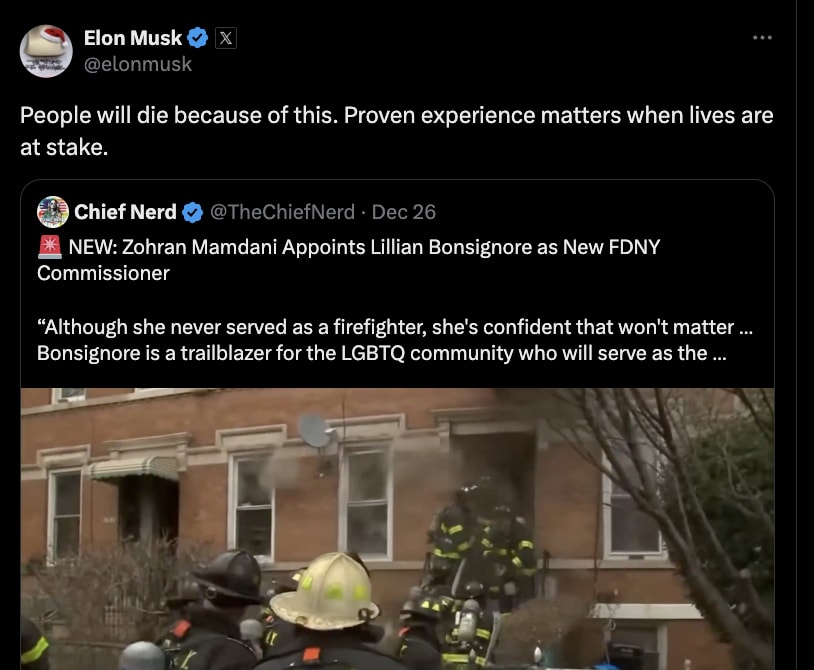 |
Elon Musk attacked the appointment of the new head of the New York City’s Fire Department, on the grounds that “proven experience matters when lives are at stake” in public services. (Mamdani clapped back, pointing out that the appointee had decades of experience working in emergency services).
It is hard to fathom anyone on the planet less qualified than Elon Musk to opine on the value of public service experience when lives are at stake. And yes, I know that pointing out that Musk is a hypocrite is like pointing out that water is wet. With DOGE, he held extraordinary public power. How did he use it? Across the government Musk put people with zero experience of government services in charge of those services, determining what contracts would be maintained, which employees would stay or go. At one point they fired the guys taking care of nuclear weapons, before rehiring them after some members of Congress got very nervous. Literally hundreds of thousands of people have died because Musk ignored the people with real experience.
So a year on from its creation, its time for a reckoning: What did DOGE do? Lets dig in.
The Effects of DOGE Were Predictable
It is important to distinguish between the formal mission of DOGE (“modernizing federal technology and software to maximize efficiency and productivity”) and the reason for its creation. It is especially important to remember that Musk pushed DOGE on Trump, not vice-versa. DOGE is best understood a political project of an increasingly politically active and right-wing broligarchy.
The day before Trump took office I laid out out what we might expect from DOGE. I wanted to be hopeful. The idea of DOGE was not a bad one. But having watched Musk cook his brain on social media, and listen to the stated goals of the people sponsoring DOGE, it was hard to maintain such optimism. So my bottom line was this:
Here is a factual description of DOGE: it is a group run by right-wing billionaires who oppose government regulation of their businesses, and benefit from government contracts. It avoids accountability standards that we expect of other groups who seek to influence government. It is not run by people who have a deep knowledge of the function of government, or have much patience with the procedural requirements that flow from laws.
A year later, I feel pretty happy with description. I argued that DOGE would not be like traditional government commission or a sideshow — it would not deliver a report of recommendations that would be summarily ignored. I also argued that DOGE would serve as a propaganda machine to justify an assault on government that would otherwise be deeply unpopular:
Evoking norms like “efficiency” or cutting “fraud and abuse” serves to abstract real cuts to real programs that people depend upon. But with a sophisticated enough messaging operation, maybe you can change the policy before enough people realize what has been taken from them.
Again, this proved fairly accurate. DOGE immediately promised to cut fraud in government. This proved to be a mirage, used to justify cutting services while reducing trust in government. It turns out that 40% of calls to Social Security were not fraudulent and armies of the dead were not collecting benefits. US AID was not distributing condoms to Hamas. Such claims were grounded in internet rumors, fueled by the man who controlled the means to amplify those rumors.
When a case of actual, albeit exaggerated, fraud arose in Minnesota, Musk, Vance and Trump jumped right back on the bandwagon, using it to stop payments to other safety net programs in other states. In this way, what is happening to many public services is what happened to US AID, and what DOGE tried to do across government: claim fraud, cut services.
DOGE as State Capture
My main prediction about DOGE is that it would operate as a form of state capture: a means by which the owner class of Silicon Valley protected their businesses, as well as created new business opportunities to work with government. Their major business complaint against Biden was that he was regulating the growth of crypto currencies and AI. For example, Marc Andreessen’s explanation for supporting Trump was: “They just ran this incredible terror campaign to try to kill crypto. Then they were ramping up a similar campaign to try to kill AI. That’s really when we knew that we had to really get involved in politics.”
To assess the evidence, we need to look not just at DOGE but the also the broader tech coalition that lined up behind Trump and benefited from his election. Some of this coalition appears to be opportunistic, seeing the alignment as primarily a business move, while others, like Musk, Peter Thiel, or Marc Andreessen, who were more involved in setting up DOGE, seem to be true believers. Lets take a couple of data points on their gains:
Crypto: Trump has reversed course from Biden-era regulation, writing an executive order to encourage and deregulate crypto, creating a strategic Bitcoin Reserve and a U.S. Digital Asset Stockpile. Enforcement cases have been largely dropped. Pro-crypto legislation has been passed. Banking regulations have been reversed. In short, the industry got everything it wanted. And yet—for all these sweeping changes—the perception of crypto as a questionable, even illegitimate industry lingers. Not so long ago, Trump himself dismissed crypto as “a scam.” His recent embrace of the sector seems transparently connected to broadening his political coalition, and leveraging his position to ensure his family would make billions.
AI offers tech leaders another victory. Trump again revoked Biden era regulations, and also blocked state regulation. He has also green-lit the use of AI within government, with DOGE leading the push. While AI offers less obvious means of corruption than Crypto, the competition between the key players in the US allows Trump to run a mini-Apprentice style competition for his favor. For example, the co-founder of OpenAI recently made a $25 million donation to Trump’s PAC.
Overseas regulation: Having defeated American regulation, the broligarchy would like Trump to use state power to advance their business interests elsewhere, like a latter-day East India Trading Company dependent on the coercive power of the British Empire. The U.S. has sanctioned and imposed travel bans on Europeans engaged in tech regulations or drawing attention to online radicalization, a treatment normally reserved for gangsters and dictators. When X was fined for violating E.U. regulations, the U.S. threatened to fine European companies and to upend trade agreements. At one point, JD Vance said that US support for NATO could be pulled because of European countries regulation of Musk’s companies.
Foreign opportunities: If the comparison with the East India Trading Company sound outlandish, consider also that key members of the tech coalition have been encouraging and stand to profit from Trump’s efforts to capture Greenland. Key parts of the broligarchy are openly pro-imperialist and see U.S. territorial expansion as a way to pursue their vision of “network states” free of government oversight.
Key allies and contracts: Across government, you can the new political power of Silicon Valley reflected in appointments. Whereas in an earlier era, they typically came in to provide advice on science and technology issues, or to modernize government, many more now are running core parts of government. David Sacks, an ally of Musk and Andreessen, was appointed the as a special advisor on crypto. An Andreessen employee, Scott Kupor, runs federal government personnel. A former Palantir executive is the Chief Information Officer at OMB. Another Musk ally heads NASA, an area where Musk as critical interests.
Silicon Valley sees the federal government as a potential goldmine of new contracts as it pivots increasingly to national security. But who is capturing who? After Musk threatened to expose Trump’s connection to the Epstein files and start his own political party, Trump directly threatened Musk’s government contracts and businesses. Musk deleted his posts, pledged to keep supporting Republicans financially, and continues to use his platform to advance Trump’s agenda. It was a reminder that the richest man in the world is now just one of many broligarchs, allowed to amass a fortune with government help as long as he remains loyal. This is the system they have traded for.
It would be too much to say that DOGE facilitated all of these outcomes, and there is much we do not know about its inner workings. But I do think it is reasonable to say the coalition that pushed DOGE has mostly gotten what it wanted, and that DOGE was part of its ability to establish influence. How much pushback could the DOGE alliance face in an atmosphere where it had the power to remove dissenting voices from government?
But what about the rest of us? Musk described the explosion of one of his space rockets as a “rapid unscheduled disassembly.” He did the same with your government.
What Did DOGE Do for — or to — the Rest of Us?
DOGE Did not Save Money
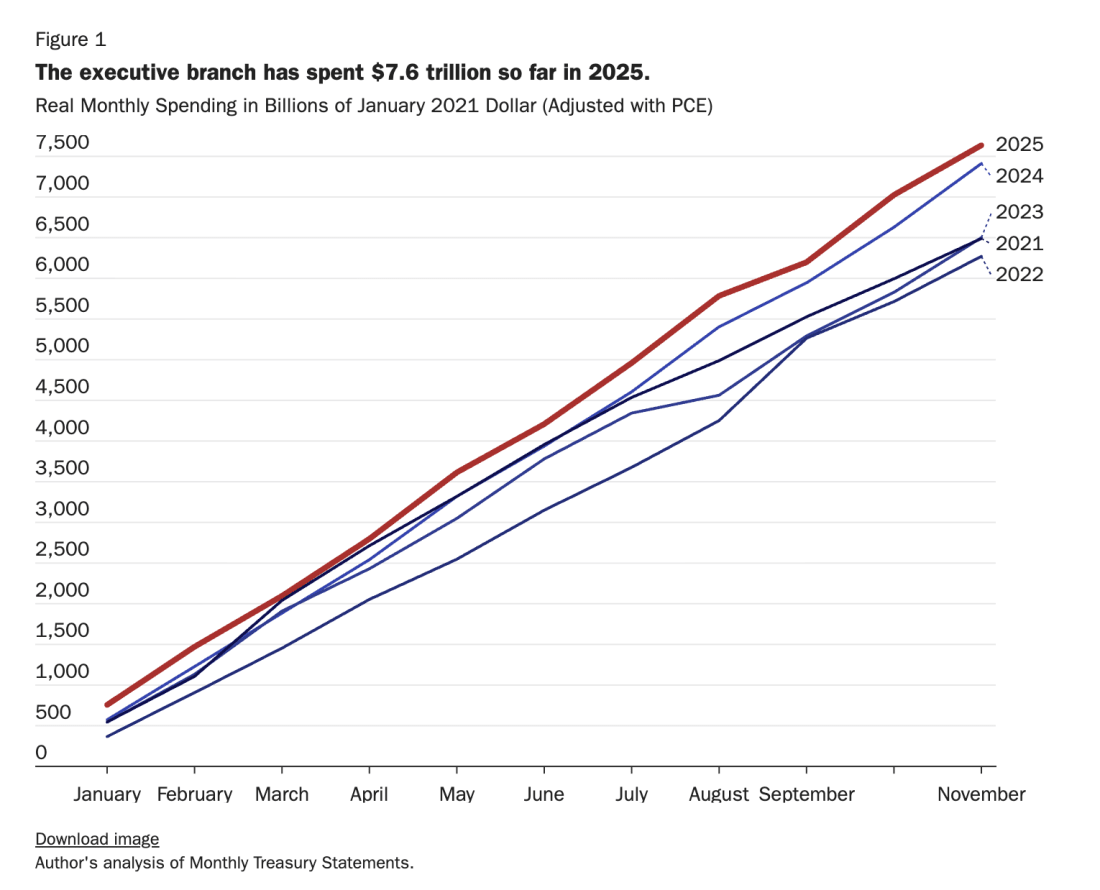
Musk promised to slash the federal deficit. He failed. Far from saving $1 trillion, DOGE made no meaningful impact on spending.
 |
DOGE Did Shrink the Federal Workforce
DOGE did significantly cut the workforce. Some of this would have occurred anyway if DOGE did not exist. But it seems safe to say the cuts happened more quickly and more deeply because of Musk. Russell Vought, who leads the Office of Management and Budget saw DOGE as a useful battering ram, utilizing Musk’s political capital and power that Vought lacked.
According to the Office of Personnel Management 322,049 employees left the federal government between the start of the Trump administration and the end of last year, resulting in a net loss of employees of about 220,000. DOGE played a key role, leading the elimination of probationary employees, pushing the “fork in the road” resignations, and being involved in Reductions in Force. It notably made no meaningful effort to distinguish between good and bad employees in the purges.
DOGE Weakened State Capacity
There is no single metric to capture the effects of DOGE. But if you look at the goal and purpose of federal programs and agencies affected by DOGE cuts, it is hard not to conclude that the U.S. government is simply worse off with the loss of experienced employees. DOGE hollowed out promising new innovations, like Direct File, and pushed experienced and skilled technologists out of government. (It is now trying to rebuild tech talent in government). It also cut employees even in cases where their work demonstrably paid for itself, such as the CFPB and IRS. Indeed, the IRS estimated hundreds of billions in lost revenue because of DOGE cuts. So much for cutting the deficit!
DOGE Killed a Lot of People
Musk’s USAID cuts have already resulted in an estimated 600,000 people dying, with millions of potential deaths in the coming years. Trump allowed the richest man in the world, who has increasingly embraced a white nationalist worldview, to condemn potentially millions of mostly non-white people to death. Its that simple. The elimination of USAID is the greatest moral atrocity of the Trump administration to date, and one driven by DOGE.
DOGE cuts follow a clearly ideological and partisan pattern
Some agencies were decimated with DOGE cuts, while others were protected, or even grew, most obviously the immigration enforcement parts of government.
The pattern of cuts was partisan. As Stanford political scientist Adam Bonica has pointed out, agencies that are viewed as serving more progressive causes were disproportionately subject to DOGE cuts:
DOGE systematically targeted liberal-leaning agencies for cuts while directing every budget increase to conservative-leaning agencies. The efficiency rationale was a cover for ideological restructuring.
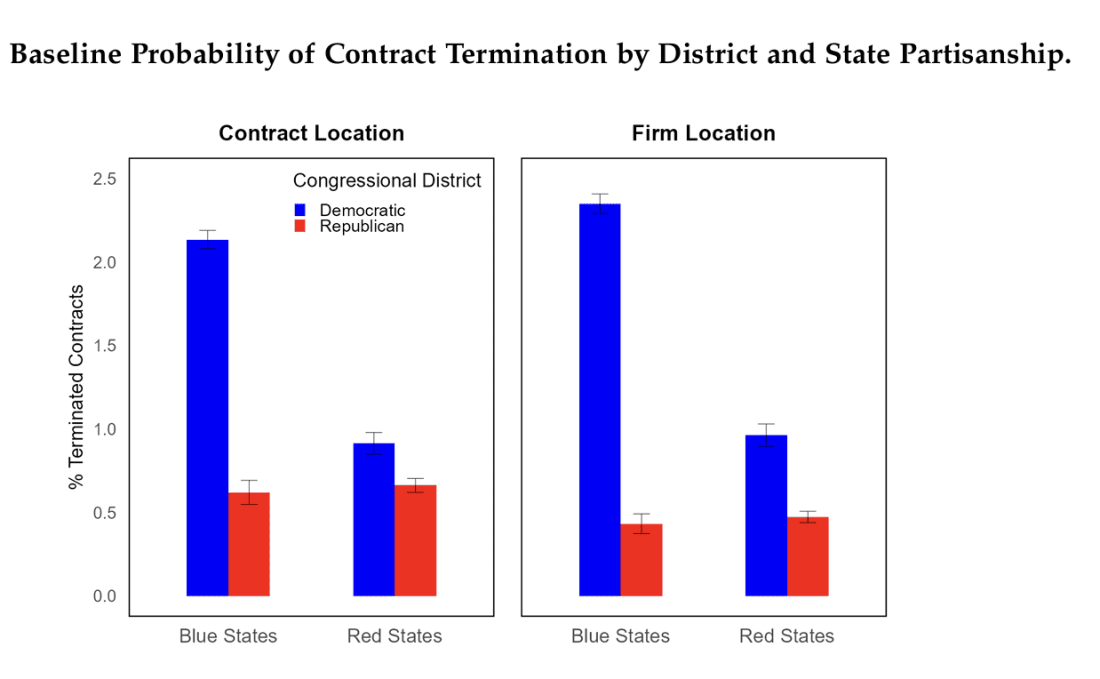
New research from Luca Bellodi of Stanford University and Kyuwon Lee of the University of Southern California show that DOGE contract cuts also followed a spoils system model, where ideologically aligned donors were more protected from cuts:
Drawing on detailed procurement data and DOGE’s cancellation records, we find that Republican donor firms were less likely to face cancellations, whereas firms donating to Democrats were more likely to lose contracts. Cancellations were less frequent in Republican-held districts, conservative agencies, and states favorable to the Republican Party.
Another indicator of the partisan nature of cuts was timing. For example, DOGE delayed major contract cuts in Wisconsin until after a pivotal Supreme Court election which Musk had personally campaigned in. DOGE cuts were more likely to fall heavily in blue states, and on contractors in blue states.
 |
How Did DOGE Get It so Wrong?
DOGE Did Not Understand the Math
Musk seems to have genuinely thought the government was Twitter. This was one of the rationales for hiring him - he dramatically cut Twitter’s personnel and underlying costs, and no big deal! But one major difference is that unlike a tech firm, personnel for the federal government is a minor cost. Because federal employee salaries make up only about 5% to 6% of spending, you can fire a huge proportion of them, and barely put a dent in federal spending.
One of my favorite government sayings that conveys this point is that the federal government is basically an insurance company with an Army. Most of our spending is on military, homeland security, veterans administration, health care and entitlements. Once you set aside safety net programs and military spending, there is not much left to cut. Because Trump values military and veteran spending, the cuts here were minor. Homeland security spending increased. Trump said he would not cut major social programs. While this turned out to be a lie, those cuts came via the One Big Beautiful Bill rather than via Musk’s handiwork.
DOGE Did Not Understand or Care about Public Services
Beyond not understanding the math of government, Musk and DOGE did not get the purpose of government. They equated cuts in spending with an increase in public value. They saw the work of government programs, or the employees, as having no value, or even negative value. When pushing the deferred resignation program Musk told public employees: “The way to greater American prosperity is encouraging people to move from lower productivity jobs in the public sector to higher productivity jobs in the private sector.” They were not interested in outputs, outcomes, or capacity — just inputs. They could not see any value in public work because of their ideological blinders.
DOGE Lied to Cover its Tracks
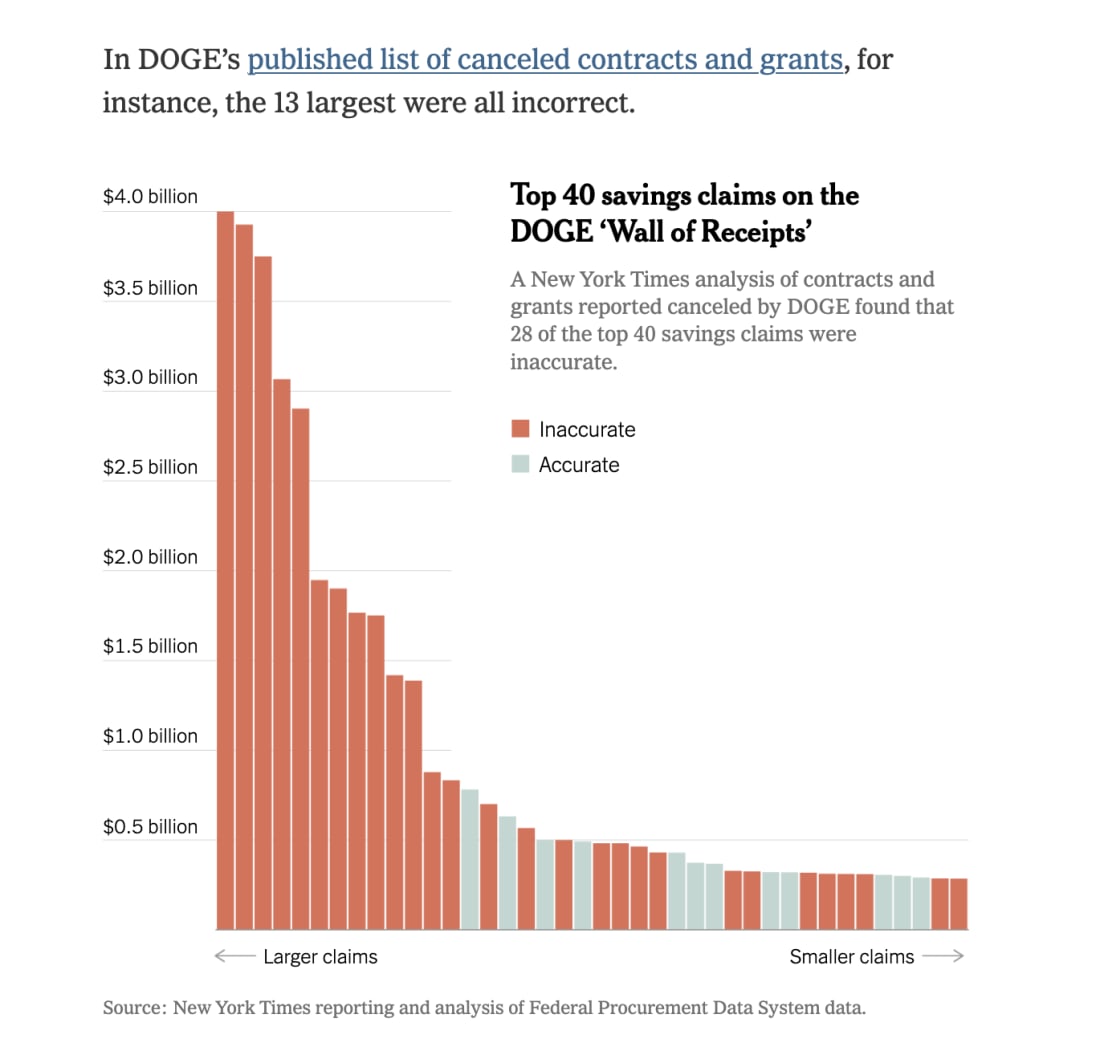
DOGE simply lied a lot about its achievements, consistent with how both Trump and Musk behave. Investigative journalists have done an incredible job in showing the discrepancy between claimed savings and what took place. Perhaps the definitive analysis came from the New York Times, who showed a pattern of double-counting, claiming cuts from the Biden administration or expiring cuts, claiming programs that remain in place have been eliminated, or vastly exaggerating the scale of cuts.
The “wall of receipts” was mostly a wall of lies.
 |
DOGE Was Not Accountable to the Public
It is hard to think of a greater mismatch between the scale of DOGE’s actions and its fundamental lack of accountability. Ultimately, Musk and his lieutenants were pushed out of the administration when they became a political drag, but many remain, burrowing into agencies. There are credible accusations that DOGE broke multiple laws in its treatment of federal employees, programs, and data.
In particular, one concern has been DOGE’s efforts to bring data under a single federal overview, contrary to the Privacy Act and other data protections. In truth, we don’t have a lot of hard evidence about this, because the Trump administration has not investigated the accusations. But details are starting to emerge and they are not reassuring. While the initial fears center on the use of such data to target non-citizens, handing an increasingly authoritarian government more personal data seems like a problem for us all.
At a reunion, one DOGEr said: “Guys, seriously, get your own lawyer if you need it. Elon’s great, but you need to watch your own back.” But mostly, they have little to fear, at least for now. Executive branch accountability processes have been switched off for Trump officials. For example, the USAID Inspector General was fired the day after he released a report documenting how Musk’s cuts were resulting in billions in misuse of federal funds.
There was a House DOGE subcommittee, but it did not actually investigate DOGE, or ask it what it was doing. Instead, its entire job was to generate justification for DOGE’s activities. Elon Musk never faced a single hard question from an elected official about his actions.
Bottom Line: DOGE Disrupted Much, with Little Benefit
If you buy the idea that government needs some disruption, there is an implied tradeoff between some pain and some gain. With DOGE, the pain is plain enough, but where is the gain? DOGE has offered no meaningful new innovations that are clearly improving public services. Even Musk struggled to bring his usual boosterism when describing DOGE as “a little bit successful.”
It proved it could move quickly when it came to breaking things, but not when it came to building them. Maybe this will come with whatever the remnants of DOGE evolves into. Maybe. Or maybe there is a lesson there about how much harder it is to fix problems in government than it is to point them out.
 | A guest post by
|
Not ready to subscribe? Make a one-time donation of $10 or more to fund the digital war against the right-wing propaganda media machine from now through the mid-term elections. Every $10 reaches 1000 Americans. The Truth needs a voice. Your donation will help us amplify it.
| ||||||||||

