
John,
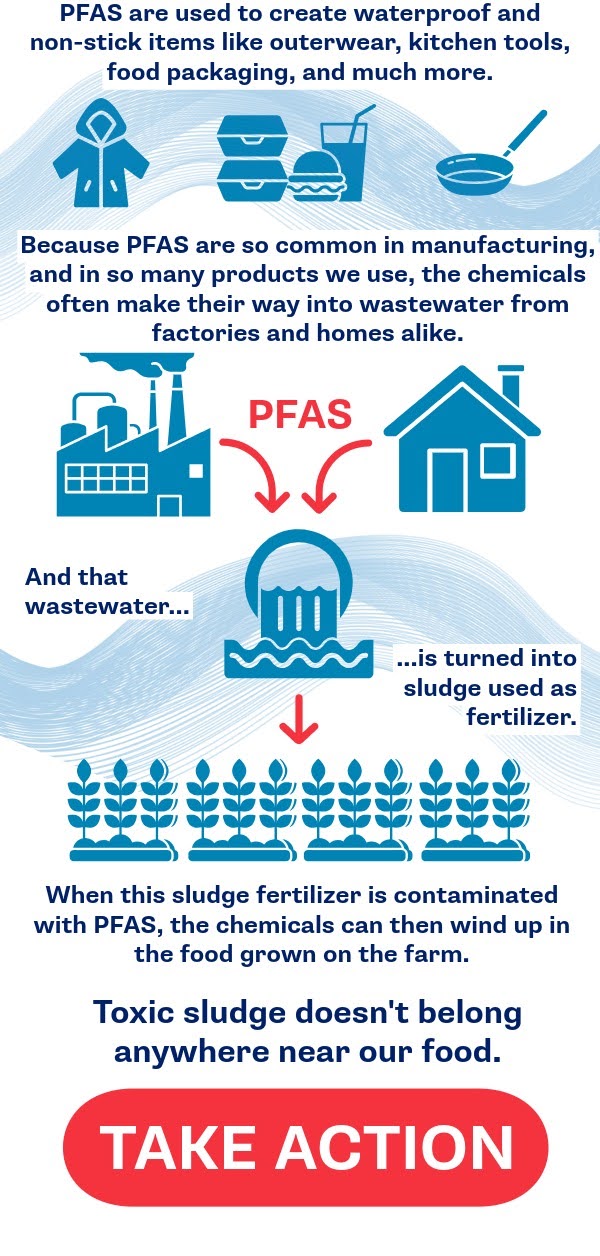
There's toxic sewage sludge on many of the farms that grow our food.1
Sludge from wastewater treatment plants is often used as fertilizer -- but this sludge can contain PFAS, or "forever chemicals," that pose real risks to our health.2
When toxic sludge is used on farms, the chemicals can contaminate the soil, the crops, and the livestock.3
This isn't just gross. It's dangerous.
And your governor can help put a stop to it in our country. Send a message today asking your governor to ban the use of PFAS-contaminated fertilizers.
How is this toxic threat making its way onto our farms?
The Environmental Protection Agency says that exposure to even tiny amounts of PFAS may be risky. PFAS have been linked to a variety of health problems, including birth defects, thyroid disease, and certain types of cancer.4
The problem is: Once PFAS are out there, they're here to stay. These toxic chemicals don't degrade or break down.5
Getting PFAS out of wastewater will be no easy task. But to protect ourselves and our families from exposure to these toxic chemicals, there's an easier place to start: We need to stop applying this stuff as fertilizer to farmland.
Ask your governor to ban the use of toxic sewage sludge as fertilizer on farmland.
Thank you,
Faye Park
President
1. Barbara Moran, "Our sewage often becomes fertilizer. Problem is, it's tainted with PFAS," Maine Public Radio, April 10, 2023.
2. Barbara Moran, "Our sewage often becomes fertilizer. Problem is, it's tainted with PFAS," Maine Public Radio, April 10, 2023.
3. Barbara Moran, "Our sewage often becomes fertilizer. Problem is, it's tainted with PFAS," Maine Public Radio, April 10, 2023.
4. "Our Current Understanding of the Human Health and Environmental Risks of PFAS," U.S. Environmental Protection Agency, last accessed January 9, 2026.
5. "The Threat of "Forever Chemicals"," PIRG, June 13, 2023.
Support U.S. PIRG. Contributions by people just like you make our advocacy possible. Your contribution supports a staff of organizers, attorneys, scientists and other professionals who monitor government and corporate decisions and advocate on the public's behalf.
Join us on Facebook | Follow us on Twitter
U.S. PIRG, Main Office: 1543 Wazee St., Suite 460, Denver, CO 80202, (303) 801-0582
Federal Advocacy Office: 600 Pennsylvania Ave. SE, 4th Fl., Washington, DC 20003, (202) 546-9707
Member Questions or Requests: 1-800-838-6554.

If you want us to stop sending you email then follow this link -- unsubscribe.