
| From | Hudson Institute Weekend Reads <[email protected]> |
| Subject | Did Iran Drop a Dirty Bomb on US Forces? |
| Date | January 31, 2026 2:00 PM |
Links have been removed from this email. Learn more in the FAQ.
Links have been removed from this email. Learn more in the FAQ.
No images? Click here [link removed]
Weekend Reads
Did Iran Drop a Dirty Bomb on US Forces? [[link removed]]
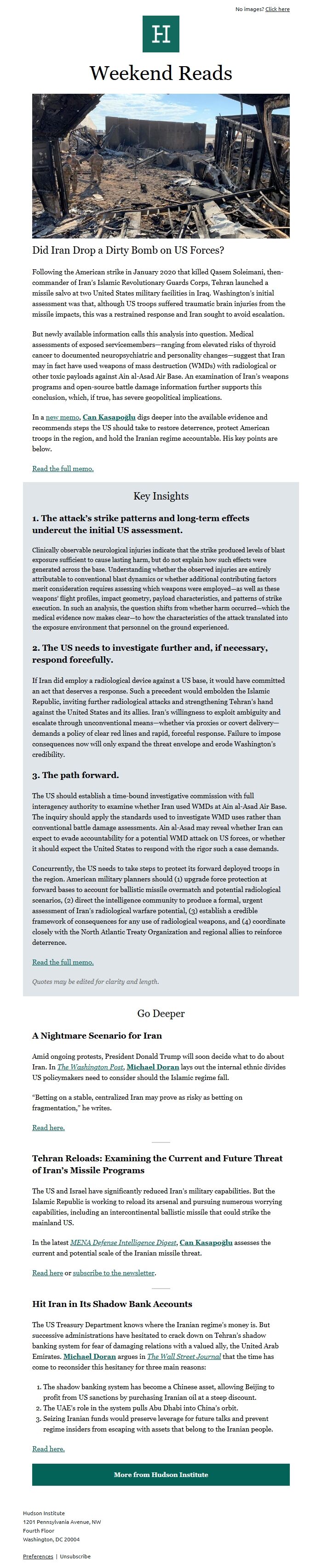
Following the American strike in January 2020 that killed Qasem Soleimani, then-commander of Iran’s Islamic Revolutionary Guards Corps, Tehran launched a missile salvo at two United States military facilities in Iraq. Washington’s initial assessment was that, although US troops suffered traumatic brain injuries from the missile impacts, this was a restrained response and Iran sought to avoid escalation.
But newly available information calls this analysis into question. Medical assessments of exposed servicemembers—ranging from elevated risks of thyroid cancer to documented neuropsychiatric and personality changes—suggest that Iran may in fact have used weapons of mass destruction (WMDs) with radiological or other toxic payloads against Ain al-Asad Air Base. An examination of Iran’s weapons programs and open-source battle damage information further supports this conclusion, which, if true, has severe geopolitical implications.
In a new memo [[link removed]], Can Kasapoğlu [[link removed]] digs deeper into the available evidence and recommends steps the US should take to restore deterrence, protect American troops in the region, and hold the Iranian regime accountable. His key points are below.
Read the full memo. [[link removed]]
Key Insights
1. The attack’s strike patterns and long-term effects undercut the initial US assessment.
Clinically observable neurological injuries indicate that the strike produced levels of blast exposure sufficient to cause lasting harm, but do not explain how such effects were generated across the base. Understanding whether the observed injuries are entirely attributable to conventional blast dynamics or whether additional contributing factors merit consideration requires assessing which weapons were employed—as well as these weapons’ flight profiles, impact geometry, payload characteristics, and patterns of strike execution. In such an analysis, the question shifts from whether harm occurred—which the medical evidence now makes clear—to how the characteristics of the attack translated into the exposure environment that personnel on the ground experienced.
2. The US needs to investigate further and, if necessary, respond forcefully.
If Iran did employ a radiological device against a US base, it would have committed an act that deserves a response. Such a precedent would embolden the Islamic Republic, inviting further radiological attacks and strengthening Tehran’s hand against the United States and its allies. Iran’s willingness to exploit ambiguity and escalate through unconventional means—whether via proxies or covert delivery—demands a policy of clear red lines and rapid, forceful response. Failure to impose consequences now will only expand the threat envelope and erode Washington’s credibility.
3. The path forward.
The US should establish a time-bound investigative commission with full interagency authority to examine whether Iran used WMDs at Ain al-Asad Air Base. The inquiry should apply the standards used to investigate WMD uses rather than conventional battle damage assessments. Ain al-Asad may reveal whether Iran can expect to evade accountability for a potential WMD attack on US forces, or whether it should expect the United States to respond with the rigor such a case demands.
Concurrently, the US needs to take steps to protect its forward deployed troops in the region. American military planners should (1) upgrade force protection at forward bases to account for ballistic missile overmatch and potential radiological scenarios, (2) direct the intelligence community to produce a formal, urgent assessment of Iran’s radiological warfare potential, (3) establish a credible framework of consequences for any use of radiological weapons, and (4) coordinate closely with the North Atlantic Treaty Organization and regional allies to reinforce deterrence.
Read the full memo. [[link removed]]
Quotes may be edited for clarity and length.
Go Deeper
A Nightmare Scenario for Iran [[link removed]]
Amid ongoing protests, President Donald Trump will soon decide what to do about Iran. In The Washington Post [[link removed]], Michael Doran [[link removed]] lays out the internal ethnic divides US policymakers need to consider should the Islamic regime fall.
“Betting on a stable, centralized Iran may prove as risky as betting on fragmentation,” he writes.
Read here. [[link removed]]
Tehran Reloads: Examining the Current and Future Threat of Iran’s Missile Programs [[link removed]]
The US and Israel have significantly reduced Iran’s military capabilities. But the Islamic Republic is working to reload its arsenal and pursuing numerous worrying capabilities, including an intercontinental ballistic missile that could strike the mainland US.
In the latest MENA Defense Intelligence Digest [[link removed]], Can Kasapoğlu [[link removed]] assesses the current and potential scale of the Iranian missile threat.
Read here [[link removed]] or subscribe to the newsletter [[link removed]].
Hit Iran in Its Shadow Bank Accounts [[link removed]]
The US Treasury Department knows where the Iranian regime’s money is. But successive administrations have hesitated to crack down on Tehran’s shadow banking system for fear of damaging relations with a valued ally, the United Arab Emirates. Michael Doran [[link removed]] argues in The Wall Street Journal [[link removed]] that the time has come to reconsider this hesitancy for three main reasons:
The shadow banking system has become a Chinese asset, allowing Beijing to profit from US sanctions by purchasing Iranian oil at a steep discount.The UAE’s role in the system pulls Abu Dhabi into China’s orbit.Seizing Iranian funds would preserve leverage for future talks and prevent regime insiders from escaping with assets that belong to the Iranian people.
Read here. [[link removed]]
More from Hudson Institute [[link removed]]
Hudson Institute
1201 Pennsylvania Avenue, NW
Fourth Floor
Washington, DC 20004
Preferences [link removed] | Unsubscribe [link removed]
Weekend Reads
Did Iran Drop a Dirty Bomb on US Forces? [[link removed]]
Following the American strike in January 2020 that killed Qasem Soleimani, then-commander of Iran’s Islamic Revolutionary Guards Corps, Tehran launched a missile salvo at two United States military facilities in Iraq. Washington’s initial assessment was that, although US troops suffered traumatic brain injuries from the missile impacts, this was a restrained response and Iran sought to avoid escalation.
But newly available information calls this analysis into question. Medical assessments of exposed servicemembers—ranging from elevated risks of thyroid cancer to documented neuropsychiatric and personality changes—suggest that Iran may in fact have used weapons of mass destruction (WMDs) with radiological or other toxic payloads against Ain al-Asad Air Base. An examination of Iran’s weapons programs and open-source battle damage information further supports this conclusion, which, if true, has severe geopolitical implications.
In a new memo [[link removed]], Can Kasapoğlu [[link removed]] digs deeper into the available evidence and recommends steps the US should take to restore deterrence, protect American troops in the region, and hold the Iranian regime accountable. His key points are below.
Read the full memo. [[link removed]]
Key Insights
1. The attack’s strike patterns and long-term effects undercut the initial US assessment.
Clinically observable neurological injuries indicate that the strike produced levels of blast exposure sufficient to cause lasting harm, but do not explain how such effects were generated across the base. Understanding whether the observed injuries are entirely attributable to conventional blast dynamics or whether additional contributing factors merit consideration requires assessing which weapons were employed—as well as these weapons’ flight profiles, impact geometry, payload characteristics, and patterns of strike execution. In such an analysis, the question shifts from whether harm occurred—which the medical evidence now makes clear—to how the characteristics of the attack translated into the exposure environment that personnel on the ground experienced.
2. The US needs to investigate further and, if necessary, respond forcefully.
If Iran did employ a radiological device against a US base, it would have committed an act that deserves a response. Such a precedent would embolden the Islamic Republic, inviting further radiological attacks and strengthening Tehran’s hand against the United States and its allies. Iran’s willingness to exploit ambiguity and escalate through unconventional means—whether via proxies or covert delivery—demands a policy of clear red lines and rapid, forceful response. Failure to impose consequences now will only expand the threat envelope and erode Washington’s credibility.
3. The path forward.
The US should establish a time-bound investigative commission with full interagency authority to examine whether Iran used WMDs at Ain al-Asad Air Base. The inquiry should apply the standards used to investigate WMD uses rather than conventional battle damage assessments. Ain al-Asad may reveal whether Iran can expect to evade accountability for a potential WMD attack on US forces, or whether it should expect the United States to respond with the rigor such a case demands.
Concurrently, the US needs to take steps to protect its forward deployed troops in the region. American military planners should (1) upgrade force protection at forward bases to account for ballistic missile overmatch and potential radiological scenarios, (2) direct the intelligence community to produce a formal, urgent assessment of Iran’s radiological warfare potential, (3) establish a credible framework of consequences for any use of radiological weapons, and (4) coordinate closely with the North Atlantic Treaty Organization and regional allies to reinforce deterrence.
Read the full memo. [[link removed]]
Quotes may be edited for clarity and length.
Go Deeper
A Nightmare Scenario for Iran [[link removed]]
Amid ongoing protests, President Donald Trump will soon decide what to do about Iran. In The Washington Post [[link removed]], Michael Doran [[link removed]] lays out the internal ethnic divides US policymakers need to consider should the Islamic regime fall.
“Betting on a stable, centralized Iran may prove as risky as betting on fragmentation,” he writes.
Read here. [[link removed]]
Tehran Reloads: Examining the Current and Future Threat of Iran’s Missile Programs [[link removed]]
The US and Israel have significantly reduced Iran’s military capabilities. But the Islamic Republic is working to reload its arsenal and pursuing numerous worrying capabilities, including an intercontinental ballistic missile that could strike the mainland US.
In the latest MENA Defense Intelligence Digest [[link removed]], Can Kasapoğlu [[link removed]] assesses the current and potential scale of the Iranian missile threat.
Read here [[link removed]] or subscribe to the newsletter [[link removed]].
Hit Iran in Its Shadow Bank Accounts [[link removed]]
The US Treasury Department knows where the Iranian regime’s money is. But successive administrations have hesitated to crack down on Tehran’s shadow banking system for fear of damaging relations with a valued ally, the United Arab Emirates. Michael Doran [[link removed]] argues in The Wall Street Journal [[link removed]] that the time has come to reconsider this hesitancy for three main reasons:
The shadow banking system has become a Chinese asset, allowing Beijing to profit from US sanctions by purchasing Iranian oil at a steep discount.The UAE’s role in the system pulls Abu Dhabi into China’s orbit.Seizing Iranian funds would preserve leverage for future talks and prevent regime insiders from escaping with assets that belong to the Iranian people.
Read here. [[link removed]]
More from Hudson Institute [[link removed]]
Hudson Institute
1201 Pennsylvania Avenue, NW
Fourth Floor
Washington, DC 20004
Preferences [link removed] | Unsubscribe [link removed]
Message Analysis
- Sender: Hudson Institute
- Political Party: n/a
- Country: United States
- State/Locality: n/a
- Office: n/a
-
Email Providers:
- Campaign Monitor