
Email
A Brief History of the Annexation of Foreign Territories by the United States
| From | National Constitution Center <[email protected]> |
| Subject | A Brief History of the Annexation of Foreign Territories by the United States |
| Date | January 31, 2026 1:00 PM |
Links have been removed from this email. Learn more in the FAQ.
Links have been removed from this email. Learn more in the FAQ.
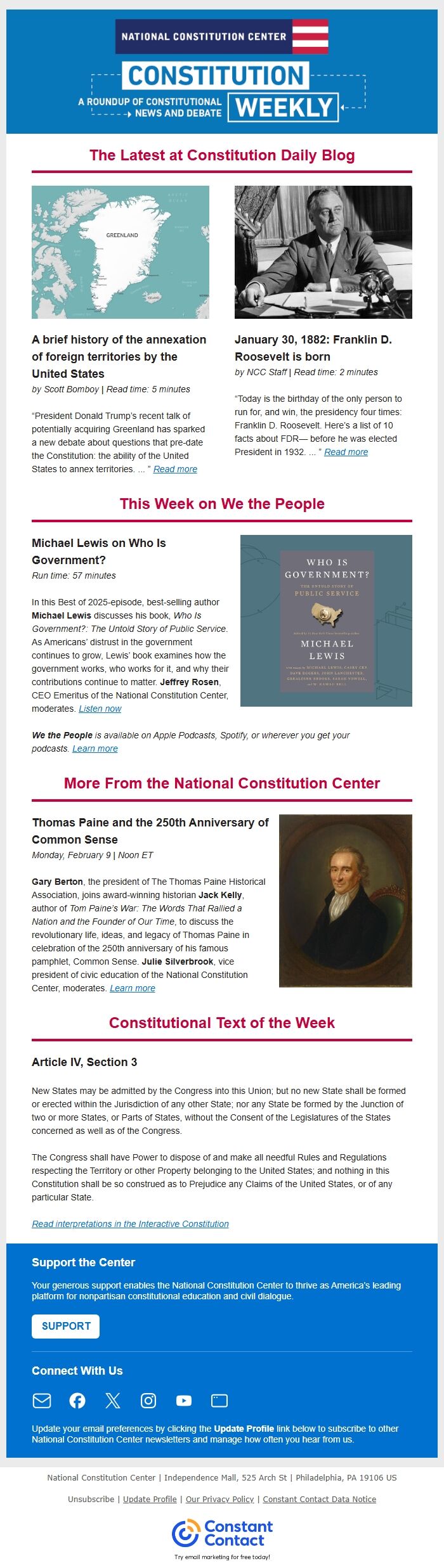
Email from National Constitution Center Plus: 10 facts about young Franklin D. Roosevelt The Latest at Constitution Daily Blog A brief history of the annexation of foreign territories by the United States by Scott Bomboy | Read time: 5 minutes “President Donald Trump’s recent talk of potentially acquiring Greenland has sparked a new debate about questions that pre-date the Constitution: the ability of the United States to annex territories. ... ” Read more January 30, 1882: Franklin D. Roosevelt is born by NCC Staff | Read time: 2 minutes “Today is the birthday of the only person to run for, and win, the presidency four times: Franklin D. Roosevelt. Here’s a list of 10 facts about FDR— before he was elected President in 1932. ... ” Read more This Week on We the People Michael Lewis on Who Is Government? Run time: 57 minutes In this Best of 2025-episode, best-selling author Michael Lewis discusses his book, Who Is Government?: The Untold Story of Public Service. As Americans’ distrust in the government continues to grow, Lewis’ book examines how the government works, who works for it, and why their contributions continue to matter. Jeffrey Rosen, CEO Emeritus of the National Constitution Center, moderates. Listen now We the People is available on Apple Podcasts, Spotify, or wherever you get your podcasts. Learn more More From the National Constitution Center Thomas Paine and the 250th Anniversary of Common Sense Monday, February 9 | Noon ET Gary Berton, the president of The Thomas Paine Historical Association, joins award-winning historian Jack Kelly, author of Tom Paine’s War: The Words That Rallied a Nation and the Founder of Our Time, to discuss the revolutionary life, ideas, and legacy of Thomas Paine in celebration of the 250th anniversary of his famous pamphlet, Common Sense. Julie Silverbrook, vice president of civic education of the National Constitution Center, moderates. Learn more Constitutional Text of the Week Article IV, Section 3 New States may be admitted by the Congress into this Union; but no new State shall be formed or erected within the Jurisdiction of any other State; nor any State be formed by the Junction of two or more States, or Parts of States, without the Consent of the Legislatures of the States concerned as well as of the Congress. The Congress shall have Power to dispose of and make all needful Rules and Regulations respecting the Territory or other Property belonging to the United States; and nothing in this Constitution shall be so construed as to Prejudice any Claims of the United States, or of any particular State. Read interpretations in the Interactive Constitution Support the Center Your generous support enables the National Constitution Center to thrive as America’s leading platform for nonpartisan constitutional education and civil dialogue. SUPPORT Connect With Us Update your email preferences by clicking the Update Profile link below to subscribe to other National Constitution Center newsletters and manage how often you hear from us. National Constitution Center | Independence Mall, 525 Arch St | Philadelphia, PA 19106 US Unsubscribe | Update Profile | Our Privacy Policy | Constant Contact Data Notice
Message Analysis
- Sender: National Constitution Center
- Political Party: n/a
- Country: United States
- State/Locality: n/a
- Office: n/a
-
Email Providers:
- Constant Contact