January 30, 2026
 Armstrong rolls out statewide program to improve North Dakota’s soil health and wildlife habitat
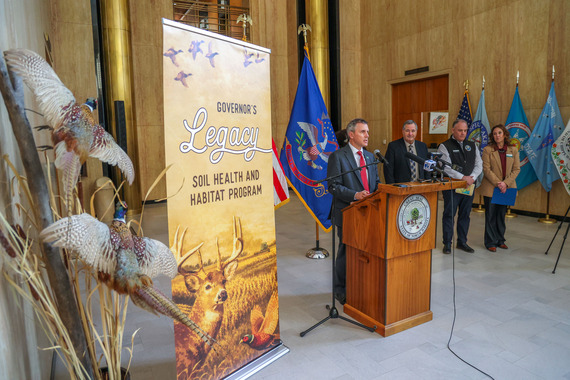
Gov. Kelly Armstrong rolled out the Governor’s Legacy Soil Health and Habitat Program, a cooperative effort to improve soil health and wildlife habitat on marginally productive cropland across North Dakota’s rural landscape.
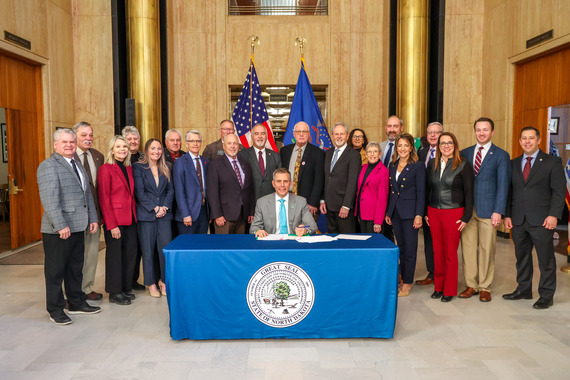
Joining Armstrong at a Capitol press conference to unveil the program were state Agriculture Commissioner Doug Goehring, Game and Fish Director Jeb Williams and North Dakota Association of Soil Conservation Districts Executive Director Rhonda Kelsch, along with roughly 50 partners and supporters of the pilot project.
The goal of the voluntary working lands program is to help North Dakota farmers strengthen cropland productivity and resilience with perennial grass cover, while improving soil health and water retention and creating much-needed wildlife habitat and access for hunters.
The Game and Fish Department partnered with the Association of Soil Conservation Districts to secure $4.3 million from the state’s Outdoor Heritage Fund, along with $2.2 million in matching contributions from partners, for the two-year, $6.5 million pilot project.
“This joint effort will help preserve and promote our rich heritage of farming and hunting for generations to come, while also showcasing the spirt of cooperation that makes North Dakota special,” Armstrong said. “Healthy soils and wildlife habitat are essential to our strong economy and the unmatched quality of life that makes North Dakota the best place to live, work and raise a family. We appreciate the ag, conservation, hunting and energy stakeholders who worked with Game and Fish and the soil conservation districts to make this program possible with Outdoor Heritage Fund support.”
“This gives us the ability to look at planting some perennial grasses in a short period – I love that flexibility about it,” Goehring said, adding, “There’s a lot of value in this. ... It’s going to do more to change the landscape and help landowners and sportsmen out there.”
Williams said the additional grassland will provide much-needed cover for deer and grassland birds. Access is not a requirement of the program, but producers can elect to receive additional incentives for access if they enroll in the state’s existing Private Lands Open To Sportsmen (PLOTS) program. The program could be used to enhance habitat on existing PLOTS land, Williams said, noting the program has received input and broad support from ag, conservation and energy partners.
“This program is designed to be simple, locally led and producer-friendly,” Williams said. “Our goal is to create a soil health and habitat program with strong support from all partners to build a lasting legacy of healthy soils, thriving habitats and resilient communities.”
The Association of Soil Conservation Districts will administer the program, with local delivery through soil conservation districts and partners.
“This working lands program will encompass environmental stewardship, an economic return on investment, and increased development of wildlife habitat. Through these tools we will continue to build upon a legacy North Dakota can be proud of,” Kelsch said.
The pilot program will cover approximately 10,000 acres, with the goal of eventually seeking dedicated funding to execute the program on a larger scale. All types of cropland are eligible for the program, which offers annual payments on five-year agreements for producers to establish perennial grasses. Producers are also eligible to receive a crop insurance premium reduction in coordination with USDA’s Risk Management Agency, on acres seeded to perennial grasses.
The “Legacy” title of the program is an acronym for Land stewardship, Ecology and energy, Growth and governance, Agriculture and access, Conservation and collaboration, and Yield and your future.
Landowners interested in this effort to improve soil health and wildlife habitat can contact their local soil conservation district at NDASCD.com. Enrollment is open from Feb. 2 to March 27.
North Dakota will participate in a new federal program that offers a tax credit for certain donations to organizations that provide K-12 education scholarships and services.
The tax credit applies to cash contributions to Scholarship Granting Organizations, or SGOs, which are nonprofits that award scholarships to help students pay for elementary and secondary education. Taxpayers may be able to claim the federal tax credit beginning Jan. 1, 2027.
“This program incentivizes charitable giving to support our state’s most precious resource – its students,” Gov. Armstrong said. “We look forward to implementing the program with additional federal guidance to empower school choice and support North Dakota students in their education.”
The program was established in the One Big Beautiful Bill Act passed by Congress and signed by President Trump last year. Before the tax credit can be claimed, the state must choose to participate in the program and submit a list of approved SGOs to the U.S. Treasury Department. To qualify, an SGO must be recognized as a 501(c)(3) public charity and may not be a private foundation. Eligible covered expenses include tuition, tutoring, special needs supports, technology costs and public education supplemental services for students enrolled in public or private schools. Income limits apply, and the maximum annual credit is $1,700 per taxpayer, per year.
State Superintendent of Public Instruction Levi Bachmeier encouraged parents with children in school to familiarize themselves with the tax credit, calling it an exciting opportunity.
“Thousands of students attending public and private schools will benefit from the funds enabled by this tax credit,” Bachmeier said. “I appreciate Governor Armstrong’s leadership to unleash more resources to support our students as North Dakota works to lead the nation with America’s best schools.”
Additional program guidance from Treasury is pending, and more information about the program, including a list of eligible SGOs in North Dakota, will be released as it becomes available. The tax credit is nonrefundable, which means it can reduce federal income tax liability but won’t result in a refund if the credit is larger than what the individual owes.
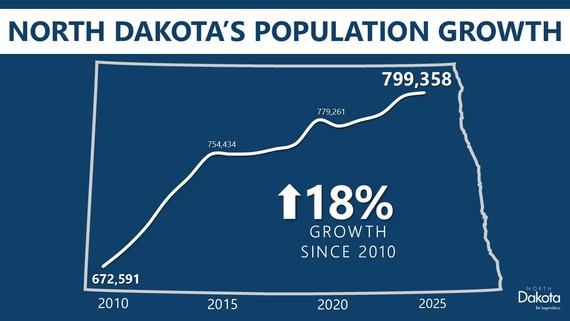 North Dakota’s growth continues with record population estimate of nearly 800,000
Gov. Armstrong announced that North Dakota’s population grew for the fourth consecutive year to a record high of 799,358 people as of July 1, 2025, according to U.S. Census estimates. State Demographer Nigel Haarstad said the state has likely since surpassed the 800,000 mark for the first time, based on current growth rates.
“North Dakota continues to see steady growth and attract new residents as one of the best places to live, work and raise a family,” Armstrong said. “From historic property tax relief and reform to phone-free schools and robust economic development, our state made significant progress this past year to improve the quality of life for our citizens, which will always be our top priority.”
The population estimate released today exceeds the original 2024 estimate of 796,568 residents by 2,790 and represents an increase of 20,264 residents since the 2020 decennial census.
In the July 2025 estimate, North Dakota was just 642 people from crossing 800,000 for the first time, Haarstad noted.
“At current growth rates, North Dakota likely crossed this milestone in August 2025,” he said.
After a brief COVID-era population dip in 2021, North Dakota has grown every year. Births continue to exceed deaths in the latest estimate, and total net migration was positive, both domestic and international. The state’s working-age population also has grown for three straight years to 473,249, the highest since 2020, Haarstad noted.
North Dakota ranked 14th among the states for per capita population growth this year, growing about 50% faster than the national average. The state has grown nearly 19% since 2010. Forty-six states experienced positive growth this year.
IN OTHER NEWS
 |
|
Gov. Armstrong delivered the State of the State Address on Wednesday, Jan. 21, as the 69th Legislative Assembly convened in special session to appropriate federal funding for a statewide Rural Health Transformation Program. |
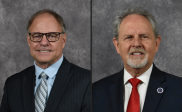
Gov. Armstrong thanked North Dakota House Majority Leader Mike Lefor of Dickinson and House Appropriations Chair Don Vigesaa of Cooperstown for their service to the state. Both announced they will not seek another term in the state Legislature in November.
|

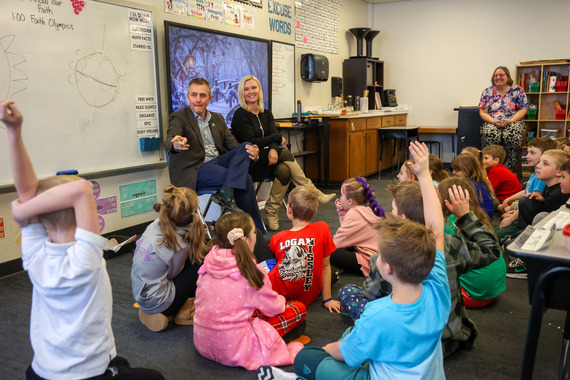
Gov. Armstrong and First Lady Kjersti made visits to the Bismarck Public Schools Health Sciences Center and St. Mary's Elementary School as part of School Choice Week in North Dakota.
|
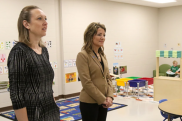
Lt. Gov. Michelle Strinden toured the Little Blue Jays Nest at the James Valley Career and Technology Center in Jamestown.
|

Gov. Armstrong appointed Fargo businesswoman and former state commerce and labor commissioner Michelle Kommer to a vacancy on the State Board of Higher Education. She succeeds Levi Bachmeier, who resigned from the board in November when he took office as North Dakota’s new superintendent of public instruction.
|
First Lady Kjersti Armstrong presented the 1 Million Thanks Lifetime Impact Awards posthumously to the families of former state Rep. Cindy Schreiber-Beck and former Bank of North Dakota President Eric Hardmeyer at the Plains Art Museum in Fargo. Cindy's daughter, Whitney, accepted the award on her behalf while Eric's son, Tom, accepted the award on his behalf. |
|
 |
|