|
| |
The Shameful Legacy of Tuskegee Is Still Relevant
Pete Shanks, Biopolitical Times | 01.28.2026
After the scandal of the U.S. Public Health Service’s 40-year syphilis study was uncovered, the common refrain was “never again.” Now, RFK Jr.’s choice to fund a study in Guinea-Bissau that would withhold Hepatitis B vaccines from infants at risk of being infected is generating comparisons to the Tuskegee study, with a MAHA twist.
| | | | |
The Mysterious Eugenics of Aesthetic Taste
Michael Rossi, The Los Angeles Review of Books | 01.11.2026
A new essay in the CGS-supported Legacies of Eugenics series shows how artists’ work linked biology with aesthetics, supporting eugenic fictions of race as biological reality and the inequalities predicated on that myth.
| | |
| |
Some of Our Favorite 2025 Blog Posts
Pete Shanks, Biopolitical Times | 01.06.2026
As pronatalism surged and eugenic ideas made a comeback in politics and tech, CGS’ Biopolitical Times contributors offered insights and analysis on the risks of human gene editing and the implications of new genetic technologies. Take a look at some of our top posts from 2025 here.
| | |
GENE EDITING AND GENE THERAPY | GENOMICS | EUGENICS
SURROGACY 360 | ASSISTED REPRODUCTION | AI | VARIOUS
| | GENE EDITING AND GENE THERAPY | | |
First patient treated with gene therapy to improve heart bypasses
George Janes, BioNews | 01.12.2026
A heart attack patient was the first person to be treated in a clinical trial using an experimental gene therapy to treat grafted vessels. Researchers hope to use this approach to strengthen blood vessels after coronary bypass surgery.
| |
Baby KJ scientist launches personalized CRISPR therapy startup
Nick Paul Taylor, Fierce Biotech | 01.09.2026
Based on the “Baby KJ” gene therapy treatment, Jennifer Doudna and Fyodur Urnov have launched a new startup, Aurora Therapeutics, to develop gene therapies for phenylketonuria. By targeting multiple disease-causing mutations initially and adding rarer variants later, they hope to advance more quickly through FDA review.
| |
Flu Is Relentless. Crispr Might Be Able to Shut It Down
David Cox, Wired | 01.05.2026
Virologists are trying to use a Crispr “cousin,” the Cas13 enzyme, to inactivate flu viruses, which are composed entirely of RNA.
| |
This CRISPR breakthrough turns genes on without cutting DNA
ScienceDaily | 01.05.2026
A modified CRISPR technique, epigenetic editing, avoids cutting DNA and instead targets chemical markers attached to genes to restore gene activity without altering the underlying DNA sequence. Researchers are testing the technique for therapies for sickle cell disease and other conditions.
| | |
These genes were thought to lead to blindness 100% of the time. They don't.
Stephanie Pappas, LiveScience | 01.15.2026
Genetic variants believed to cause blindness in nearly everyone who carries them actually lead to vision loss less than 30% of the time, new research finds. The results call into question theories about how genetic mutations are inherited and cause disease in future generations.
| | |
The ‘R-Word’ Returns, Dismaying Those Who Fought to Oust It
Dan Barry and Sonia A. Rao, The New York Times | 01.26.2026
Donald Trump, officials in his administration, and right-wing political commentators have all returned to using a slur to refer to people with intellectual disabilities. This resurgence hearkens back to the vocabulary of early 20th century eugenics, which supported the marginalization of disabled people and paved the way for their social exclusion and mistreatment.
| | |
The New Eugenics in Medicine
Arthur Lazarus, MedPage Today | 01.23.2026
Eugenic ideas quietly persist in new biotechnologies that pursue an illusory ideal of perfection at the expense of people deemed less valuable. Scientists, clinicians, and the public need to scrutinize biotech ventures to recognize and challenge innovations that advance old eugenic ideas in new forms.
| | |
To Give Birth or Not to Give Birth
Evelina Johansson Wilén, Jacobin | 01.18.2026
Amid increasing embrace of pronatalism, critics are arguing for approaches that acknowledge ambivalence about reproduction and focus not on “maximizing or minimizing birth rates” but on “creating conditions in which relationships can be formed and sustained without systematically sacrificing certain bodies or groups.”
| | |
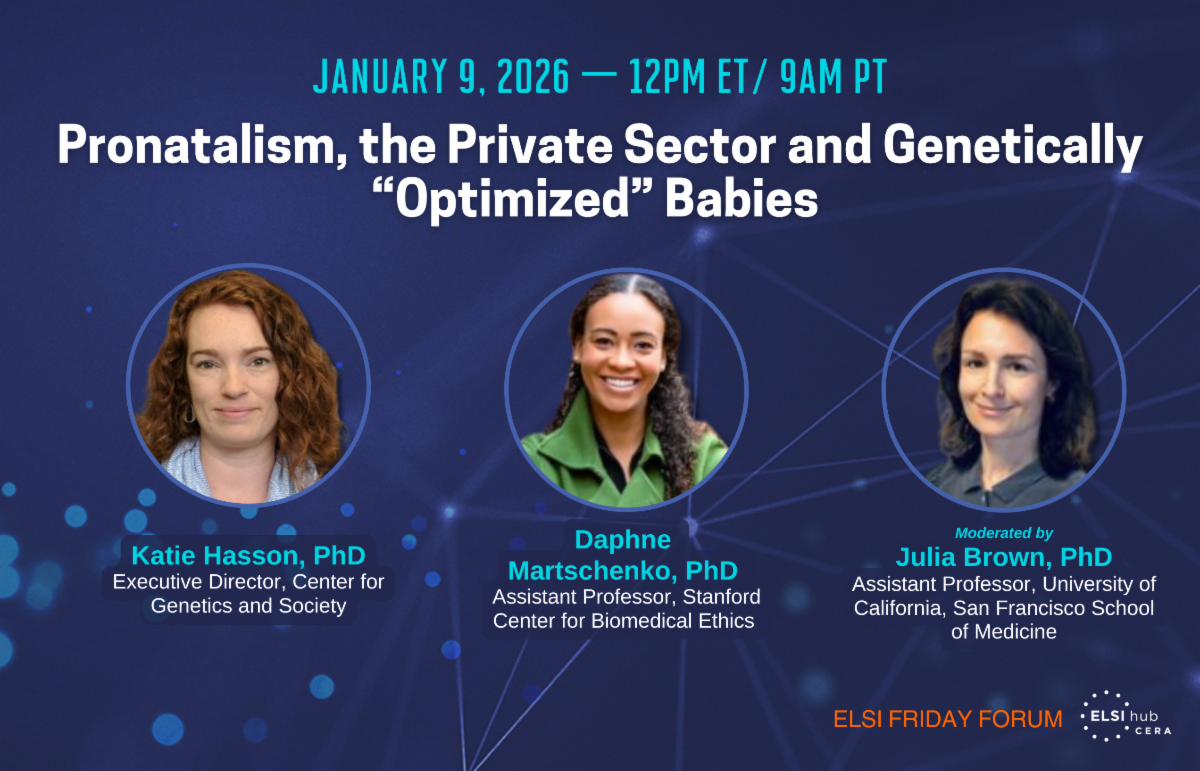
More and “Better” Babies: The Dark Side of the Pronatalist Movement
Daphne O. Martschenko and Julia E. H. Brown, Hastings Bioethics Forum | 01.14.2026
The agenda of techno-optimist pronatalists bears a striking resemblance to the 20th century eugenics movement and the "Better Babies" contests that were a part of it. Just as these contests encouraged those deemed to have the “best genes” to reproduce, the use of new repro-genetic technology is reserved for those assumed to be genetically superior.
| | |
| |
Lessons from Uruguay's first gestational surrogacy case
Paula Siverino Bavio, BioNews | 01.12.2026
Uruguay has regulated surrogacy since 2013, but it was more than 10 years before the country saw its first surrogacy arrangement. This initial case showed gaps in regulation. There are no national protocols or good-practice guidelines for the surrogacy process, and there aren’t definitions explaining leave, benefits, and labour protections for the surrogate or the intended parents.
| | |
Why these women break the law to sell their eggs for IVF
Diaa Hadid and Shweta Desai, NPR | 01.29.2026
Women selling their eggs illegally is an open secret in the Indian fertility industry. Restrictive laws with little oversight leave poor and vulnerable women open to exploitation with no recourse because they operate in a black market.
| |
Human eggs ‘rejuvenated’ in an advance that could boost IVF success rates
Hannah Devlin, The Guardian | 01.08.2026
Scientists claim to have “rejuvenated” human eggs by giving them a microinjection of a protein that has been found to decline with age and affect egg quality. Researchers think that the technique could improve IVF success rates for older women.
| |
Surrogacy Is a Multibillion-Dollar Business—but Surrogates Can Be Left With Big Debts
Katherine Long, The Wall Street Journal | 12.27.2025
Surrogates face not only emotional and physical risks, but also financial risks if things go wrong. Without regulation, surrogates end up being responsible for medical bills and legal fees that intended parents or surrogacy agencies were supposed to pay.
| |
A Russian Billionaire Fights Global Infertility—With 100 of His Own Children
Sam Schechner, Daria Matviichuk, and Thomas Grove, The Wall Street Journal | 12.22.2025
Telegram founder and billionaire Pavel Durov has said he has over 100 children around the world born from sperm he donated. He is advertising his sperm as “free” and has said that his biological children will eventually get a share of his estate.
| | |
Ed Zitron on big tech, backlash, boom and bust: ‘AI has taught us that people are excited to replace human beings’
Steve Rose, The Guardian | 01.19.2026
Rather than leading to a utopian vision, AI is “the logical conclusion of neoliberalism” and betrays an excitement about replacing human beings, according to Ed Zitron and other critics of the clamor around generative AI.
| |
The mirage of AI deregulation
Alondra Nelson, Science | 01.15.2026
Under the guise of “deregulating” AI, the Trump administration is advancing a hyper-regulatory regime that involves greater reliance on executive discretion than on deliberative, public processes. Claims that they are doing away with AI rules obscure the power-grab: through tactics of investment, ownership, research funding, immigration controls, and preemption, the administration is trying to set the terms of AI regulation globally.
| |
‘Dangerous and alarming’: Google removes some of its AI summaries after users’ health put at risk
Andrew Gregory, The Guardian | 01.11.2026
Google removed some of its AI health summaries after a Guardian investigation found people were being put at risk of harm by false and misleading information about liver blood tests.
| | |
Trump Administration Cuts Off Funding for Fetal Tissue Research. Again.
Roni Caryn Rabin, The New York Times | 01.22.2026
The NIH is ending support for all research that makes use of human fetal tissue –– a ban similar to one Trump instituted in his first term, which Biden reversed. Fetal tissue has been used to study cancer, AIDS, Parkinson’s disease, birth defects, blindness and other disorders, and to test new treatments and develop vaccines.
| |
Repairing trust in science requires a more inclusive understanding of innovation
Shobita Parthasarathya, Science | 01.22.2026
U.S. scientists can work to repair public trust in science by looking to researchers’ strategies in other countries, where they have partnered with grassroots efforts and taken seriously lay knowledge. Unlike the U.S. focus on risky “high reward” innovation, this approach embraces low-tech innovation and prioritizes positive impact while minimizing risk.
| |
Worst of Both Worlds: FDA’s Funding Structure, Corporate Capture, and Political Interference
Danny Finley, Bill of Health | 01.08.2026
The FDA gets almost half its budget funded by the industries it regulates –– an unusual funding structure that makes the agency vulnerable to executive overreach and corporate capture. Political and industry pressures affect which drugs the FDA approves, which in turn affects consumers.
| | | | |