|
Welcome to a new year at the Levy Economics Institute! This year, we celebrate the 40th anniversary of the Institute’s founding. For four decades, our work has made key contributions to economic research and policy. This year, we celebrate and build on this legacy in our anniversary conference, publications, and podcast series.
Our research on financial instability and macromodeling remains the gold standard for understanding the global macroeconomy, while our work on economic wellbeing and measurement informs the methods of statistical agencies in the US and abroad. Our foundational research on the job guarantee continues to drive real-world policy. I was pleased to serve as a leading signatory for the preservation and extension of France’s Zero Long-Term Unemployment Areas program -- a call that was heard, with two related laws passing unanimously earlier this month. In more concerning news, the Modi government is undermining the world’s largest job guarantee program, India’s Mahatma Gandhi National Rural Employment Guarantee Act (MGNREGA). In December, I authored an open letter in defense of the program’s demand-driven, rights-based design and was joined by leading economists including Nobel Prize winner and Levy advisory board member Joseph Stiglitz, Levy advisory board member Mariana Mazzucato, UN Special Rapporteur on extreme poverty Olivier De Schutter, and other leading economists including Thomas Piketty, Darrick Hamilton, and L. Randall Wray.
At home, we are re-engaging directly with US policymakers on the issue of job security. Working families in America have been loud and clear: the official economic statistics do not reflect their ongoing struggle to maintain a decent standard of living. Good jobs and affordable care are two core components of the Levy Institute’s framework for a new social contract. Stay tuned for our next Capitol Hill series seminar in the halls of Congress this spring.
We are also especially proud of our graduate students, who are already making their mark through prestigious awards and influential policy fellowships. Explore our latest news below, and be sure to register for our 40th Anniversary Conference on May 7-8, as space is limited.
Sincerely,
| | |
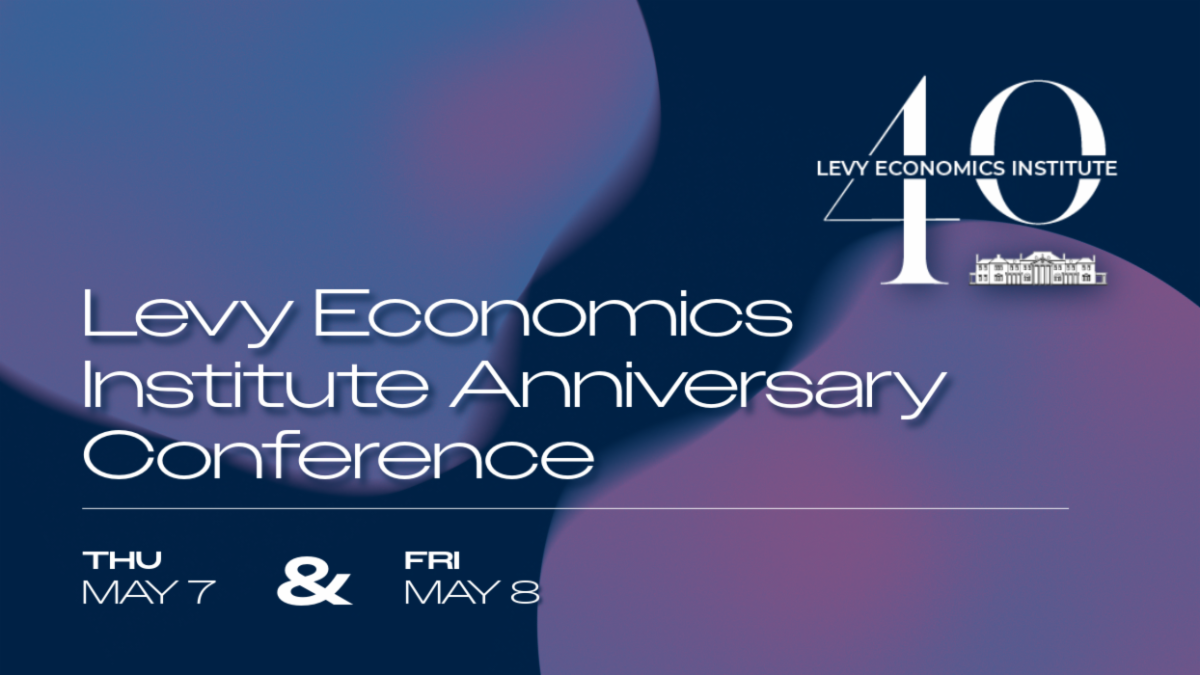
On May 7–8, 2026, the Levy Economics Institute convenes its annual conference on the 40th anniversary of the Institute’s founding.
This year’s conference will be held in person on the Bard College campus, featuring panel discussions exploring current sources of financial instability, surveying the macro picture for the US economy, and engaging with economic policy challenges in areas such as antitrust, artificial intelligence, jobs, caregiving, energy, and development finance.
Stay tuned for more information. Space is limited and registration is required.
| | |
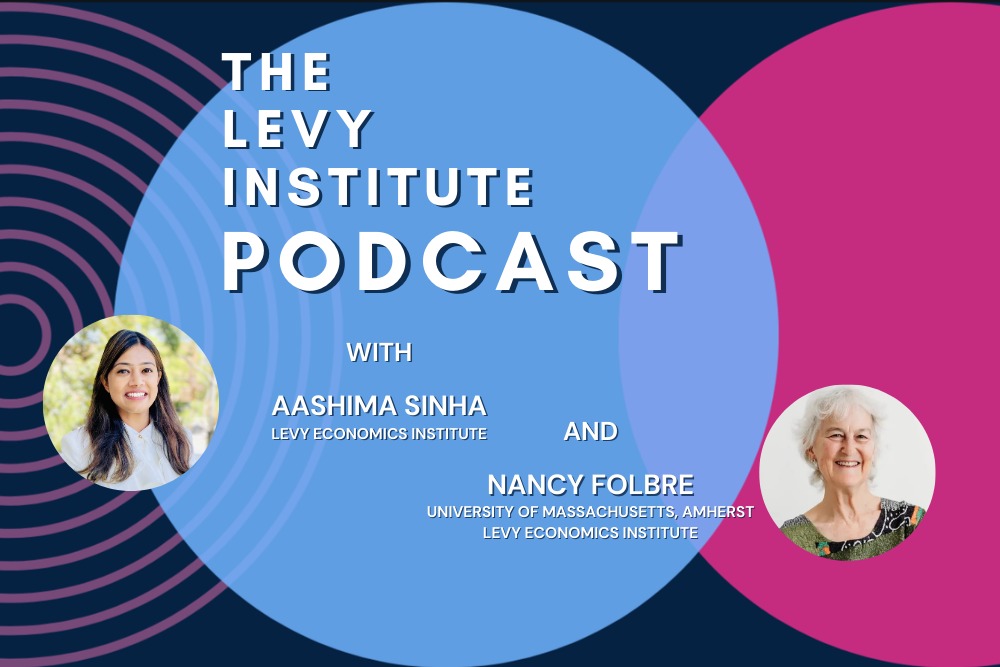
In this episode, Levy Research Scholar Aashima Sinha sits down with University of Massachusetts Amherst Professor Emerita and Levy Senior Scholar Nancy Folbre to discuss how feminist economics is reshaping our understanding of well-being, care, and inequality—from new measures that value household production to the challenges of integrating gender and care work into macroeconomics. They discuss fiscal and political barriers to gender-equitable policy, major data gaps (and efforts to fix them), and how patriarchy and capitalism reinforce each other across global contexts.
Listen Now
| | |
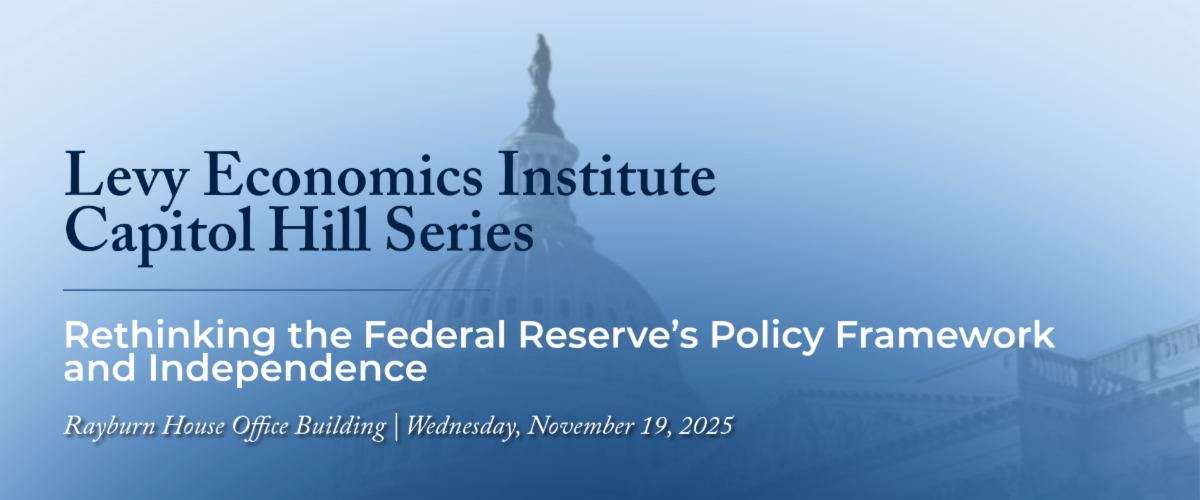
“Congress retains the ultimate authority to instruct, to direct, and to even redefine the Federal Reserve’s objectives”
— Pavlina Tcherneva, President, Levy Economics Institute
As the independence of the Federal Reserve is publicly under threat from the Trump White House, the Levy Economics Institute brought together leading economic thinkers to discuss the important role Congress must play in preserving the independence of the Federal Reserve. Levy Scholar L. Randall Wray made the important distinction that the Federal Reserve is a creature of Congress that is “independent within government,” not independent from it. It is up to Congress to make sure that the Federal Reserve follows its mandate through strong oversight.
Read More
Watch the Recording
| |
by Pavlina R. Tcherneva
"We are living through a moment of deep division across our politics, economies, and environment, a division that stems from a deliberate forgetting—a self-induced amnesia, if you will. For decades, political parties have treated the working family as a slogan rather than the foundation of a healthy society. This amnesia was aided and abetted by mainstream economic theory that treated the economy as a financial machine, not a social ecosystem..."
Read More
| |
by Yeva Nersisyan and L. Randall Wray
The whole world was watching on December 10, 2025 to finally find out what the Fed was going to do. Big money bets were placed—would the Fed leave rates unchanged (potentially exposing the Board of Governors to the wrath of President Trump) or would they lower it—and if so, by how much?
The Fed’s decision was supposedly made much more difficult because the government shutdown caused the BLS to abandon collection of October’s data. They were “flying blind”—to coin a phrase we have been using at Levy for three decades now. How could these technocrats possibly make a decision without knowing precisely how many hundredths of a percentage point the rate of inflation and the unemployment rate might have moved in October?
Read More
| | |
Featured Working Paper | Levy Institute Measure of Time and Income Poverty: United States, 2007–2022 Sources, Methods, and Assessment
by Fernando Rios-Avila, Ajit Zacharias, Thomas Masterson, and Aashima Sinha
In this paper, Levy Scholars Fernando Rios-Avila, Ajit Zacharias, Thomas Masterson, and Aashima Sinha present the empirical methodology used to estimate the Levy Institute Measure of Time and Income Poverty (LIMTIP) for the United States over the period 2007–2022. They provide a step-by-step account of the statistical matching procedure employed to construct a synthetic dataset by combining the American Time Use Survey (ATUS) with the Annual Social and Economic Supplement (ASEC). The authors describe in detail how records were matched using a combination of principal component analysis, propensity score, and clustering methods. They then assess the quality of the match, focusing on the 2022 data.
Read More
| | |
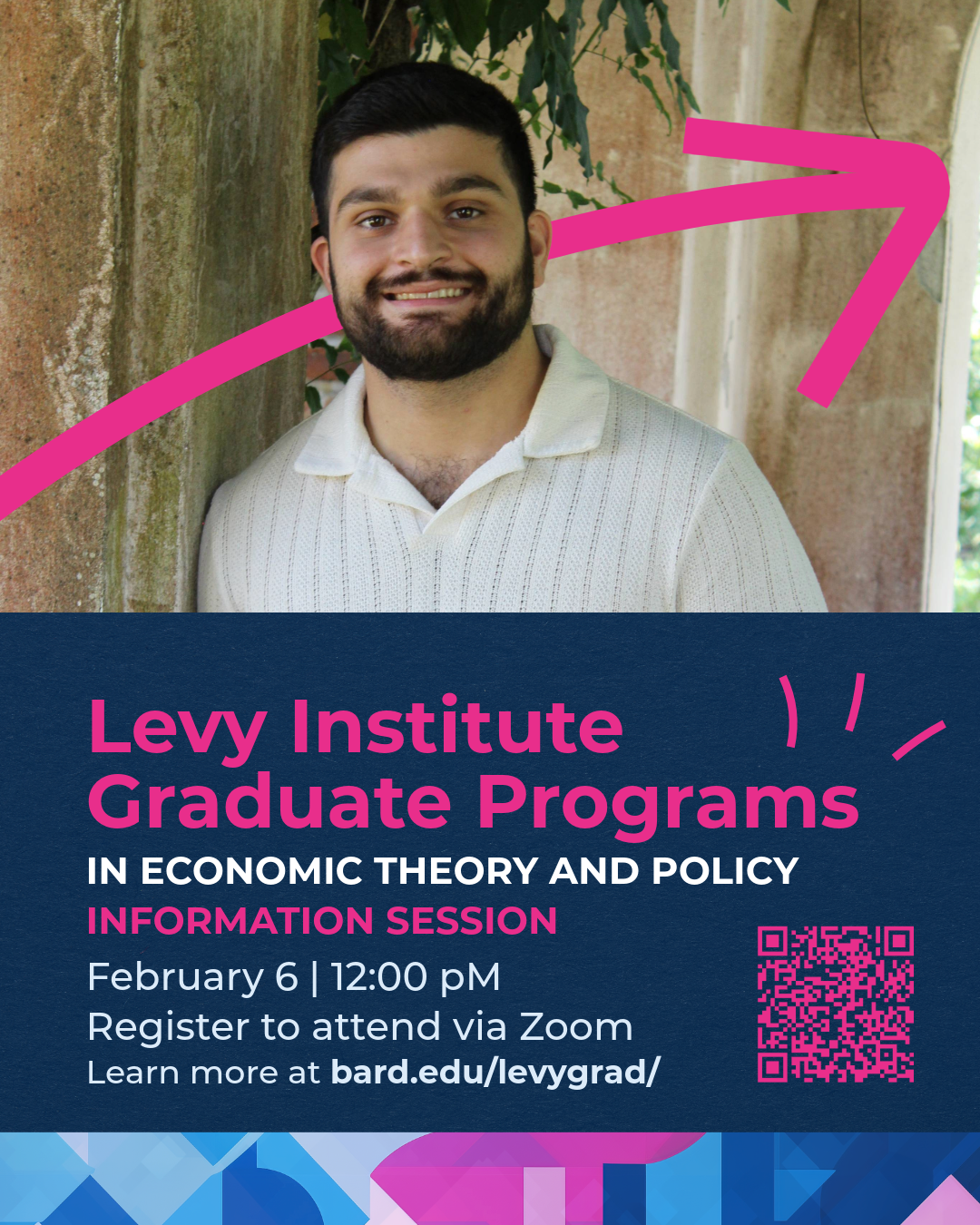
Join our next information session on Zoom, February 6th at 12:00 PM EST.
As the application deadline for our Graduate Programs in Economic Theory and Policy approaches on April 15th, we want to highlight the exciting work our current students and alumni are doing. We released a new page on our Graduate Programs website demonstrating the career paths in policy, academia, and the private sector that our programs empower Levy's students to pursue during and after their time in our programs.
Brendon Bennett | 2nd year Levy MS—Brendon was a winner of the 20th AFIT-AFEE student paper competition for his piece, "Provisioning Regimes: How Economies Evolve." Brendon has also accepted an exciting position at New York' State's Assembly in their Graduate Intern program, where he will gain hands-on experience with legislative research, policy analysis, and the state budget process.
Emilia Cooper | 2nd year Levy MS—After being selected in the Global Essay Competition for a paper about neocolonialism in the green energy transition, Emilia Cooper participated in the St. Gallen Symposium in Switzerland this past spring. This summer, Emi was the Racial Justice and Neighborhood Equity Fellow at New Economy Project performing research and outreach about financial inequities in NYC. She developed an interactive mapping tool to illustrate banking access disparities between communities. She has accepted an internship with the Restoring Promise Team at the Vera Institute of Justice.
Henry Mielarczyk | 1st year Levy MS—Henry joined Levy this fall with experience working in congressional offices. In addition to his studies, Henry has joined as Policy and Outreach Assistant for the Levy Institute, helping with Institute's new Capitol Hill Series. Henry has also accepted the Graduate Intern program position in New York State's Assembly. This full-time position will provide invaluable policy and legislative experience, along with experience managing a team of undergraduate interns for a variety of projects.
| | |
In December 2025, the Levy Economics Institute of Bard College drafted an open letter to the government of India and gathered signatures in defense of the Mahatma Gandhi National Rural Employment Guarantee Act (MGNREGA), the largest rights-based public employment program in the world. Spearheaded by Levy Institute President Pavlina R. Tcherneva, leading international experts have added their names to the open letter in support of the program, which is being repealed by the Indian government.
Scholar Yeva Nersisyan was quoted by ABC News in the January 16 article, "Trump wants much lower interest rates. Is that a good idea?"
UN Trade and Development hosted a discussion between two Levy Institute advisory board members, Rebeca Grynspan and Mariana Mazzucato, on December 2, 2025. The recording of the conversation examining examined the interconnected crises reshaping the global economy is available on YouTube.
Levy President Pavlina R. Tcherneva was invited by Modern Money Lab to give a lecture titled, "The ‘enshittification’ of jobs and the shifting political allegiance of the US working class" on January 22. Tcherneva also gave an interview for KKFI Radio Kansas City, aired January 22, discussing the economic vision that resonates with working America. The recording is available here.
| | | |
| How did you like this email? | | | | | | |