
| From | Liberty Fund <[email protected]> |
| Subject | Thomas Paine's Common Sense Turns 250 |
| Date | January 30, 2026 2:16 PM |
Links have been removed from this email. Learn more in the FAQ.
Links have been removed from this email. Learn more in the FAQ.
[link removed]
WEEK OF JANUARY 30, 2026
** This Week on Common Sense at 250
------------------------------------------------------------
[link removed]
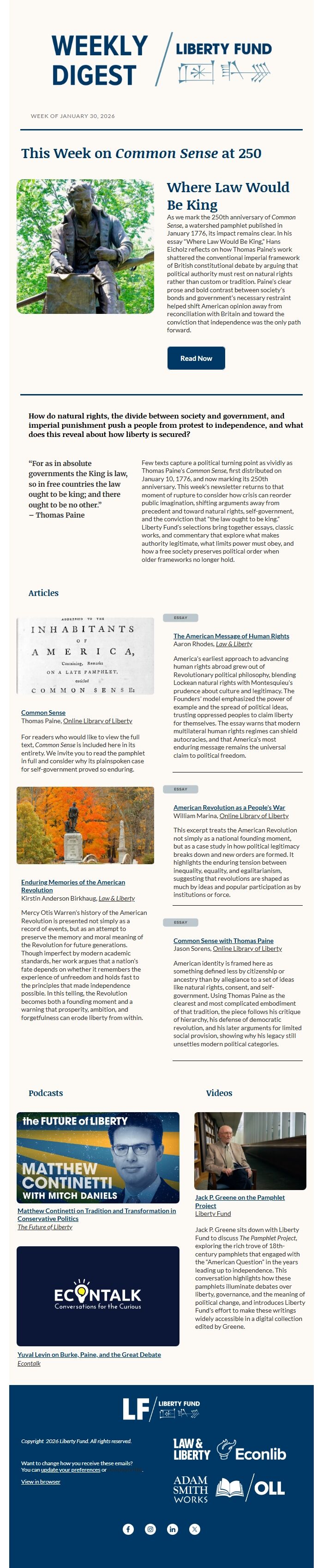
** Where Law Would Be King ([link removed])
------------------------------------------------------------
As we mark the 250th anniversary of Common Sense, a watershed pamphlet published in January 1776, its impact remains clear. In his essay “Where Law Would Be King,” Hans Eicholz reflects on how Thomas Paine’s work shattered the conventional imperial framework of British constitutional debate by arguing that political authority must rest on natural rights rather than custom or tradition. Paine’s clear prose and bold contrast between society’s bonds and government’s necessary restraint helped shift American opinion away from reconciliation with Britain and toward the conviction that independence was the only path forward.
Read Now ([link removed])
** How do natural rights, the divide between society and government, and imperial punishment push a people from protest to independence, and what does this reveal about how liberty is secured?
------------------------------------------------------------
** “For as in absolute governments the King is law, so in free countries the law ought to be king; and there ought to be no other.”
------------------------------------------------------------
** – Thomas Paine
------------------------------------------------------------
Few texts capture a political turning point as vividly as Thomas Paine’s Common Sense, first distributed on January 10, 1776, and now marking its 250th anniversary. This week’s newsletter returns to that moment of rupture to consider how crisis can reorder public imagination, shifting arguments away from precedent and toward natural rights, self-government, and the conviction that “the law ought to be king.” Liberty Fund’s selections bring together essays, classic works, and commentary that explore what makes authority legitimate, what limits power must obey, and how a free society preserves political order when older frameworks no longer hold.
** Articles
------------------------------------------------------------
[link removed]
** Common Sense ([link removed])
------------------------------------------------------------
Thomas Paine, Online Library of Liberty ([link removed])
For readers who would like to view the full text, Common Sense is included here in its entirety. We invite you to read the pamphlet in full and consider why its plainspoken case for self-government proved so enduring.
[link removed]
** Enduring Memories of the American Revolution ([link removed])
------------------------------------------------------------
Kirstin Anderson Birkhaug, Law & Liberty ([link removed])
Mercy Otis Warren’s history of the American Revolution is presented not simply as a record of events, but as an attempt to preserve the memory and moral meaning of the Revolution for future generations. Though imperfect by modern academic standards, her work argues that a nation’s fate depends on whether it remembers the experience of unfreedom and holds fast to the principles that made independence possible. In this telling, the Revolution becomes both a founding moment and a warning that prosperity, ambition, and forgetfulness can erode liberty from within.
** The American Message of Human Rights ([link removed])
------------------------------------------------------------
Aaron Rhodes, Law & Liberty ([link removed])
America’s earliest approach to advancing human rights abroad grew out of Revolutionary political philosophy, blending Lockean natural rights with Montesquieu’s prudence about culture and legitimacy. The Founders’ model emphasized the power of example and the spread of political ideas, trusting oppressed peoples to claim liberty for themselves. The essay warns that modern multilateral human rights regimes can shield autocracies, and that America’s most enduring message remains the universal claim to political freedom.
** American Revolution as a People’s War ([link removed])
------------------------------------------------------------
William Marina, Online Library of Liberty ([link removed])
This excerpt treats the American Revolution not simply as a national founding moment, but as a case study in how political legitimacy breaks down and new orders are formed. It highlights the enduring tension between inequality, equality, and egalitarianism, suggesting that revolutions are shaped as much by ideas and popular participation as by institutions or force.
** Common Sense with Thomas Paine ([link removed])
------------------------------------------------------------
Jason Sorens,[link removed] Library of Liberty ([link removed])
American identity is framed here as something defined less by citizenship or ancestry than by allegiance to a set of ideas like natural rights, consent, and self-government. Using Thomas Paine as the clearest and most complicated embodiment of that tradition, the piece follows his critique of hierarchy, his defense of democratic revolution, and his later arguments for limited social provision, showing why his legacy still unsettles modern political categories.
** Podcasts
------------------------------------------------------------
[link removed]
** Matthew Continetti on Tradition and Transformation in Conservative Politics ([link removed])
------------------------------------------------------------
The Future of Liberty ([link removed])
[link removed]
** Yuval Levin on Burke, Paine, and the Great Debate ([link removed])
------------------------------------------------------------
Econtalk ([link removed])
** Videos
------------------------------------------------------------
[link removed]
** Jack P. Greene on the Pamphlet Project ([link removed])
------------------------------------------------------------
Liberty Fund ([link removed])
Jack P. Greene sits down with Liberty Fund to discuss The Pamphlet Project, exploring the rich trove of 18th-century pamphlets that engaged with the “American Question” in the years leading up to independence. This conversation highlights how these pamphlets illuminate debates over liberty, governance, and the meaning of political change, and introduces Liberty Fund’s effort to make these writings widely accessible in a digital collection edited by Greene.
[link removed]
Copyright 2026 Liberty Fund. All rights reserved.
Want to change how you receive these emails?
You can update your preferences ([link removed]) or unsubscribe ([link removed]) .
View in browser ([link removed])
[link removed] [link removed]
[link removed] [link removed]
[link removed]
[link removed]
[link removed]
[link removed]
WEEK OF JANUARY 30, 2026
** This Week on Common Sense at 250
------------------------------------------------------------
[link removed]
** Where Law Would Be King ([link removed])
------------------------------------------------------------
As we mark the 250th anniversary of Common Sense, a watershed pamphlet published in January 1776, its impact remains clear. In his essay “Where Law Would Be King,” Hans Eicholz reflects on how Thomas Paine’s work shattered the conventional imperial framework of British constitutional debate by arguing that political authority must rest on natural rights rather than custom or tradition. Paine’s clear prose and bold contrast between society’s bonds and government’s necessary restraint helped shift American opinion away from reconciliation with Britain and toward the conviction that independence was the only path forward.
Read Now ([link removed])
** How do natural rights, the divide between society and government, and imperial punishment push a people from protest to independence, and what does this reveal about how liberty is secured?
------------------------------------------------------------
** “For as in absolute governments the King is law, so in free countries the law ought to be king; and there ought to be no other.”
------------------------------------------------------------
** – Thomas Paine
------------------------------------------------------------
Few texts capture a political turning point as vividly as Thomas Paine’s Common Sense, first distributed on January 10, 1776, and now marking its 250th anniversary. This week’s newsletter returns to that moment of rupture to consider how crisis can reorder public imagination, shifting arguments away from precedent and toward natural rights, self-government, and the conviction that “the law ought to be king.” Liberty Fund’s selections bring together essays, classic works, and commentary that explore what makes authority legitimate, what limits power must obey, and how a free society preserves political order when older frameworks no longer hold.
** Articles
------------------------------------------------------------
[link removed]
** Common Sense ([link removed])
------------------------------------------------------------
Thomas Paine, Online Library of Liberty ([link removed])
For readers who would like to view the full text, Common Sense is included here in its entirety. We invite you to read the pamphlet in full and consider why its plainspoken case for self-government proved so enduring.
[link removed]
** Enduring Memories of the American Revolution ([link removed])
------------------------------------------------------------
Kirstin Anderson Birkhaug, Law & Liberty ([link removed])
Mercy Otis Warren’s history of the American Revolution is presented not simply as a record of events, but as an attempt to preserve the memory and moral meaning of the Revolution for future generations. Though imperfect by modern academic standards, her work argues that a nation’s fate depends on whether it remembers the experience of unfreedom and holds fast to the principles that made independence possible. In this telling, the Revolution becomes both a founding moment and a warning that prosperity, ambition, and forgetfulness can erode liberty from within.
** The American Message of Human Rights ([link removed])
------------------------------------------------------------
Aaron Rhodes, Law & Liberty ([link removed])
America’s earliest approach to advancing human rights abroad grew out of Revolutionary political philosophy, blending Lockean natural rights with Montesquieu’s prudence about culture and legitimacy. The Founders’ model emphasized the power of example and the spread of political ideas, trusting oppressed peoples to claim liberty for themselves. The essay warns that modern multilateral human rights regimes can shield autocracies, and that America’s most enduring message remains the universal claim to political freedom.
** American Revolution as a People’s War ([link removed])
------------------------------------------------------------
William Marina, Online Library of Liberty ([link removed])
This excerpt treats the American Revolution not simply as a national founding moment, but as a case study in how political legitimacy breaks down and new orders are formed. It highlights the enduring tension between inequality, equality, and egalitarianism, suggesting that revolutions are shaped as much by ideas and popular participation as by institutions or force.
** Common Sense with Thomas Paine ([link removed])
------------------------------------------------------------
Jason Sorens,[link removed] Library of Liberty ([link removed])
American identity is framed here as something defined less by citizenship or ancestry than by allegiance to a set of ideas like natural rights, consent, and self-government. Using Thomas Paine as the clearest and most complicated embodiment of that tradition, the piece follows his critique of hierarchy, his defense of democratic revolution, and his later arguments for limited social provision, showing why his legacy still unsettles modern political categories.
** Podcasts
------------------------------------------------------------
[link removed]
** Matthew Continetti on Tradition and Transformation in Conservative Politics ([link removed])
------------------------------------------------------------
The Future of Liberty ([link removed])
[link removed]
** Yuval Levin on Burke, Paine, and the Great Debate ([link removed])
------------------------------------------------------------
Econtalk ([link removed])
** Videos
------------------------------------------------------------
[link removed]
** Jack P. Greene on the Pamphlet Project ([link removed])
------------------------------------------------------------
Liberty Fund ([link removed])
Jack P. Greene sits down with Liberty Fund to discuss The Pamphlet Project, exploring the rich trove of 18th-century pamphlets that engaged with the “American Question” in the years leading up to independence. This conversation highlights how these pamphlets illuminate debates over liberty, governance, and the meaning of political change, and introduces Liberty Fund’s effort to make these writings widely accessible in a digital collection edited by Greene.
[link removed]
Copyright 2026 Liberty Fund. All rights reserved.
Want to change how you receive these emails?
You can update your preferences ([link removed]) or unsubscribe ([link removed]) .
View in browser ([link removed])
[link removed] [link removed]
[link removed] [link removed]
[link removed]
[link removed]
[link removed]
[link removed]
Message Analysis
- Sender: Liberty Fund
- Political Party: n/a
- Country: United States
- State/Locality: n/a
- Office: n/a
-
Email Providers:
- MailChimp